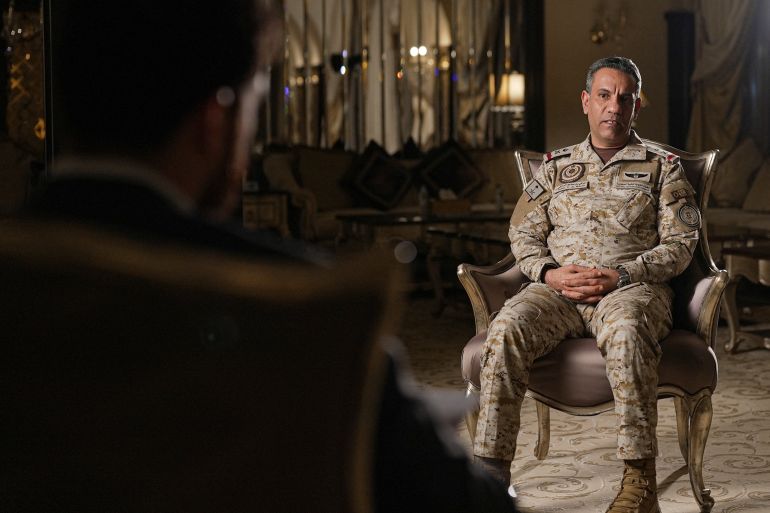
‘War can end tomorrow’: Saudi-led coalition urges Houthis to join UN plan
Saudi-led coalition spokesman Turki al-Maliki says the ‘best solution is the political solution’.


29 Nov 2026
The Saudi-led coalition fighting in Yemen has said the war could end “tomorrow” if the Houthis, an armed group also known as Ansar Allah (Arabic for “Supporters of God”), agree to a United Nations-endorsed peace plan.
Speaking in an interview with Reuters published on Sunday, Saudi-led coalition spokesman Turki al-Maliki said that political settlement is the best way forward, but that coalition forces would keep pressuring the Houthis militarily until the group opts to negotiate.
“The best solution is the political solution,” said al-Maliki, adding that the coalition would support Yemen’s internationally recognised government to “achieve their objective”.
“If the Houthis decided to go for the roadmap with the Yemeni government, the war can end… tomorrow,” he said, referring to a UN-backed peace plan.
Al-Maliki also stressed that Riyadh’s “red line” was the internationally recognised Yemeni government’s interim capital Aden, which Houthi fighters have recently advanced towards. He said the coalition would do “whatever it takes” to safeguard the port city.
The conflict in Yemen re-emerged this summer, with many analysts viewing the escalation as an extension of the United States-Israel war on Iran. In recent months, thousands of people have been killed, and hundreds of thousands more have been displaced in Yemen, while Saudi Arabia has faced regular Houthi attacks on its infrastructure, including airports and oil facilities, killing dozens of people.
On Sunday, the Houthis threatened to strike Saudi Arabia’s Red Sea ports, including in Jeddah, as Houthi-affiliated media reported a Saudi attack on Yemen’s Ras Isa port, located in Hodeidah governorate.
Earlier, the Saudi-led coalition in Yemen had urged civilians to evacuate the fuel port “for their safety”.
Battlefield ‘gaps’
Al-Maliki told Reuters that the Houthis are difficult to contend with because they don’t abide by the rules of armed conflict.
“What the Houthis are doing is [not] a military operation,” said al-Maliki. “He’s doing a terror act against, you know, civilians and civilian objects.”
“If you are not respecting the laws of armed conflict, you can do whatever you like. And I say that the challenge is that we are dealing with… a terrorist group.”
Al-Maliki also acknowledged some coordination issues between the Saudi-led coalition and Yemeni government army, saying there had been several battlefield “gaps” in recent months that they were working to correct.
Saudi Arabia has been fighting against the Houthis for more than a decade, supporting the internationally recognised government based in Yemen’s south after the Houthis seized the capital, Sanaa, in 2014.
Fighting escalated this summer as the Houthis seized much of Yemen’s Red Sea coastline. The Yemeni government army and forces loyal to it are now focused on defending Aden and breaking a Houthi siege of another city, Taiz.
So long as the Houthis do not agree to a peace roadmap, al-Maliki said, the Saudi-led coalition will continue relying on military force to make the conflict costly for them. That will include non-stop air support for Saudi-backed Yemeni forces on the ground and actions to degrade Houthi military capabilities, he added.
“We are achieving the objective to dismantle and to destroy the TBMs [theatre ballistic missiles] and also the launchers and some of the components of the ballistic missiles and UAVs [unmanned aerial vehicles],” said al-Maliki.
The Houthis have demanded that Saudi Arabia withdraw its support for Yemen’s internationally recognised government – which the kingdom trains, arms, funds and partially hosts in Riyadh – and agree to lifting restrictions on air and sea ports as well as providing financial compensation.