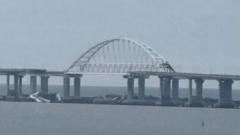
The long-term impact of the Crimean Bridge strike is still not fully clear though the risk of a serious transport and logistics crisis for the Russian military has increased significantly.
The collapse of the arched section of the Crimean Bridge has cut off the peninsula’s direct road and rail links with Russia – at least until the crossing can be repaired.
However, there is still a land corridor running through the occupied parts of the Zaporizhzhia and Kherson regions – though Ukraine has been systematically striking transport routes across northern Crimea, as well as bridges and other crossings in the area around Chongar.
This has already caused problems with the delivery of fuel and other supplies, including military cargo.
There is a ferry crossing across the Kerch Strait. It could partly compensate for the loss of the bridge, but its capacity is very limited and it is also vulnerable to attack.
Russia could also supply Crimea by sea, but this route is also risky, as Ukrainian naval and aerial drones operate extensively in the area.
In addition, debris from the Crimean Bridge – particularly its enormous arch – may have blocked the shipping channel.
This would make it harder for larger vessels to pass through and create further problems for ports in the Sea of Azov, including Mariupol and Berdiansk.
Russia’s launched its full-scale invasion of Ukraine in February 2022. Approximately one-fifth of Ukraine is now under Russian occupation and Kyiv has refused Putin’s demand to give up areas of Ukraine’s eastern Donbas that remain under its control.