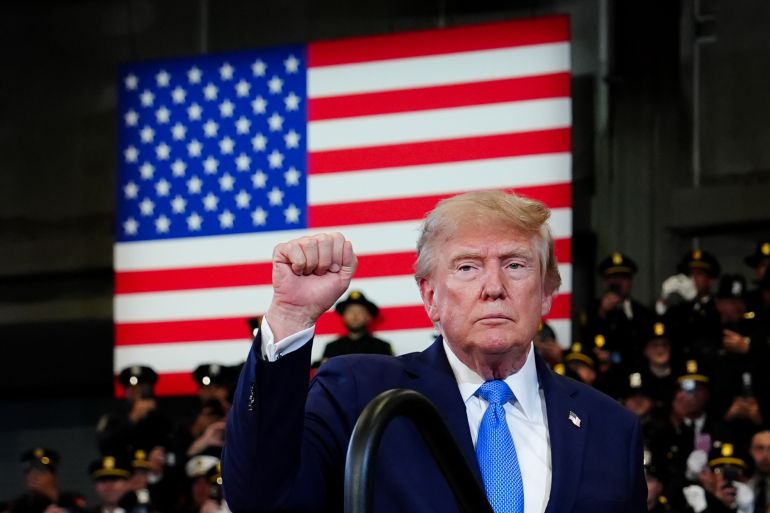
Trump hails Mecca pact: Can it replace the region’s US security umbrella?
As Trump pushes allies to do more for their own defence, three US partners have created a security pact of their own.
Save

 By Abid HussainPublished On 17 Aug 202617 Aug 2026
Islamabad, Pakistan — When Saudi Arabia, Turkiye and Pakistan signed a mutual defence pact in Mecca 10 days ago, some geopolitical analysts saw the deal as a message to Washington — that several of the United States’ closest military allies and partners no longer trusted its security umbrella.
On Sunday, US President Donald Trump made it clear that he didn’t mind the Middle East finding ways to defend itself.
Recommended Stories
list of 4 itemsend of list
“Very happy to see that Saudi Arabia, Turkey, and Pakistan have recently, and finally, signed the Mecca Joint Defence Agreement,” Trump wrote on Truth Social. “It shows that the Middle East is coming together and how Countries will finally be able to defend themselves in a more meaningful way.”
Pakistan’s Prime Minister Shehbaz Sharif thanked Trump within hours on Monday, crediting his “courageous and decisive leadership” with helping avert “a nuclear catastrophe in South Asia”.
In many ways, Trump’s apparent happiness over US partners seeking other security arrangements beyond their traditional reliance on Washington is in keeping with his political posture: The US president has long accused allies of not spending enough on their own defence, and of stretching America’s resources in their service.
But even as three close US allies build their own collective defence arrangement, one question hovers as an elephant in the room, say analysts: Can deals like the Mecca pact actually replace the reliance of countries like Pakistan, Turkiye and Saudi Arabia on the US?
A deliberate drawdown
The timing of Trump’s statement is not incidental, say analysts. The US president has spent much of the past year pushing allies to shoulder more of their own defence burden.
Advertisement
At NATO’s summit in The Hague in June 2025, member states agreed to more than double their defence spending target, from 2 percent of gross domestic product (GDP) to 5 percent by 2035, after sustained pressure from Trump, who had questioned whether Washington should keep defending allies that fell short.
On Sunday, before his post on the Mecca pact, Trump also announced he was “substantially” reducing joint military exercises with South Korea, citing cost and his “very good relationship” with North Korea’s Kim Jong Un, while criticising Seoul for not helping the US against Iran.
Betul Dogan-Akkas, assistant professor of international relations at Ankara University, argued that Turkiye’s role in the Mecca pact should be read against that broader backdrop.
“It is obvious that the Arab Gulf states lost their deterrence since February 28, and they have to re-establish their deterrence without relying on the US,” she told Al Jazeera, referring to the date when the US and Israel launched their war on Iran, without consulting the US’s Gulf allies — who faced Iranian retaliation. “Erdogan signals to the world and to the Gulf that he can support a regional security complex, as the world’s hegemony is not doing its job properly.”
But not all analysts see Trump’s reaction as signalling a retreat from the region.
“I don’t think the US is stepping back as such, but perhaps the limits of its military presence and its impact, as well as the associated liabilities, have been exposed quite significantly, compelling all regional actors to speed up their attempts to diversify their security linkages,” said Umer Karim, an associate fellow at the Riyadh-based King Faisal Center for Islamic Research and Studies, who specialises in Gulf and Pakistani affairs.
“The US will remain in the region, but perhaps in a manner where local partners increase their own contribution and align more closely to fill the gaps left by their near-total dependence on the US,” Karim added.

Mansoor Ahmed, an honorary lecturer at the Australian National University’s Strategic and Defence Studies Centre, took a different view.
“The Trump administration is following a graduated retrenchment as it seeks to rebuild the US military-industrial base, and is asking allies and partners to take greater responsibility for their own defence,” he told Al Jazeera.
Advertisement
Even so, Ahmed does not see the pact itself as a product of that retrenchment.
“While the Mecca pact inadvertently and indirectly helps US retrenchment, it was conceived and planned independently of any shifts in US policy or posture,” he said.
“It was a response to the loss of credibility of US will and capability to effectively defend the GCC countries during the US-Iran conflict,” Ahmed added, referring to the Gulf Cooperation Council countries: Saudi Arabia, the United Arab Emirates, Qatar, Kuwait, Oman and Bahrain.
More than security
For Ankara, Dogan-Akkas said, the calculation is about status as much as security.
“The main strategic gain for Turkiye is not to support its national security; its primary gain is to underline its role as a security provider, rather than a security consumer,” she said.
Gokhan Ereli, an international relations expert and assistant professor at Istanbul’s Ibn Haldun University, sees Turkiye’s willingness to bind itself to two non-NATO partners in similar terms, but traces it to Ankara’s long-standing doubts about Washington.
“Where the Gulf states fear that the American umbrella has holes, Ankara suspects the umbrella was never really held over it in the first place,” he told Al Jazeera.
He called the pact “a hedge with Turkish characteristics”, adding that the posture is “not anti-American so much as post-dependent”.
An untested promise
The Mecca agreement states that an armed attack on one member “shall be regarded as an attack against them all”, language modelled on NATO’s Article 5.
But Turkiye’s Foreign Minister Hakan Fidan has said a state under attack would first have to request assistance and specify what kind of help it wants — whether intelligence, logistics or troops.
Ahmed sees similar discretion built into the pact itself.
“Each country is likely to be sovereign in determining the timing, nature, extent and scope of the military assistance from the other two parties, or if any assistance is required in the first place,” he said.
Reza Khanzadeh, a Middle East analyst at George Mason University, points to precedent suggesting the clause is unlikely to drag its signatories automatically into each other’s wars.
The bilateral Saudi-Pakistan pact signed in September 2025 “did not result in a wider conflict” after Iran and then the Houthis attacked Saudi Arabia this year, he said.
Karim agrees that the commitments are conditional rather than fixed.
“This is an alignment that provides additional defence options and resources to every country but doesn’t really replace existing capabilities,” he said.
The practicality of those commitments, he explained, depends on the needs of the country under attack, with a hierarchy developing “in accordance with the needs, resources, platform availability and nature of the threat” that determines what each side can actually spare.
Still, Karim calls it a genuine institutional first, “a new thing in the region since the time of the Baghdad Pact or CENTO”.
The Baghdad Pact, renamed the Central Treaty Organization (CENTO) in 1959, was a Cold War-era alliance linking Turkiye, Iran, Pakistan, Iraq and the United Kingdom against Soviet expansion, with Washington backing it but never becoming a full member. It collapsed in 1979 after the Iranian revolution.
Advertisement
That ambiguity cuts both ways. It allows Riyadh, Ankara and Islamabad to project unity without directly provoking Iran.
But it also means the pact, for now, is nowhere near matching the roughly 50,000 US troops stationed across the region.
Karim is cautious about how far that gap can close.
“It all depends on the security needs of the three states, how extensive their trilateral alignment is, and the nature of the threat they are facing,” he said.
“In any case, this does create a workable alternative, but considering the structural reliance of Gulf states on the US, it doesn’t really replace it. It should be considered as adding a separate layer of deterrence.”