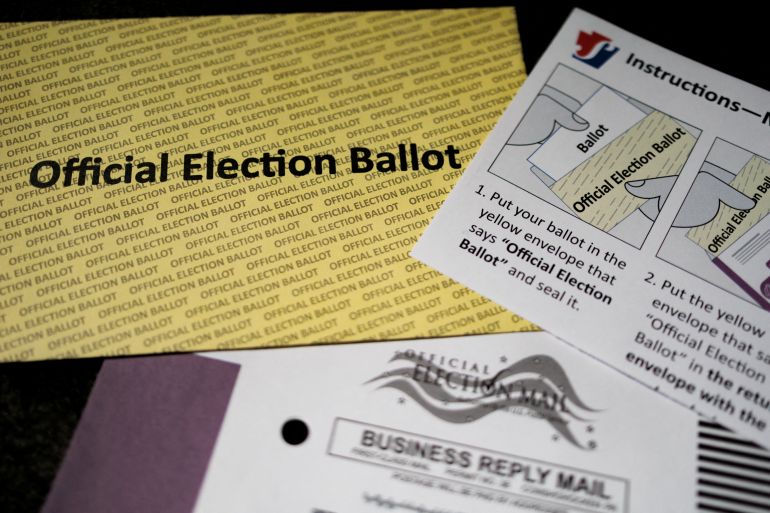
Trump asks US Supreme Court to allow mail-in voting restrictions
A lower court blocked the mail-in ballot restrictions, ruling Trump lacked authority to change state election rules.
Save


Published On 27 Jul 202627 Jul 2026
The administration of United States President Donald Trump has asked the Supreme Court to allow it to move ahead with sweeping restrictions on mail-in voting ahead of November’s midterm elections, as it continues its push to reshape how federal elections are run.
In an emergency filing on Monday, the Justice Department asked the country’s highest court to pause a lower court ruling that blocked parts of Trump’s March executive order in 23 Democratic-led states and Washington, DC. The pause would remain in effect as the legal challenges play out, per the request.
Recommended Stories
list of 4 itemsend of list
The executive order directed federal agencies to help create state lists of eligible voters and required the US Postal Service to deliver mail ballots only to people on those lists. It also instructed the Justice Department to prioritise investigations into election officials accused of issuing ballots to ineligible voters.
US District Judge Indira Talwani blocked the order in June, ruling that Trump lacked the authority to unilaterally change how states administer federal elections. She noted that under the Constitution, states oversee voter-eligibility requirements.
Over the weekend, the First US Circuit Court of Appeals declined to pause that ruling, prompting the administration to take the issue to the Supreme Court.
In its request to the top court, the administration argued that the order amounted to “general policy guidance” rather than a directive dictating how states should administer elections.
Solicitor General John Sauer wrote: “The injunction is especially indefensible because the agencies are still deliberating over how (if at all) to implement the Order, yet the district court preemptively decided that whatever the agencies may choose to do will necessarily be unlawful.”
Advertisement
He urged the Supreme Court to act quickly as the new policy would have to be in place by August to be effective by the midterm election in November.
Trump has long claimed, without evidence, that widespread voter fraud undermined the 2020 presidential election and has repeatedly questioned the security of mail-in voting, despite studies showing that such fraud is rare.
He has promised to end the widespread use of mail ballots before the midterms, which will determine which party takes control of the US House of Representatives and Senate.
Voting rights advocates say restricting mail-in voting could disproportionately affect Democratic voters, who have historically been more likely than Republicans to cast their ballots by mail.