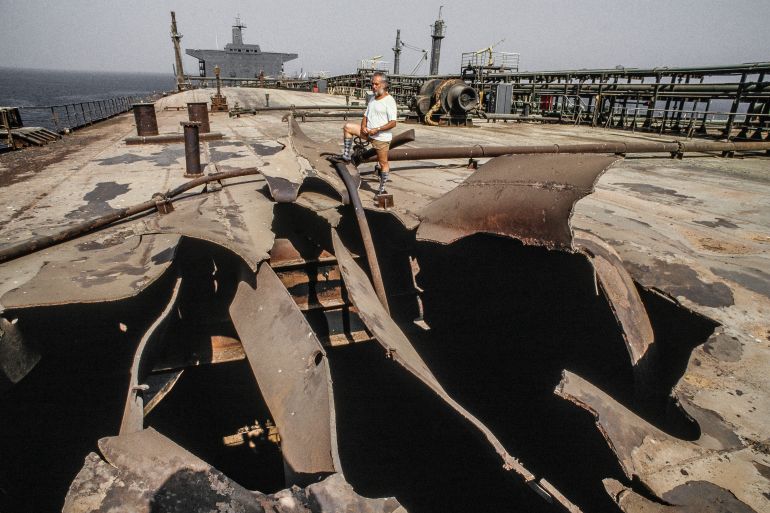
Iran-Iraq Tanker War redux? Why the Strait of Hormuz crisis is different
The Tanker War between Iran and Iraq in the 1980s also disrupted global shipping. But the situation today is not entirely the same.
Save

 By Priyanka ShankarPublished On 24 Apr 202624 Apr 2026
On April 20, the United States fired at and then seized an Iranian-flagged container ship close to the Strait of Hormuz in the northern Arabian Sea, amid its blockade of Iranian ports.
It was similar to a scene which played out in the 1980s during the so-called Tanker War between Iran and Iraq, during which both countries fired on each other’s tankers in the Strait of Hormuz, seeking to cripple each other’s economies.
Recommended Stories
list of 3 itemsend of list
As naval tensions rise again in the Strait of Hormuz – this time between Iran and the US – we break down what happened in the 1980s and examine the parallels and differences between the situations then and now:

How the 1980s Tanker War played out – a timeline
The war between Iran and Iraq began in 1980 when then-Iraqi President Saddam Hussein launched a full-scale invasion of Iran following Iran’s 1979 Islamic revolution.
In 1984, this war reached the Gulf when Iraq attacked Iranian oil tankers, seeking to cripple its oil-revenue-dependent economy. Iran retaliated by firing at oil tankers belonging to Iraq and its allies in the Gulf.
According to a report by the University of Texas’s Robert Strauss Center for International Security and Law, Iran also threatened to close the Strait of Hormuz then, but did not do so since its own economy, already crippled by the war, was dependent on exporting oil to the rest of the world through it.
Advertisement
In November 1986, when Iran struck Kuwait’s ships, Kuwait asked for foreign help. The former Soviet Union was the first to respond and helped escort the nation’s ships in the Gulf.
The US, led by then-president Ronald Reagan, launched Operation Earnest Will in July 1987, also seeking to protect tankers in the Gulf and render more assistance than Moscow. The operation involved reflagging Kuwaiti tankers with the US flag so they could legally sail under US protection.
According to an article by the Veterans Breakfast Club, a US-based website which shares experiences of former US military veterans, during Washington’s very first escort mission in July 1987, a reflagged tanker hit an Iranian mine in the Gulf.
“The convoy continued, but the incident made clear that the United States had entered a shadow war with Iran at sea,” the article said.
“Over the next fourteen months, dozens of US warships rotated through the region escorting tankers and protecting shipping lanes. US forces also conducted special operations to hunt Iranian mine-layers at night and conducted strikes against Iranian military positions and ships. The mission wasn’t a small one, consuming 30 US Navy ships at one time,” the article added.
Then in April 1988, the US frigate USS Samuel B Roberts was damaged by an Iranian mine in the Strait of Hormuz. Historian Samuel Cox, writing for the US Naval History and Heritage Command (NHHC), noted in 2018 that by the end of 1987 that vessel was so badly damaged, that “the only thing actually holding the ship together was the main deck”.
So, the US launched Operation Praying Mantis, seeking to destroy Iranian vessels.
The tanker war eventually ended in August 1988, following a United Nations-brokered ceasefire agreement between Iran and Iraq.
Cox noted that by the end of 1987, “Iraq had conducted 283 attacks on shipping, while Iran attacked 168 times. Combined, the attacks had killed 116 merchant sailors, with 37 missing and 167 wounded, from a wide variety of nationalities.”
“Initially, there was great concern that the attacks would cut off the vital flow of oil from the Arabian Gulf, but all they really did was drive up insurance rates. The world’s need for oil was so great, that over 100 dead merchant seamen was apparently an acceptable price,” he wrote.

What is happening in the Strait of Hormuz now?
The current hostilities between the US and Iran in the Strait of Hormuz began when Tehran, whose territorial waters extend into the strait, closed passage to all vessels after the US and Israel began bombing the country. On March 4, the Islamic Revolutionary Guard Corps (IRGC) declared that it was in full control of the strait, and ships would need to get clearance from them to pass through it.
Advertisement
Shipping through the strait collapsed by 95 percent, sending the price of oil – 20 percent of global supplies of which are shipped this way – soaring above $100 a barrel.
Iran, through its imposition of control over who passes through Hormuz, has for almost eight weeks now, determined which vessels can exit the strait from the Gulf into the Gulf of Oman.
At first, Iran indicated that it would allow “friendly” ships to pass if they paid a toll. On March 26, Iran’s Foreign Minister Abbas Araghchi told Iran’s state TV: “The Strait of Hormuz, from our perspective, is not completely closed. It is closed only to enemies. There is no reason to allow the ships of our enemies and their allies to pass.”
Vessels from Malaysia, China, Egypt, South Korea, India and Pakistan passed through the strait through most of March and early April.
Iran’s Islamic Revolutionary Guard Corps (IRGC) provided these vessels with an alternative route through the Strait of Hormuz to avoid potential sea mines. US officials, including Donald Trump, have said mines have been placed there by Iran, although it has not officially confirmed or denied this.

But on April 13, alarmed that Iran was continuing to ship its own oil out of the strait, the US imposed a naval blockade of all Iranian ports. Since then, US Central Command has said US forces have directed 33 Iran-linked vessels to turn around or return to an Iranian port.
On Monday, the US military fired on and then captured the Iranian-flagged container ship Touska close to the Strait of Hormuz in the northern Arabian Sea, and, a day later, detained another oil tanker sanctioned for transporting Iranian crude oil as it sailed in the Bay of Bengal, which links India and Southeast Asia.
In a post on social media after detaining the Touska, the Pentagon wrote: “As we have made clear, we will pursue global maritime enforcement efforts to disrupt illicit networks and interdict sanctioned vessels providing material support to Iran – anywhere they operate. International waters are not a refuge for sanctioned vessels.”
Since the US naval blockade of Iranian ports began, Tehran, which was earlier allowing vessels from “friendly” nations to pass through the Strait of Hormuz, has further tightened its grip on the strait.
Justifying the decision not to allow any foreign ships to pass until the US ends its naval blockade on April 19, Iran’s First Vice President Mohammad Reza Aref said the “security of the Strait of Hormuz is not free”.
“One cannot restrict Iran’s oil exports while expecting free security for others,” he wrote in a post on X.
Last Saturday, Iran reportedly fired at two Indian-flagged merchant vessels in the strait. The IRGC said the two ships were attacked because they were “operating without authorisation”, according to state media reports.
Then, on April 22, Iran captured two container ships seeking to exit the Gulf via the Strait of Hormuz after firing on them and another vessel.
What are the parallels between the two wars?
Just like during the Tanker War of the 1980s, shipping has been severely disrupted by the US-Israel war on Iran, upending global oil and gas prices.
Advertisement
According to an April 17 article by the World Economic Forum, from the mid-1980s when the Tanker War took place, to the start of the new millennium, a barrel of crude oil averaged $20.
On Friday, while a ceasefire between the US and Iran was in effect, a naval battle was still playing out in the Strait of Hormuz, and Brent crude, the international benchmark, topped $106 per barrel. During open warfare between the US, Israel and Iran in March and early April, oil rose as high as $119 per barrel.
Mines in the sea are another problem common to both time periods.
While vessels were damaged by mines during the 1980s Tanker War, there has so far been no report of vessels being damaged by mines in the current war. However, the risk is the same.
US President Donald Trump has said the US will ramp up efforts to remove mines from the Strait of Hormuz. This has not begun yet, however.
According to CNN, there are only a few US minesweeping ships in the Gulf. The US Navy also told the broadcaster that four dedicated minesweepers stationed in the Gulf region were decommissioned last year.
John Phillips, a British safety, security and risk adviser and former military instructor, told Al Jazeera: “There are some clear parallels between the current situation in Hormuz and the Tanker War of the 1980s. In both cases, the basic idea is the same: pressure at sea can have effects far beyond the water itself.
“A relatively small amount of naval disruption, whether that means mining, harassment of shipping, missile threats, or attacks on tankers, can create real strategic and economic consequences, especially in a chokepoint like the Strait of Hormuz. So in that sense, the original Tanker War is a useful reminder of how vulnerable global trade can be when the maritime domain becomes part of a wider political or military confrontation.”
What are the differences between the two wars?
During the Tanker War, the US escorted ships to protect them from Iranian attacks and also deployed vessels to remove mines. NATO countries like the United Kingdom, Belgium, the Netherlands, France and Italy also joined.
But in the current standoff in the Strait of Hormuz, US allies like the UK and other NATO nations have refused to join Washington in reopening the Strait of Hormuz, or begin minesweeping operations, fearing they will be dragged into the war.
In a post on Truth Social in early April, the US president took aim at allies, “like the United Kingdom”, which, he said, have “refused to get involved in the decapitation of Iran”, telling them to either buy US fuel or get involved in the rapidly escalating war.
“You’ll have to start learning how to fight for yourself, the U.S.A. won’t be there to help you anymore, just like you weren’t there for us. Iran has been, essentially, decimated. The hard part is done. Go get your own oil!” Trump wrote.
The framework of the US-Israel war on Iran is different from that of the war between Iraq and Iran in the 1980s, experts say.
“In the 1980s, the Tanker War was part of the broader Iran-Iraq War, so the shipping attacks were tied to a much larger land conflict between two regional armies. Today, the situation is more about Iran’s standoff with the United States and its allies, and the maritime activity is less about asymmetrical war at sea and more about deterrence, signalling and the threat of escalation,” said Phillips.
“The military lesson, really, is that Hormuz is still one of those places where limited actions can have outsized effects, but the modern setting is more fast-moving, more technologically advanced and potentially more volatile than the original Tanker War,” he added.
Advertisement
Analysts have also pointed out that, unlike in the 1980s, Iran is currently stronger when it comes to withstanding attacks and naval blockades by the US.
In the Tanker War, Iraq was militarily supported by Western allies, while Iran was under a US arms embargo imposed in 1979 after the Iranian revolution. While this gave Iraq a military advantage, Iran’s IRGC used asymmetric warfare tactics by striking Iraq’s allies’ ships and oil tankers.
Experts also say that since the 12-day war between Iran and Israel last year, Tehran has shifted its military doctrine from one that is primarily about defensive containment to an explicitly offensive asymmetric posture.
“Iran today appears more structurally aggressive in doctrine where it is formally embracing earlier and more extensive use of regional missiles, drones, cyberattacks and energy coercion [when energy resources and infrastructure are targeted or cut off], but is operationally constrained by battle damage, sanctions and internal instability,” Phillips, the risk adviser and a former military chief instructor, told Al Jazeera in an interview on March 2.
A former US ambassador to Bahrain, Adam Ereli, also told Al Jazeera that Iran and the IRGC have “revolutionary fervour”, which means they can “survive”.
“They can tolerate pain for a lot longer than I think most American decision-makers and planners calculate,” he said.