Iran war’s big winners: Wall Street, weapons firms, AI and green energy
The global economic outlook for 2026 looks grim if the Iran war continues, but some industries are booming.
Save

Published On 17 Apr 202617 Apr 2026
The International Monetary Fund has downgraded its global growth forecast for 2026 from 3.3 to 3.1 percent, citing the impact of the United States-Israeli war on Iran and the shutdown of the Strait of Hormuz on the world economy.
The war has damaged energy infrastructure across the Gulf, while critical exports like oil, gas, chemicals and fertiliser remain largely stranded by Iran’s shutdown of the strait and the subsequent US naval blockade of Iranian ports.
Recommended Stories
list of 4 itemsend of list
In the worst-case scenario of a prolonged war, the IMF said global growth could fall to 2.5 percent in 2026, with low-income and developing economies hit the hardest by soaring commodity and energy prices. The global shipping and logistics industry is facing a separate crisis.
But every economic crisis also has beneficiaries: despite the dire macroeconomic outlook, some corners of the global economy are thriving on the uncertainty.
Here’s a look at five industries that are doing well either despite – or because of – the darkening economic outlook.
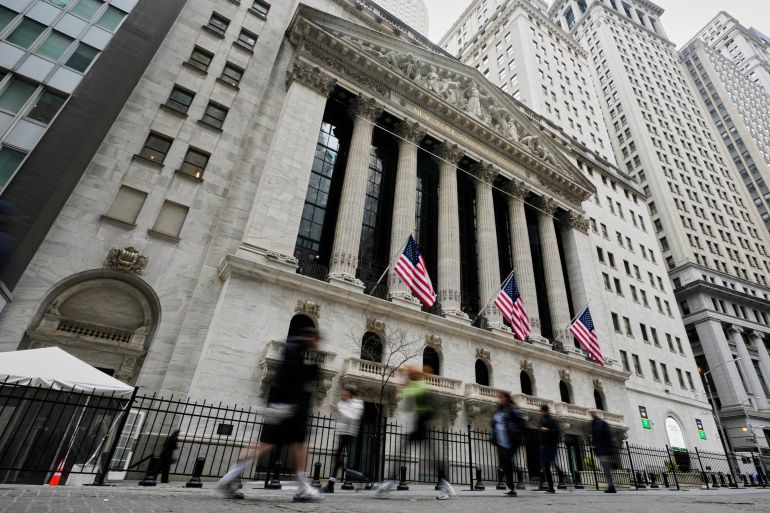
Wall Street investment banks
Global investors have been on a rollercoaster since the start of US President Donald Trump’s second term last year. The president’s erratic decision-making, where he often issues an ultimatum one day and then changes it the next, has led traders to coin the term “TACO trade”, where TACO stands for “Trump Always Chickens Out”.
The recent volatility has made some investors anxious, but it’s been a boon to investment banks, which make millions in commissions and revenue from the surging volume of trade, according to Sean Dunlap, a director of equity research at Morningstar Research Services.
Advertisement
“Clients want to reposition, so they trade frequently,” he told Al Jazeera. “Spreads tend to increase, which increases the profitability for trade intermediaries like banks.”
First-quarter results for 2026 – released this week – showed that Morgan Stanley reported a profit of $5.57bn, up 29 percent year on year, while Goldman Sachs reported a profit of $5.63bn, up 19 percent year on year.
JP Morgan Chase also reported major gains, with first-quarter earnings of $16.49bn, up 13 percent year on year. The banks all cited high levels of trading, deal-making, and “robust client engagement” as the reasons behind surging profits.
The boomtime for banks could reverse course, however, if volatility persists for too long, Dunlap warned, because investors may become increasingly cautious and less willing to borrow money to make trades.
Prediction markets
As mainstream Wall Street banks reap profits, the crypto-based prediction platform Polymarket has been earning upwards of $1m a day since the start of the month by letting users make peer-to-peer bets on everything from sports tournaments to elections.
Polymarket has been doing well since the start of the war, but it revised its fee structure on March 30 to cash in even more on its popularity.
Rival platforms like Kalshi, Novig and Robinhood also follow the same business model, but Polymarket has been the standout winner of 2026 because it controversially allows users to bet on the outcome of conflicts like the Iran war.
Polymarket revised its fee structure on March 30 to cash in on its popularity. The change has already netted the platform more than $21m in fees since April 1, up from $11.6m for all of March and $6.23m for all of February, according to DefiLlama, a website that provides data analysis for decentralised finance platforms.
If the current trend continues, Polymarket could make $342m in fees this year alone, according to DefiLlama’s analysis.
Anonymous users have also made millions correctly predicting the dates of major events like the US-Iran ceasefire, but the outcomes for rank-and-file users are typically less impressive.
Researchers found that the top 1 percent of Polymarket users captured 84 percent of all trading gains, according to a new report released this month analysing 70 million trades from 2022 to 2025. The returns are so high that US federal regulators have pledged to crack down on insider trading in prediction markets following suspiciously well-timed bets on Iran war outcomes.
Aerospace and defence
Unsurprisingly, the aerospace and defence industries are booming this year due to major conflicts in Ukraine, Iran, Sudan, Gaza and Lebanon and a surge in global defence spending.
Advertisement
About half of the world’s countries have increased their military budgets over the past five years, according to an April report from the IMF, which means they are also buying everything from drones to missiles — more than ever before. Demand is growing particularly fast in Europe, where NATO countries have committed to raising defence spending to 5 percent of gross domestic product (GDP) by 2035.
The defence industry has, in turn, seen major gains on the stock market. The MSCI World Aerospace and Defence Index – which tracks aerospace and defence stocks across 23 global markets – reported net returns of 32 percent year on year at the end of March.
The defence index outpaced the MSCI World Index, which tracks 1,300 large and mid-cap companies across the same 23 markets. The index, which gives a broader overview of global stock markets, reported net returns of 18.9 percent over the same period.
Artificial intelligence
Last year, the United Nations Trade and Development (UNCTAD) office predicted that the AI industry would grow from $189bn in 2023 to $4.8 trillion by 2033, and the Iran war does not seem to have dented the outlook.
“Despite the shocks from the Iran war, we’re still seeing resilience in a lot of sectors like artificial intelligence and renewable energy,” said Nick Marro, lead analyst for global trade at the Economist Intelligence Unit.
One metric for the AI boom has been the high volume of semiconductor chips still being exported out of East Asia, he said. At the top of the chart is chipmaking powerhouse Taiwan, which reported record-breaking merchandise exports of $80.2bn in March, up 61.8 percent year on year, according to EIU analysis.
The surge was led by exports to the US, which grew by 124 percent year on year, the EIU said.
Taiwan Semiconductor Manufacturing Company, the world’s top chipmaker better known by its acronym “TSMC,” on Thursday posted a net income of 572.8 billion New Taiwan Dollars (NTD) ($18.1bn) for the first three months of 2026 – up 58 percent year on year in NTD.
Another metric, initial public offerings or “IPOs,” also shows that the industry is confident for the moment, with industry leaders Anthropic and OpenAI both planning to go public this year.
Renewable energy
The Iran war has highlighted the need to transition from fossil fuels not only for environmental reasons, but also for reasons of energy security. The war marks the third major energy shock this decade, following the COVID-19 pandemic and the 2022 Russian invasion of Ukraine.
The Iran war has “boosted” renewable energy “given the urgency to switch away from fossil fuels and diversify towards renewable sources,” Marro of the EIU said.
Even before the Iran war began, the International Energy Agency reported that global governments were already taking active measures to invest in renewable energy for geopolitical reasons.
According to an IEA report released this month, “150 countries have active policies to advance renewable and nuclear deployment, 130 have energy efficiency and electrification policies, and 32 have policies to incentivise supply chain resilience and diversification across critical minerals and clean energy technologies.”
Advertisement
The Iran war has triggered another flurry of policymaking in Asia, which typically buys 80 to 90 percent of the oil and gas that transits through the Strait of Hormuz. Since the shutdown, the region has been struggling to find alternative sources of energy, forcing governments to deploy emergency measures like fuel rationing and price caps.
South Korea, Thailand, India, Cambodia, Indonesia, Vietnam and the Philippines have all announced a variety of measures from tax breaks for at-home solar panels to commissioning new renewable energy projects – and even restarting nuclear reactors.
The surge in policymaking has been good for the renewable industry. The S&P Global Clean Energy Transition Index, which tracks 100 companies that produce solar, wind, hydro, biomass and other renewable energy across emerging and developed markets, is up 70.92 percent year on year.