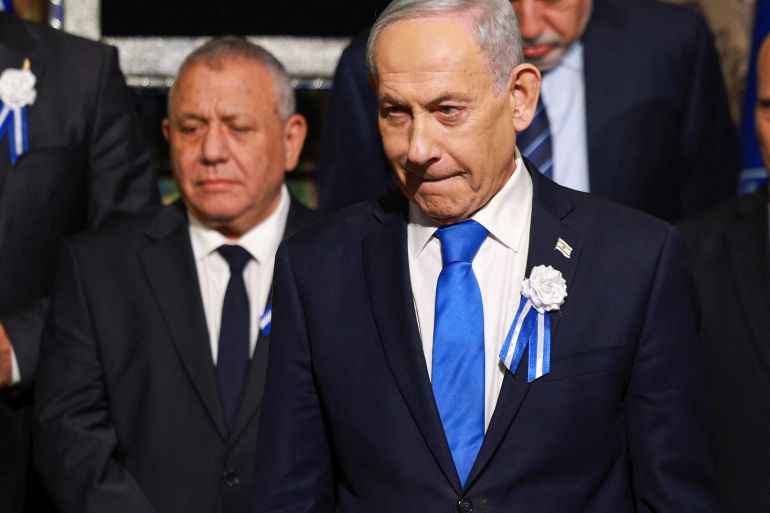
Netanyahu offers to rotate Israeli premiership with Gadi Eisenkot
Prime Ministerial hopeful Eisenkot offers immediate talks with Netanyahu to test whether Likud is ‘ready for genuine unity’.

 By Al Jazeera Staff28 Nov 2026
Israel’s caretaker Prime Minister Benjamin Netanyahu has proposed a rotating premiership with his main rival Gadi Eisenkot, who responded by offering immediate talks to see if the Likud leader is serious about a proposal for the country’s future government.
“If Likud is ready for genuine unity, I am prepared to see how serious it is over the next 24 hours,” Eisenkot said in a statement on Saturday. “I invite Netanyahu and his team to join me tonight … to conduct genuine and accelerated negotiations,” he added, naming a hotel near Tel Aviv as the location for talks.
end of list
Eisenkot is the leader of the centrist Yashar party and was tapped by Israel’s president to form a new government.
Earlier on Saturday, Netanyahu said on X that he was willing to let Eisenkot serve first as prime minister in a rotating premiership agreement as part of a unity government.
He said that with Likud being the largest in the country, he should “naturally” lead the unity government, but he would be willing to abandon that principle this time.
“Given the gravity of the existential danger and the possibility that a government will be formed that lacks the ability to confront it, my responsibility as a leader requires me to set everything aside, including the principle of the largest party, and agree that Gadi Eisenkot will serve first as prime minister, while I will serve as alternate prime minister at the beginning of the term,” Netanyahu said.
Eisenkot had pledged on Friday to announce the formation of Israel’s next government by the official deadline of December 6, without using the option of a 14-day extension. He also accused Netanyahu of stalling coalition talks in a bid to bring about new elections. The prime ministerial hopeful has so far struggled to put together a ruling coalition.
“I expect that, in light of this agreement on my part, we will immediately begin genuine, sincere and accelerated negotiations in which the other side will also be willing to make similar compromises and concessions, to establish a national unity government that will repel these dangers and ensure Israel’s security and future,” Netanyahu said.
‘Deceitful tactics’
Israel’s public broadcaster Kan earlier reported that the offer had already been proposed unofficially, so Likud could assume “plausible deniability” as the party remains conflicted on the terms of the proposal.
The October 27 elections failed to deliver a clear majority for either bloc.
Netanyahu and his traditional alliance of far-right and ultra-Orthodox parties won 53 seats, short of a majority in the 120-seat parliament, while Eisenkot and his presumed partners won 48 seats.
Netanyahu’s announcement underscores the pressure he also faces as Eisenkot wins support from potential partners that could hand him a governing majority or allow him to form a coalition government.
After his proposal, the leader of the Democrats group, Yair Golan, who has also publicly opposed any unity formula with Netanyahu in the past, rejected the latest offer.
“Enough tricks and deceitful tactics, Netanyahu has lost and our duty is to respect the will of the voter and form a government of change and rescue,” he posted on X.
Yousef Jabareen, leader of the Joint List, which is an alliance of Arab-led parties, also said that Netanyahu was attempting to thwart a change of government.
“The democratic majority has decided: this blood-stained, neglectful government must go,” he wrote on X. “It is time to fulfil the shared will of the entire public, Jews and Arabs alike, and remove Netanyahu this very week.”