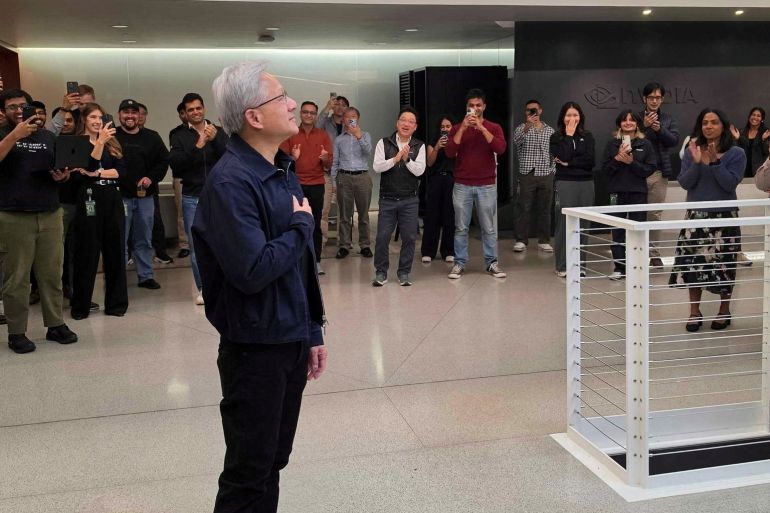
Was Jensen Huang too big to fire? Why Nvidia, Trump brought him back
Huang’s ‘mistakes’ had consequences far beyond just chip giant Nvidia. He is back nonetheless, in less than two weeks after spy scandal sacking.

 By Al Jazeera Staff24 Nov 2026
Jensen Huang has returned as Nvidia’s chief executive officer, just 11 days after he resigned from the board of the chip giant over an affair with an executive of a client company, alleged to be involved in a Chinese spy plot.
On Monday, Huang returned to a cheering crowd of employees at Nvidia’s headquarters in Santa Clara, California – a week after the board said it would not reinstate him.
US President Donald Trump took the credit for bringing back Huang – even as multiple inquiries continue, including an FBI-led counterintelligence review of his alleged links to a suspected Chinese intelligence asset.
The White House said: “We need to protect our geniuses.”
So, was Huang simply too big to fire? We look at what factors compelled Nvidia, the world’s most valuable semiconductor company, which controls 90 percent of the data centre graphics processing unit (GPU) market globally, to roll out the red carpet for Huang’s second coming.

What happened at Nvidia?
Huang, the 63-year-old cofounder and chief of Nvidia, resigned on November 12 amid reports of extramarital affairs, including with Alice Huang, a Chinese businesswoman who led Singapore-based Megaspeed – and is believed to be a Chinese intelligence asset by some in the Trump administration. The New York Times first reported the alleged Chinese spy plot.
Beijing has denied that Alice Huang is a spy for China. Nvidia’s board began an investigation into the allegations, but Jensen Huang resigned before it concluded.
He was reportedly romantically involved with at least two other executives at Nvidia as well.
Analysts warned that losing Huang could significantly undermine Nvidia’s market value, with some estimating that his departure could wipe as much as 30 percent off the company’s roughly $4 trillion valuation. In the event, the share price fell by 27.7 percent to a November 20 low of $3.04 trillion.
Following news of his reinstatement, shares rebounded, propelling the company back to a valuation of $3.98 trillion at the close of trading on Monday.
Several investigations are under way, including a Justice Department antitrust probe into Nvidia’s business practices and an SEC inquiry into its accounting. Congress is also examining the potential diversion of Nvidia chips to China through Megaspeed.
Amid mounting pressure from the market and the Trump administration, Nvidia brought Huang back to lead the company by Monday.
“I am honoured to return to Nvidia and lead one of the most consequential technology companies in the world at the beginning of a new industrial revolution,” Huang said in his statement.

Who was pushing to bring back Huang?
Huang’s departure prompted a backlash from influential figures in Silicon Valley.
A petition calling for his reinstatement attracted more than 180,000 signatures, including SpaceX CEO Elon Musk.
“Bring Jensen back while an independent investigation establishes the facts, unless and until you can provide compelling evidence that his removal is in NVIDIA’s best interests,” stated the letter published on the petition’s website.
But it was the Trump administration that made the decisive move, after a group of Silicon Valley insiders reportedly put together a so-called war room and lobbied the White House for support.
“The board decided to do what we wanted them to do,” Trump told CNBC in an interview, adding that he had spoken with board members and Huang.
“Basically, I was represented at the board,” Trump said, adding that Nvidia’s board asked for assurance about reported threats to national security.
“And we gave them assurances at least with everything we know and we know a lot,” the president said.
How did Nvidia’s board flip?
Huang does not have the voting power to control Nvidia’s board. In fact, he only has a 3.58 percent ownership stake – unlike, for example, Mark Zuckerberg, who leads Meta and holds a 13.4 percent economic stake, but commands nearly 60 percent of the company’s voting power.
Amid the campaign to reinstate Huang, the ousted CEO added that he would be “honoured” to return if the board deemed it best.
Board Chair Harvey Jones, however, told investors that Huang left voluntarily and would not return.
The board announced a new committee to investigate the matter internally and also formed a so-called National Security and Export Control Committee to oversee trade compliance and national security risks.
Then came the about-face, with Jones saying on Monday that the board “believes Jensen is the right person to lead Nvidia and that his reinstatement is in the best interests of our stockholders, employees, partners and customers”.
“In the process of reaching its decision, the Board received input from senior levels of the United States government and based on that input the Board is confident that Mr Huang’s reinstatement poses no national security risk,” the statement added.
What made Nvidia bring back Huang?
There are several reasons.
Trump’s influence
The US president’s administration, including Vice President JD Vance, pressured the board to chart a path for Huang’s return.
Trump claimed that he played a central role in Huang’s reinstatement to the consequential company, which had lacked a clear succession plan.
In the middle of the heated scandal, Trump repeatedly backed the “genius” Huang, who built Nvidia over three decades and was deeply involved in its technology strategy, relationships with customers and governments.
“I think this move is unprecedented in the sense that a sitting president has exerted very public pressure on a corporate board to make a particular decision,” Aleksandar Tomic, associate dean for strategy, innovation and technology at Boston College, told Al Jazeera.
Stock market
Huang’s departure created concern among investors and employees about whether Nvidia could maintain its momentum without him – as reflected in its tumbling stock price.
Nvidia’s share price fell nearly 28 percent between November 11, when the board accepted Huang’s resignation, and November 20, amid mounting uncertainty over its leadership.
It surged 31 percent in early trading on Monday after the board announced his reinstatement – adding about a trillion dollars to the company’s valuation – lifting stock markets, with the tech-heavy Nasdaq climbing 6.5 percent and the S&P 500 by 4.75 percent.
Tech and AI companies make up about 40 percent of S&P 500 valuations.
On Tuesday, major Asian stock indices in Seoul, Tokyo and Taipei all rose as well.
In Taiwan, where Huang was born, the market soared by more than 9 percent, while South Korea’s Kospi index increased more than 6.8 percent and Japan’s Nikkei 225 by 3.8 percent.
Nvidia’s role in AI
Huang’s company makes chips that literally power the modern AI revolution as we see it.
Nvidia holds an extraordinary near-90 percent share of the market for GPUs – graphics processing units, which are specialised AI processors – used in AI data centres, giving it an oversized influence over the infrastructure powering the global AI boom.
That also makes the company central to the AI rivalry between the US and China.
Hours after Huang returned to Nvidia, the US added Megaspeed – the Singapore-based company at the centre of the alleged spying scandal involving Nvidia – to its trade blacklist.
Washington does not allow the sale of advanced chips to Beijing in order to maintain its lead in the rapidly developing industry and says it would punish those who try to circumvent the restrictions.
Nvidia’s customers include tech giants such as Microsoft, Google, Amazon and Meta, which rely on Nvidia hardware to build and operate their AI data centres.
Huang has spent years lobbying in Washington against such restrictions, arguing that restricting sales would surrender a strategically important market to domestic Chinese competitors. That puts him at odds with US legislators who view access to Nvidia’s advanced chips as a national security risk, particularly given their potential military applications.