What next for Iraq’s push against militias following Jurf al-Sakhar deal?
Thursday’s Iran-brokered compromise may bode poorly for Baghdad’s attempt to curb militia influence.


 22 Nov 2026
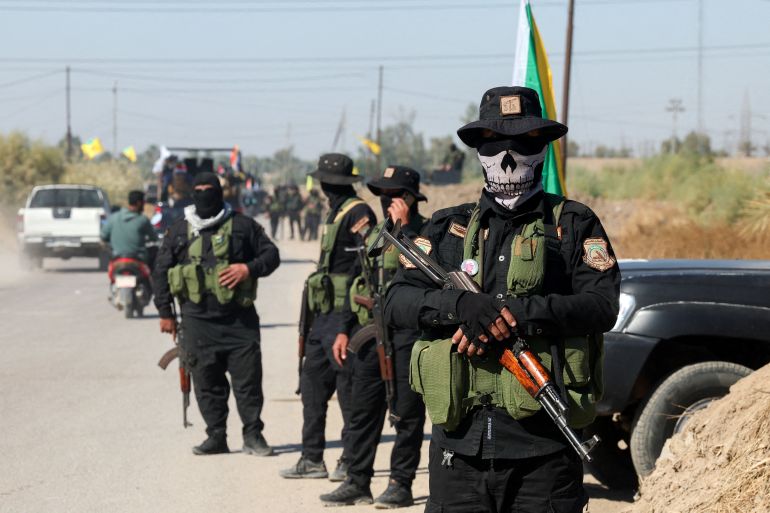
The entry of Iraqi government forces into Jurf al-Sakhar, a town 60km (37 miles) southwest of Baghdad long held by the Iran-backed armed group Kataib Hezbollah, has raised questions about the future of Iraqi militias in the country.
A deal reached between Iraqi authorities and Kataib Hezbollah about control of Jurf al-Sakhar, where oil smuggling was allegedly taking place, staved off a potential confrontation between the two sides.
end of list
It is the latest episode in Prime Minister Ali al-Zaidi’s push to assert federal government control over the country and crack down on corruption, which is allegedly funding pro-Iran militias.
So how does Thursday’s compromise bode for the Iraqi state’s mission to rein in militias and weapons outside its control?
What happened at Jurf al-Sakhar?
Kataib Hezbollah seized Jurf al-Sakhar from ISIL (ISIS) in 2014, renaming it Jurf al-Nasr (“victory”). For the 12 years since then, it has prevented state authorities from re-establishing control and allegedly siphoned oil from local pipelines.
After an intelligence report was released this week about oil smuggling in Jurf al-Sakhar, the government formed a high-level committee to investigate the issue.
After an anti-corruption crackdown was announced, al-Zaidi then gave Kataib Hezbollah until Friday to withdraw from the town. A compromise deal was reached a day before the due date, with government forces entering Jurf al-Sakhar and establishing a joint operations centre in the town. This should see the gradual withdrawal of Kataib Hezbollah units and the phased deployment of an army brigade, a federal police brigade, an energy police regiment and two brigades from the Popular Mobilisation Forces (PMF) to the town.
The compromise reportedly came after direct Iranian intervention brokered by Esmail Qaani, head of the Islamic Revolutionary Guard Corps (IRGC) elite Quds Force, which once joined the PMF on the front lines against ISIL and maintains deep ties with several of Iraq’s militias.
Why is Baghdad moving against militias?
PM al-Zaidi, a businessman with a Shia background, took power in May, vowing to end corruption and the fragmentation of the country’s security landscape.
Initially, he set a deadline of September 30 for militias to place their weapons under state control, coinciding with the withdrawal of US and allied forces from Iraq. While US forces withdrew, the militias refused to comply, and the deadline was pushed to June 2027.

Of major concern to Baghdad is the use of Iraq by armed groups to launch unauthorised attacks at Iran’s behest. Since the start of the US-Israeli war on Iran, several Iraqi militias have pledged to support Iran’s war effort. Baghdad has acknowledged that attacks targeting neighbours have been launched from its territory and has vowed to put an end to them.
Akeel Abbas, an expert in Iraqi affairs, said Baghdad was the reason for the government’s intervention in Jurf al-Sakhar, not the issue of oil smuggling.
“This area, which the state could not enter since 2014, did actually participate in Iran’s war effort, bombing Gulf countries, bombing US interests in Iraq,” he told Al Jazeera.
“There are other areas, but this one is the strongest, most fortified, and the best weaponry is stored there.”
In July, after Iran-aligned militias attacked Saudi Arabia’s East-West Pipeline, the United States and Saudi Arabia launched retaliatory strikes against PMF targets across Iraq, killing at least 20 personnel and drawing condemnation from Baghdad.
By establishing a presence in Jurf al-Sakhr, once the site of former President Saddam Hussein’s military-industrial complex, Baghdad signalled to the US that it was removing it as a potential target.
What next?
Zeidon Alkinani, founding director of the Doha-based Arab Perspectives Institute, said the deal over Jurf al-Sakhar was a positive step, especially as it was secured through negotiation and not armed confrontation.
“The remaining questions are how long this will take and what the armed groups will want in return,” he told Al Jazeera. Kataib Hezbollah may also retain its influence in the area through PMF units, with the process of deployment likely to take weeks to complete.
“How the next phases go will determine whether this becomes a real return of state authority or just a rearrangement of who controls the area,” Alkinani said.
Tallha Abdulrazaq, an Iraq expert and strategy and security consultant, said that the deal was compromised by the presence of militia and pro-militia personnel in the security contingent sent by Baghdad.
“Effectively, we’re changing Shia militias for Shia militias, but in uniform,” he said. “There has been no announcement about them being disarmed and their missile and drone manufacturing facilities set up with Iranian expertise being dismantled.”

Where did Iraq’s militias come from?
Iran-backed armed groups have become some of the most powerful actors in Iraq since the US-led invasion of Iraq overthrew President Saddam Hussein’s government in 2003.
Some of Iraq’s most influential militias – like Kataib Hezbollah and Asa’ib Ahl al-Haq – found their genesis in the resistance to US occupation, many with the alleged support of Iran.
Others were formed in response to the threat posed by ISIL after a fatwa was issued by leading Iraqi Shia cleric Ali al-Sistani, fighting under the banner of the PMF.
The PMF are a recognised component of Iraq’s security forces, granting the militias semiofficial status. However, some Iraqi militias, such as Kataib Hezbollah, still operate outside the framework of the state and have been accused of undermining the government’s legitimacy.
There have also been frequent accusations that militias operate corrupt patronage networks to finance themselves, and that their close relationship with Tehran has frustrated the Iraqi government’s efforts to govern the country.