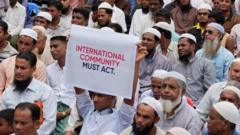
Philippe Sands KC, a top human rights lawyer who helped bring the case, described it as an “historic judgment”.
He told BBC Radio 4’s World at One programme that it was “right up there with the great moments of international justice: Nuremberg, Pinochet, and others”, referring to the trials of Nazi leaders following World War Two and that of the Chilean dictator, respectively.
However, the ICJ is not a criminal court and its powers of enforcement are limited. It cannot send military officials to prison, while it relies on the UN Security Council and political pressure to impose its rulings.
The ruling will, though, have implications for other genocide cases pending with the ICJ, including one brought by South Africa against Israel over its war in Gaza.
Sands said that pending case had been the “elephant in the room” during the Myanmar hearings.
He added that, while ruling against Myanmar did not mean the court would find similarly with Gaza, if it had not found Myanmar responsible, the case against Israel “would, in effect, be over”. Israel says the case against it is “wholly unfounded”.
Antonia Mulvey, executive director of Legal Action Worldwide, told the BBC that the court had not accepted Myanmar’s counter-terrorism defence and had found for the first time that rape and sexual violence was an act of genocide, positions it would bear in mind for future cases.
Following Thursday’s ruling, UK Foreign Secretary Ed Miliband said the government was ordering Myanmar’s defence attaché be expelled and that he was summoning its charge d’affaires.
He pledged to set out “further action in the coming days to ensure those responsible are held to account” after a cross-party group of MPs called for the government to resume sanctions against Myanmar’s military.