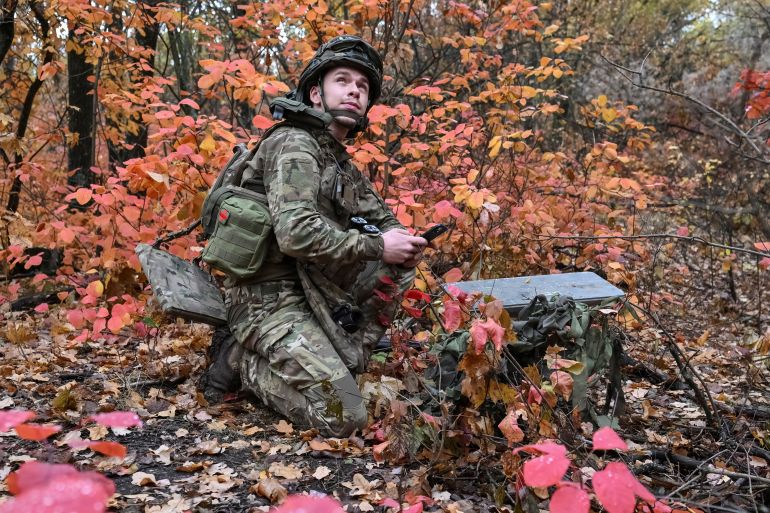
Why Starshield limits are hurting Ukraine against jet-powered drones
Ukraine’s military has been relying on the internet service since December 2024 to intercept Russian drones.

 By Al Jazeera Staff16 Nov 2026
Ukraine’s President Volodymyr Zelenskyy has warned that limits on SpaceX’s Starshield military-grade internet service are disrupting Ukrainian drone operations and hindering the country’s war effort against Russia.
Over the weekend, two people were killed in a Russian jet-powered drone attack on what Ukrainian officials called “critical infrastructure” in the northern Koriukivka region. An energy facility was also hit in Odesa overnight on Sunday, leaving 41,000 households without electricity.
end of list
Zelenskyy linked the success of these Russian strikes to limits that he said had been placed on Ukraine’s use of Starshield. The country’s military has been relying on the service since December 2024 to intercept Russian drones.
Starshield is a sister service to Starlink, a network of 11,000 satellites launched into low Earth orbit by SpaceX to provide high-speed internet connectivity, even in remote areas.
What did Zelenskyy say?
In a statement on X on Sunday, Zelenskyy said that Russia was targeting energy substations with Shahed drones, which both sides often use to attack each other.
He added that “many of these strikes are getting through because restrictions on the operating speed of Starshield terminals along the front line and in the temporarily occupied territories are still there”.
“We are counting on these restrictions being lifted. The protection of lives and Ukraine’s energy infrastructure ahead of winter directly depends on this,” he added.
Zelenskyy also accused Starlink’s sister service of throttling internet speeds and hampering military operations on Saturday. He said that the internet restrictions had been in place for five days.
This is not the first time Ukrainian officials have complained about limits on Starshield hampering Kyiv’s defence efforts.
Last month, Ukrainian defence officials said they had lost access to important satellite-based communications and that the disruptions had affected military missions. This came in the wake of heavy Russian missile and drone strikes, for which Ukraine said it had received no prior warning.

How is slow-speed internet impacting Ukraine’s defences?
According to a November 2 report by the Center for Strategic and International Studies (CSIS), Starshield is critical to Ukraine since it helps in encrypting satellite communications, which are needed to guide drones in order to carry out interceptions.
“In addition to using Starshield service for strikes within Ukrainian territory occupied by Russian forces, Ukraine uses Starshield-equipped drones to intercept and defend against Russian drones, such as new jet-powered drones taking aim at Ukrainian critical infrastructure and civilian targets,” the CSIS report noted.
Without access to Starshield internet, these Ukrainian drones are unable to work as effectively.
“Our interceptor drones lose connection with their operators at a speed of 161 kilometres per hour (100 miles per hour) and simply cannot catch up with Russian jet-powered ‘shaheds’,” Zelenskyy said on X on Sunday.
After last month’s disruptions, Zelenskyy said on X that “intelligence on Russian ballistic missile launches helps save lives, and this is one of the most critical issues”.
“This is precisely what helps prevent people from being killed – when there is an early warning about ballistic missiles,” he added.
Last month, Serhiy Beskrestnov, a defence adviser to Zelenskyy, had posted on Telegram that SpaceX had also “implemented a speed limit” on Starlink terminals, capping internet speeds at 100mph (161km/h).
That meant any drones or missiles flying at more than 100mph lost their guidance connection.
“Our armed forces did not receive a warning about these restrictions, and this led to the failure of a number of missions,” he had said, adding that this was clearly “related to the current political situation”.
Officials have said the restrictions have also reduced capabilities for front-line logistics, reconnaissance and relaying signals.
What are the jet-powered drones Russia is using?
Jet-powered drones are high-speed uncrewed aerial vehicles equipped with small turbojet engines rather than traditional propellers or piston engines.
In its war on Ukraine, Russia has increasingly deployed jet-powered variants such as the Geran-3, Geran-4, and Geran-5 models.
These drones fly at much higher speeds than traditional propeller-powered drones, making them significantly harder for Ukrainian air defences to intercept.
In August, 38 people were killed in the village of Myla in Ukraine, when a Russian drone attack struck an ammunition depot. Another 12 were killed in attacks across the country in September.
Ukraine’s Air Force spokesman Yurii Ihnat said in September that while the country has an interception rate of more than 90 percent against propeller-powered drones, that success rate falls to only 60 percent against jet-powered models.
Ukraine has, however, retaliated using its own drone systems, and has also struck Russian refineries, hitting 12 in August, along with two gas-processing plants and three oil shipment terminals, according to its defence ministry.
On Sunday, Ukraine’s army said it also shot down 106 of 132 Russian drones launched overnight.
But to counter Russia’s jet-powered drones more efficiently, Zelenskyy said he had told teams of Ukraine’s Ministry of Foreign Affairs, the Ministry of Defence, and the presidential office “to work as closely as possible with the American side and SpaceX” and remove restrictions on Starshield.
“It is important to be on the right side of history. It is essential to help Ukraine,” he said on Sunday.
Didn’t Trump and Musk say Starshield internet was restored?
Starlink, owned by US billionaire Elon Musk’s SpaceX, is yet to respond to recent accusations about Starshield from Zelenskyy.
But last month, the company and Musk denied restricting internet speeds.
Responding to a post on X by Ukraine’s former Defence Minister Mykhailo Fedorov, who said the speed limits were being lifted and demanded unrestricted internet speed, Musk wrote last month, “Starshield systems are owned and controlled by the US government.”
“Any limits on speed or usage are decided by the US military and ultimately POTUS,” he said, referring to the US president.
Musk further clarified that Starlink is for “civilian or defensive activities and cannot be used for offensive military action, as doing so would be inappropriate for a commercial company” – an apparent attempt to differentiate it from Starshield.
Zelenskyy said in an interview with the Financial Times last month that US military officials had earlier warned Kyiv that Washington would block intelligence unless attacks on Russian energy infrastructure stop.
The Ukrainian leader added that he did not accept suggestions that the Starshield incident could have been a glitch. “It was not a technical problem; it was the will,” he said.
Tensions between Kyiv and Washington have been building since Donald Trump returned to the presidency last year, including over Washington’s increasing reluctance to militarily support Ukraine and its mounting efforts to forge a deal with Russia.
But Trump has said that it is Musk who controls Starlink’s operations in Ukraine.
When asked about internet restrictions in Ukraine, he told reporters last month that Musk had restored Kyiv’s access, while denying any White House role in the episode.
US Secretary of State Marco Rubio also said last month that decisions about Starlink’s speed and access belong to Musk.
“The bottom line is that that is governed by a private commercial contract as to how their stuff can be used and what speeds they’ll allow it to be used at,” Rubio had said.
What is the status of Russia-Ukraine negotiations?
Meanwhile, officials from Ukraine and Russia held peace talks in Abu Dhabi, in the United Arab Emirates, last week. The talks, mediated by the US, only yielded an agreement on a prisoner exchange and failed to make a breakthrough on ending the war, which is nearing the five-year mark.
The US, however, pitched a new pathway for Ukraine to join NATO, an aspiration that Kyiv has long held as a means to guarantee its defence against Russia.
According to Zelenskyy, Trump’s administration has suggested that Ukraine would need to agree to give up all of the Donbas region in the country’s east, which Russian President Vladimir Putin has demanded as one of his conditions for ending the war.
On Saturday, Zelenskyy told reporters that the prospect of Ukraine joining NATO in exchange for ceding territory had not been raised by members of the alliance before and reiterated that Kyiv would not give up any of its territories.
But Zelenskyy said if Ukraine received a peace deal which included security guarantees, the right to maintain a strong and well-funded Ukrainian army, and funds to rebuild the country, then he would hold a national referendum on the question of ceding territory in exchange for NATO membership.
The Kremlin has not yet responded to the latest US proposal. But it has maintained a strict position that Ukraine’s NATO membership is a red line for Moscow and a direct threat to Russia’s national security. In fact, Putin has also cited the issue of Ukraine’s NATO aspirations as one reason why Russia launched its war in 2022.
Moscow has, however, insisted that Ukraine should cede sovereignty over the Donbas region, in addition to parts of Zaporizhzhia and Kherson provinces that Russia already occupies.