How a Harvard dream ended in tragedy for a Pakistani family
A 24-year-old physics graduate dies after her family pays millions to a man who lied about getting her admitted into the university.

 By Abid Hussain3 Nov 2026
Islamabad, Pakistan – The sign above the Rana Malik Center, a dairy shop in Islamabad’s G-10 neighbourhood, advertises milk, fresh yoghurt, lassi and desi ghee. Rana Muhammad Ijaz has lived with his family in the apartment above for more than three decades.
Sitting outside his shop in late October, Ijaz recalled how his youngest daughter, Laiba, would make tea for him every morning and then again at night before bedtime.
“She used to massage my shoulders before I went to bed too.” he told Al Jazeera.
Ijaz sat outside his shop, remembering her. “Now that she is gone, I miss it all.”
Laiba Ijaz, 24, a physics gold medallist from the publicly funded International Islamic University Islamabad (IIUI), was found dead near her home on October 9.
According to the initial findings of a police case, she likely died by suicide after she and her family were defrauded of millions of rupees – tens of thousands of dollars – by a man who promised her admission to Harvard University in the United States.
Muhammad Noman, accused of the fraud, was arrested two days later. He died on October 20 after being shot while in police custody. Police said his accomplices had opened fire to free him.
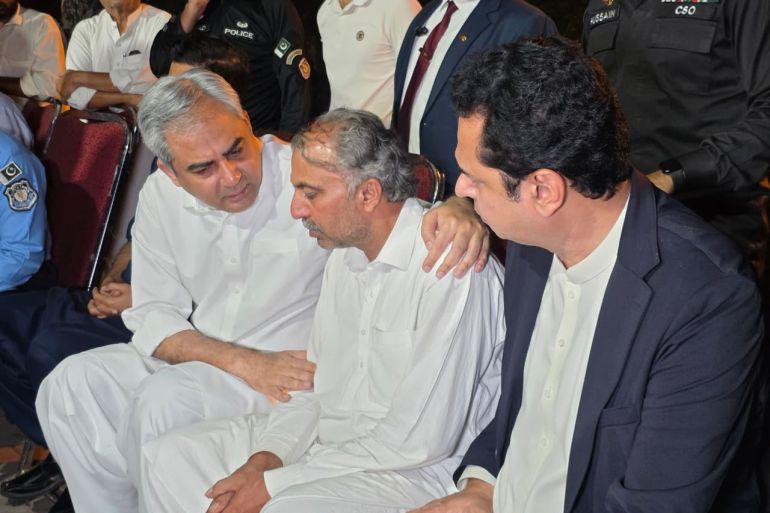
On October 21, Interior Minister Mohsin Naqvi visited the family and handed over more than 5 million rupees ($18,000) that officials said had been recovered from Noman.
But that money means little to Ijaz and his family. What mattered most – his daughter – is gone.

A dream of Harvard
Ijaz studied until the eighth grade and his wife until grade 10, but all four of their daughters went to university.
Two of the sisters studied mathematics while one of Laiba’s elder sisters spent a year in China on a scholarship, learning Mandarin. Laiba, too, studied on scholarships, her father said, and won the gold medal at her university.
“The day she got it, Laiba danced and jumped in front of her sisters,” Ijaz said.
Laiba later taught science at an Islamabad school and gave out-of-school tuition classes to children between grades 2 and 6. IIUI offered her a scholarship to study in Saudi Arabia, but she wanted to pursue higher studies in the US, her father said.
She asked him to pay for her studies abroad.
“’I did all the work myself, and I teach tuitions too, so can’t you do this for me?’” she asked her father, he recalled.
He told her: “My dear daughter, I will.”
“From there, we started preparing,” Ijaz said.
Then they met Noman, and the dream grew. Unknown to the family at the time, it was built on hollow promises and outright lies.

‘The card looked right’
Laiba met Noman this year at a call centre where she worked in Islamabad’s Blue Area, the capital’s main business district. Her hours were late, and most of her colleagues were male. Ijaz was uncomfortable with Laiba’s work environment and encouraged her to leave. She quit the job.
But Noman then began coming to the shop to buy milk and yoghurt. During his visits, Ijaz said, he asked about Laiba’s plans to study in Saudi Arabia.
“No, we will not go to Saudi Arabia. We will go to America,” Ijaz said he told Noman.
Noman claimed to work at the Supreme Court, showed Ijaz a service card and said he needed no licence because he was a government employee.
“The card looked right to me too. I showed it to the people next to me,” Ijaz said.
Noman offered to help Laiba with her application. Ijaz and Laiba decided to accept his offer. “That was our biggest mistake,” the father said.
The family paid in stages, starting with 2.2 million rupees ($7,900) for university fees, Ijaz said. Noman later claimed Harvard needed a statement proving 7.2 million rupees ($25,900) in funds, which he insisted had to pass through his account to be converted into dollars.
“To help my daughter, I sold a plot which I owned. I also sold the [family] jewellery, so I could complete the demanded 7.2 million rupees,” he said.
Documents shared with Al Jazeera appear to trace a real application: Harvard offer and scholarship letters, a US immigration form with an official-looking stamp, a sponsor’s affidavit from a New York relative, an embassy record bearing Laiba’s photograph and a business-class ticket to Boston.
The final file, handed over in late September, also contained a bank statement in Laiba’s name and an October 12 visa interview date, Ijaz said.
In early October, Ijaz said he called Noman to help prepare his daughter for the interview. Noman told him he was in Quetta and would return the next day.
Suspicious of his evasiveness, the family showed the documents to a travel agent and discovered the Boston ticket was fake.
A lawyer neighbour checked the file and told them none of the documents was genuine. They learned the truth about October 6, Ijaz said.
The family was shattered. “I used to tell her, ‘What had to happen has happened,’” Ijaz said.
But Laiba “continued to have hope” that US authorities and Harvard might still process a real application on her behalf, Ijaz said.

The final morning
On October 9 as Ijaz prepared to close his shop for Friday prayers, Laiba told him Noman had sent her a message. He would pray at their area mosque and then come to see the family.
“Laiba, my dear, he will not come. There is no need to listen to his message,” Ijaz recalled telling her. It was one of the last things he said to his daughter.
He told Laiba to stay inside and asked his wife to ensure she did. When he returned, his wife said Laiba had received a message from Noman and left despite her mother’s protestations.
“Upon hearing this, the ground slipped from under my feet,” Ijaz said.
Ijaz sent Laiba’s brother-in-law, Zaid bin Afzal, and one of Laiba’s younger brothers to search for her. One of Laiba’s sisters, meanwhile, guided them by using an app that helped them trace the missing woman’s phone to an area near the house.
They found her body about 3:30pm, less than two hours after Laiba had left home. Zaid called the police emergency number and then rang his father-in-law, asking him to come to the spot urgently. He didn’t want to tell Ijaz about Laiba’s death on the phone, so he told his father-in-law that Laiba was “being stubborn and refusing to come home”.
But Ijaz instantly sensed something was wrong. When he reached the spot, he found his daughter dead.

Students looking abroad
Laiba was among a growing number of Pakistanis hoping to study in the US.
During the 2024-2025 school year, more than 13,000 Pakistani students were enrolled at US institutions, a 75 percent increase from 2017-2018, according to the Institute of International Education’s Open Doors report.
The Federal Investigation Agency (FIA) said Noman was not a registered visa agent. The government also has left a gaping hole in the market for foreign studies: It does not regulate education consultancies, according to the industry body All Pakistan Association of Foreign Education and Immigration Consultants.
“I do not know of a regulatory body that checks or registers education consultants,” Nushmiya Sukhera, cofounder of CollegeWorks, a college consultancy in Lahore, told Al Jazeera.
“No education consultancy can guarantee admission,” she said.

Questions remain
Prime Minister Shehbaz Sharif ordered Noman’s arrest a day after Laiba died. Police and the FIA registered separate cases.
Police said on October 20 that four men on two motorcycles opened fire as Noman was being taken to recover evidence. The men, according to the police, were trying to help Noman escape, but ended up shooting him. Noman, they said, died while being treated for his bullet wounds.
To Ijaz, Noman’s death, however controversial the circumstances, represents a modicum of justice. “In my view, whatever happened was right,” the father said, of the agent’s killing. Authorities are investigating the attack on Noman, but no one has been arrested yet.
Meanwhile, a senior police official, speaking to Al Jazeera on condition of anonymity, said investigations into Laiba’s death were ongoing.
Initial postmortem findings pointed to suicide, the official said, adding that footage showed Laiba leaving home on her own with a phone in her hand.
The remaining forensic report usually takes 15 to 20 days, the official said.
But Ijaz and his family refuse to accept that Laiba died by suicide.
Zaid said after discovering Laiba that “she could not have done this herself”.
Ijaz was more blunt.
“She did not die herself,” he said. “He [Noman] killed her.”