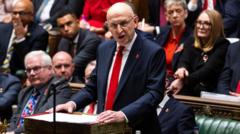
Healey also used his speech to announce plans to allow regional mayors to keep 20% of business rates and a share of income tax to spend on local priorities.
The aim was to allow mayors to retain 100% of business rates raised in their areas by the end of the decade, he added, in “the most radical act of devolution in a generation”.
And he sought to address opposition claims the Labour government is unwilling to cut benefits, insisting that both he and Burnham were committed to bringing down the welfare bill in a “Labour way”.
But he said no decisions would be taken until reviews by Alan Milburn, into young people not in work or training, and Stephen Timms, on Personal Independence Payments, had been published, with legislation to follow next year.
The £4.7bn black hole in the defence investment plan will be funded, the chancellor revealed, in part through taking money from capital budgets across Whitehall.
Healey said he will set out how the government plans to meet its commitment to spend 3% of the national income on defence by 2030, and 3.5% by 2035, at next year’s spending review.
But Badenoch said he “should have set out a plan for 3% today,” highlighting his claim when he resigned as Sir Keir Starmer’s defence secretary in June that UK forces were at risk due to a lack of cash.
“So now he is the man who is increasing risk to personnel on operations, he is the man who is making our country less safe, he has failed his own test,” the Conservative leader said.
“This is on him and no-one will ever forget. If he had any decency he would resign again today.”
The Tory leader said that with the UK heading for a record tax burden and “spending more on debt interest than on the army and schools combined”, Healey’s Budget was “not good enough, not strong enough, not bold enough”.