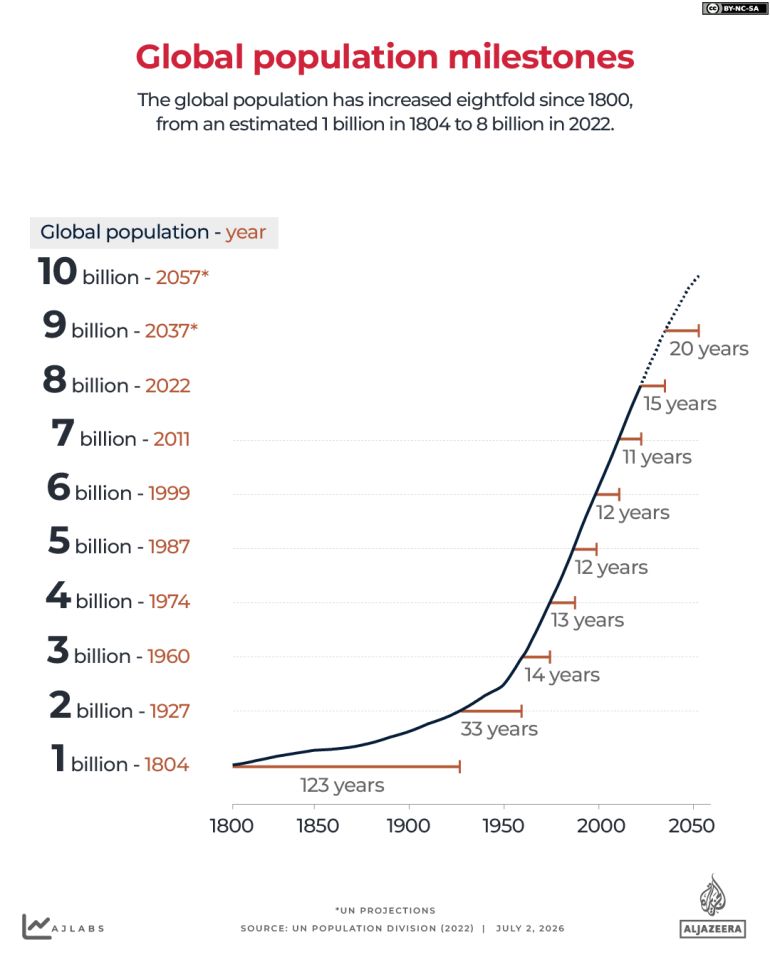
The world’s population has quadrupled over the past 100 years, from 2 billion in 1927 to more than 8 billion today. This growth can largely be attributed to the development of modern medicine and the industrialisation of agriculture, which boosted global food supplies.
While the global population continues to reach new highs, demographic experts have pointed out that the annual growth rate has consistently declined to below 1 percent.
According to estimates by the United Nations Population Division, the world will reach some 9.7 billion people by 2050 before growth stalls and, later this century, begins to reverse. The United Nations expects the global population to peak at about 10.3 billion in the mid-2080s.

Where will most people live by 2050?
Where those people live is shifting too. On the latest United Nations projections, the 10 most populous countries in 2050 will be India, China, Nigeria, the United States, Pakistan, Indonesia, Brazil, the Democratic Republic of the Congo, Ethiopia and Bangladesh. India will remain far ahead, with about 1.7 billion people, while China will have fallen to around 1.3 billion and continue to shrink.
The animation below shows how the world’s population tripled from 2.5 billion people in 1950 to 8 billion in 2022.