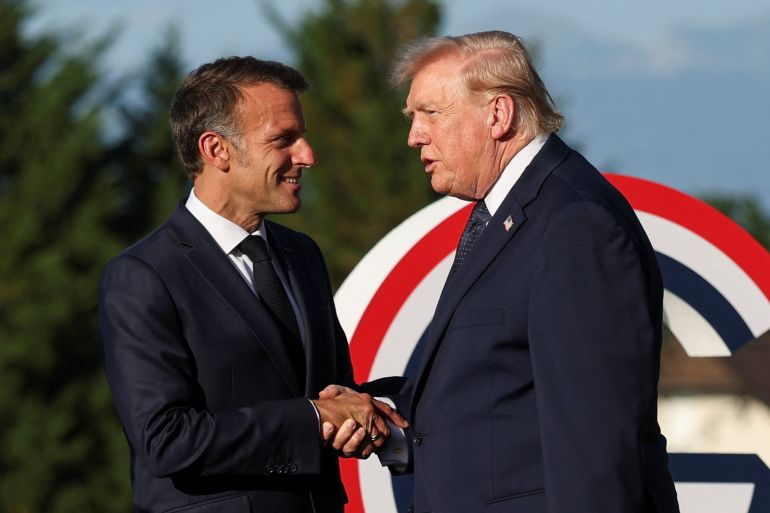
G7 leaders meet in France with Iran and Ukraine high on agenda
French President Emmanuel Macron said Tuesday’s lunch summit would focus on reopening the Strait of Hormuz.
Save


Published On 16 Jun 202616 Jun 2026
Leaders of the G7 are expected to focus on the United States deal with Iran and the Russian war on Ukraine at their meeting in France, with US President Donald Trump likely to be urged to quickly finalise the agreement to end the conflict in the Middle East.
French President Emmanuel Macron, who is hosting the summit in Evian-les-Bains near the Swiss border, said the priority was to ensure that there is a “solid, serious agreement that is finalised”.
Recommended Stories
list of 3 itemsend of list
He said Tuesday’s working lunch would focus on reopening the Strait of Hormuz, including a possible Franco-British-led maritime mission, and on identifying alternative energy routes that bypass the waterway.
Trump has said the Strait of Hormuz would be “completely open” on Friday, which is when a formal agreement will be signed in Geneva.
The agreement, which was digitally signed on Monday, is expected to open a 60-day window to allow for complex negotiations to take place, which would include Iran’s highly enriched uranium and the lifting of sanctions.
The G7 comprises the US, France, the United Kingdom, Canada, Germany, Italy, Japan and the European Union.
Leaders from the United Arab Emirates, Qatar and Egypt will also attend Tuesday’s talks but are not expected to engage in detailed discussions on Iran’s nuclear programme, diplomats told the Reuters news agency.
Trump arrived in France on Monday evening, buoyed after Washington and Tehran agreed on a preliminary deal to end the wider conflict, with a formal signing targeted for Friday.
Advertisement
“The Iran deal will bring a lot of success,” Trump said shortly after he arrived in Evian-les-Bains.
Before the G7 meeting, the leaders of France, Germany, Italy and the UK issued a joint statement congratulating the US, the Iranian government and the mediators on what they called a “diplomatic breakthrough”. Canada also signed the statement. The leaders said it was vital for detailed negotiations to take place and for the deal to be quickly implemented so the Strait of Hormuz could be reopened to tanker traffic.
Macron later said France and other Western partners are “ready to take action very quickly” to help reopen the strait peacefully. France and the UK have championed a mission to restore maritime security in the strait as soon as conditions allow.
‘Building peace in Ukraine’
European leaders have signalled that the summit would also be used to convince Trump that past US proposals to end the Russia-Ukraine war have been too favourable to Moscow.
Ukrainian President Volodymyr Zelenskyy will take part in the first session on Tuesday, which is focused on “building peace in Ukraine”, and might speak to Trump separately.
On Monday, Zelenskyy offered to meet with Russian President Vladimir Putin at the G7 summit. But earlier this month, the Ukrainian leader made a similar offer in an open letter, which Putin rejected, saying he saw “no point” in meeting unless a deal was ready.
European Commission President Ursula von der Leyen told reporters in Evian on Tuesday that Ukraine was “holding the front line and even partially regaining territory”.
“Ukraine has developed the capability to strike strategic targets deep inside Russia. And Ukraine has become a world-leading producer of cutting-edge military equipment,” von der Leyen said.
“On the other hand, Russia is feeling the strain and pressure of sanctions … Putin’s war economy has never been as weak.”
Talks between Russia and Ukraine have stalled as the two sides have continued to trade intensified attacks.
European nations want to signal that they are willing to engage in talks with Putin while tightening sanctions on Russia and boosting military support for Ukraine, emphasising that it is Moscow, not Kyiv, that is blocking progress, diplomats say.
Trump said he had good conversations on Sunday with both Zelenskyy and Putin and thought both of them were “open to do something about the war”.