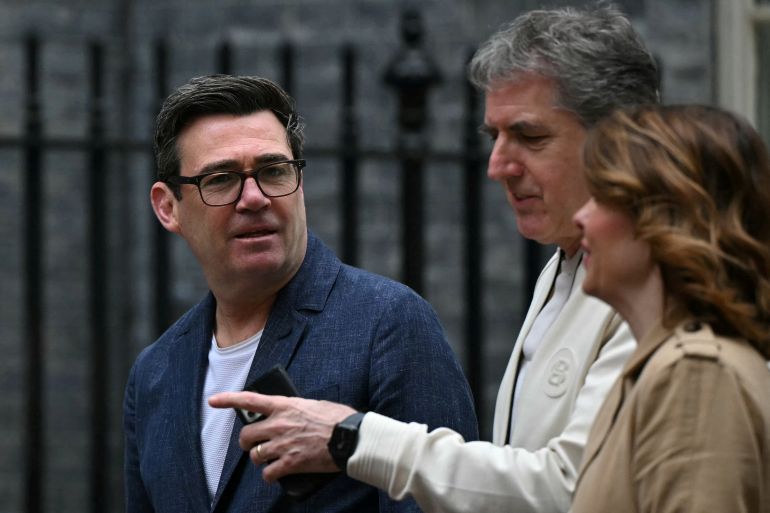
‘King of the North’: Who is Andy Burnham, a potential UK prime minister?
With Keir Starmer under fire, it is Manchester’s mayor who looks to be the key challenger.
Save

 By Simon Speakman CordallPublished On 19 May 202619 May 2026
With UK Prime Minister Keir Starmer under pressure from within his own party to announce his resignation, Manchester Mayor Andy Burnham has announced an ambitious plan of his own – to win a parliamentary seat in the northern English town Ashton-in-Makerfield.
According to his supporters, he is the best candidate to replace Starmer by the time of the Labour Party’s next annual conference in September.
Recommended Stories
list of 4 itemsend of list
Many in the party are hungry for a change following a series of missteps, culminating in a disastrous showing in local elections in early May.
Despite winning an overwhelming majority in the 2024 general election, Labour languishes in the polls, often coming second to the right-wing Reform party.
According to Ipsos, Starmer is the most unpopular prime minister since it began polling began in the late 1970s.
Burnham is one of the party’s most popular politicians, dubbed the “King of the North” in the press and a soft left contender from outside of the London political elite. According to The Times, Burnham’s rivals for the top job, including the incumbent, Keir Starmer, are reportedly being asked to stand aside should the 56-year-old mayor win a by-election.
However, just how far outside the establishment is Burnham, what is his background, and what might his possible leadership mean for domestic and global politics?
The inside man who succeeded in the outside
Analysts say Burnham has appeal because of his apparent distance from the “Westminster bubble.” That perception was consolidated in February when, in a move seen by many as protecting a vulnerable Starmer, Labour’s ruling Labour’s National Executive Committee (NEC) prevented Burnham from standing in the Manchester Gorton and Denton by-election, which was eventually won by the Green Party.
Burnham, whose speech is peppered with northern colloquialisms, leans into his outsider status. But he has also served as a prominent member of Labour’s front bench, both in power and opposition.
Advertisement
Before winning the Manchester mayoralty in 2017, he served as Chief Secretary to the Treasury and later Secretary of State for Health under Gordon Brown, giving him a front-line role in managing the aftermath of the 2008 financial crisis and NHS reform debates during a period of tightening public spending.
He also twice challenged for the party’s leadership.
Firstly, in 2010, after Gordon Brown resigned following Labour’s general election defeat, he entered the contest only to finish fourth behind winner Ed Miliband. In 2015, after Ed Miliband stepped down, he was a distant second to Jeremy Corbyn.
His disillusionment with mainstream politics began in 2009, when he was culture secretary. At an event marking the anniversary of the Hillsborough Disaster, in which 97 Liverpool fans were crushed to death 20 years earlier, he was heckled, prompting a campaign for an inquiry.
“I realised was that the entire British state had been ignoring an English city crying out for justice for 20 years. It wasn’t just by accident. It was deliberate,” he said in January. “I was thrown into crisis by that invitation because I was in a government that hadn’t done anything for the Liverpool supporters and the city of Liverpool.”
However, while his rupture with the political mainstream looked final, his subsequent role as mayor has won plaudits from locals and observers.
From his victory in 2017 to his re-elections in 2021 and 2024, Burnham has focused on expanding devolved powers for the city region, including greater control over transport, housing and skills funding. His tenure has also been marked by the introduction of bus franchising reforms, the so-called Bee Network, designed to bring services back under public control, alongside initiatives addressing homelessness and rough sleeping.
His high-profile clashes with Westminster during the COVID-19 pandemic, particularly over funding for local restrictions in Greater Manchester, led sections of the press to dub him the “King of the North,” a moniker that first emerged humorously in 2020 but has come to be viewed more seriously as his national profile has grown.
Burnham and the world
Burnham’s conflicts with Labour are not confined to national issues.
In late October 2023, while much of the Labour Party was offering Israel support, Burnham joined with London Mayor Sadiq Khan and Scottish Labour leader Anas Sarwar in calling for a ceasefire in Gaza.
Burnham has criticised Israel’s illegal settlements and Prime Minister Benjamin Netanyahu.
Advertisement
He visited the occupied West Bank with Labour Friends of Palestine in 2012 and told the Palestine Solidarity campaign in July that year that statehood was “not a gift to be given but a right to be recognised”.
However, he also supports Israel. A member of Labour Friends of Israel since 2015, Burnham said during his leadership campaign then that if successful, his first state visit would be to Israel. He also dismissed the campaign to boycott Israel “spiteful”
While a strident critic of the so-called War on Terror, he nevertheless voted in favour of the Iraq war, and twice against an inquiry.
In 2023, he conceded that while there was a case for removing Iraqi leader Saddam Hussein, “I can’t justify the rage, the rhetoric, the haste with which it was done, nor the lack of a plan for the aftermath.
“Because of that, the US-UK action resulted in huge harm to innocent civilians and the sense of injustice recruited some to the terrorists’ cause. If the response to 9/11 was supposed to root out terrorism, it is hard not to conclude it did anything but,” he wrote in the UK’s Independent newspaper.
Burnham also backs the UK’s traditional network of alliances.
He has criticised the UK’s exit from the bloc, using an appearance at last year’s conference to lambast his own party for its failure to “call out” the economic damage Brexit had done. He told a fringe event that he hoped in his lifetime to see the UK rejoin the EU.
He has shown firm support to Nato, threatening to quit Jeremy Corbyn’s cabinet if it decided to leave the alliance if elected.
However, standing between Burnham and 10 Downing Street is an as yet unscheduled by election and the insurgent right wing Reform Party.
Leader Nigel Farage has told reporters the party will “throw absolutely everything” at the Ashton in Makerfield by-election.
So, while Burnham may enjoy the title of King of the North. His coronation remains uncertain.