US military equipment worth billions of dollars destroyed in Iran war
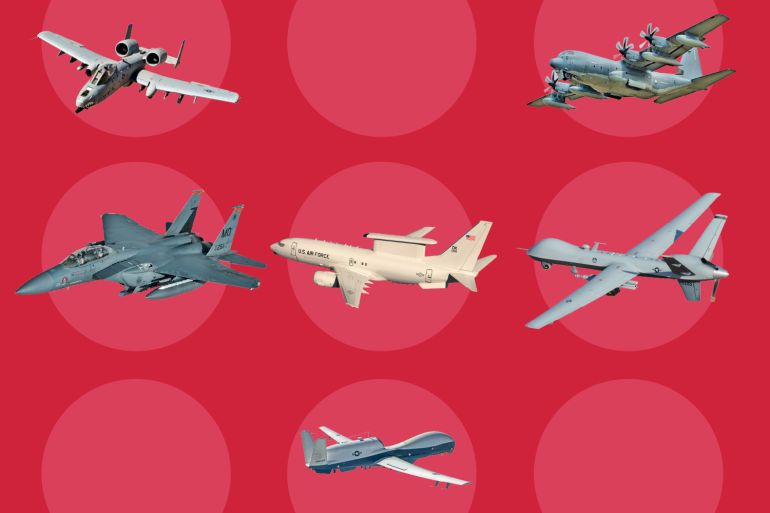
The United States lost aerial equipment worth up to $2.8bn, according to a US-based think tank.
Save

Published On 30 Apr 202630 Apr 2026
Speaking at a televised Cabinet meeting on March 26, the US secretary of defense boasted of US military successes against Iran in the ongoing war. “Never in recorded history has a nation’s military been so quickly and so effectively neutralised,” he said, seated next to US President Donald Trump.
The very next day, Iran fired missiles and drones that struck a US base in Saudi Arabia, wounding several US soldiers and destroying a radar surveillance plane that cost $700m.
It was no one-off hit. Iran’s missiles and drones, and one devastating instance of so-called friendly fire, have destroyed US military equipment worth between $2.3bn and $2.8bn, the Washington, DC-based Center for Strategic and International Studies has calculated.
The CSIS estimate is the first detailed tabulation by a major international research group of US military losses in the war that began on February 28, and Al Jazeera is the first to report it.
This estimated costing does not include losses incurred at US bases in the region, or any of the specialised equipment or naval assets.
Mark Cancian, a senior adviser with the Defense and Security Department at CSIS, carried out the calculations. He said that he was also looking at damages to bases used by the US in the Gulf. But that exercise has been more challenging. Planet Labs, a global service provider for satellite imagery, has blocked all satellite images for public and media usage at the request of the US government since February 28. Iranian satellite imagery, however, has been available.
Advertisement
“We can see from the overhead photographs, you know, what, what buildings were struck,” said Cancian, of the bases used by the US. “It’s hard to know what was in the building.”
What were the losses?
Some of the losses were the result of “friendly fire”. Three F-15 jets were shot down in one such incident in Kuwait in early March.
But most of the US aircraft and radar destroyed in the war were targeted by Iran. Two instances, in particular, stand out. On March 1, the US lost at least one powerful missile defence radar that uses the THAAD system to detect missiles and some hypersonic threats, and feeds targeting data to other defence systems. Some reports suggest two radars were destroyed. The total bill: Between $485m and $970m. The location has not been specified. The US armed forces are hosted by several Gulf nations where THAAD systems were implemented.
Read more here about the GCC military capabilities.
And on March 27, the attack on Prince Sultan airbase in eastern Saudi Arabia, fewer than 24 hours after Hegseth’s boast, destroyed the $700m E-3 AWACS/E7 radar detection aircraft. Essentially an airborne command centre, it can detect aircraft and missiles hundreds of kilometres away, and coordinate battles in the sky.

Omar Ashour, professor of security and military studies and founder of the Security Studies Programmes at the Doha Institute for Graduate Studies, said that while the US has disclosed some figures, it cannot afford full transparency for political reasons.
“At this point, I don’t think the Trump administration would want to be looking like losing equipment [and] personnel,” Ashour told Al Jazeera, adding that there might be a “price” to pay “at the [midterm] elections in November“.
The US, he said, had a history of achieving operational victories in conflicts around the world — only to then fail strategically.
“In Vietnam, they did a series of operational victories. In Afghanistan, they did. But then [they suffered] the strategic loss in the end. Because the operational victories did not serve the strategic ends,” he said.
“In this case, the strategic ends are very political,” Ashour added, referring to the proclaimed goals of regime change and denuclearising Iran.
He emphasised that at the moment, the US troops deployed to the region do not constitute even a 10th of the force used to invade Iraq in 2003. It also does not have the number of aircraft carriers used against Iraq.
How did Iran retaliate?
Cancian said that he was surprised at Iran’s decision to strike Gulf nations — and not just the US bases they host.
Advertisement
“I think that was a strategic error on their part. They thought that that would split the Gulf states away from the United States, but it drove them closer to the United States,” he argued.
For the US, he said, the failure to keep the Strait of Hormuz open was a humbling reminder of what can happen when a navy is unprepared. Iran enforced restrictions on the passage of most vessels through the strait early in the war, and on April 13, the US launched its own naval blockade of Iranian ports and ships trying to transit through the waterway.
“It’s surprising because we’ve been thinking about this with the United States military for 45 years,” he said, before referring to his own time in the military. Cancian is a retired colonel from the US Marines, and his military career spanned over three decades. He served in multiple roles in Vietnam, the 1991 Gulf War – Desert Storm, and the Iraq war.
Cancian recalled participating in amphibious planning exercises to capture Qeshm Island, where Iran is believed to hold several of its missiles in an underground facility. “So it’s not that this just popped up unexpectedly.”
But when the US launched the current war, he said, “They didn’t have the forces in place.”
“They do now, but they did not initially. And then, you know, apparently for whatever reason, they don’t have the capability or are not willing to take the risk to open it,” he added.
Ashour said that Iran, too, has suffered severe damage to its military. He says the US-Israeli operation in this case has degraded the country’s conventional military architecture, but was unable to wipe out its missiles, munitions and drones.
“That claim that the [Iranian] navy got obliterated,” he said, was “far from the truth”.
“You can still fight in the sea without a conventional or without the blue water navy,” he said. “They were degraded. But it’s far from defeated, and they’re far from down.”
