Iran’s leaders debate war and peace after Trump ceasefire extension
State television pushes line that Iranians want more war, but others urge reason and moderation.
Save

Published On 22 Apr 202622 Apr 2026
Tehran, Iran – State media and Iran’s military and security leadership say they are prepared for a resumption in the war with the United States and Israel as they continue to signal opposition to any major concessions during negotiations.
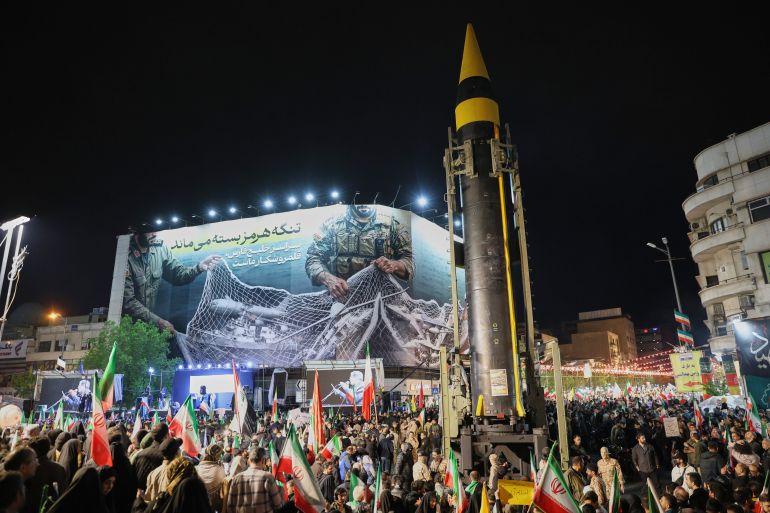
Authorities in Iran organised more displays of defiance on Tuesday night and into Wednesday with military parades on Tehran’s streets, timed to coincide with the slated end of a two-week ceasefire, which US President Donald Trump has now extended for an unspecified period of time after negotiators failed to arrive in Pakistan for talks.
Recommended Stories
list of 3 itemsend of list
In downtown Tehran’s Enghelab (Revolution) Square, a Khorramshahr-4 ballistic missile, one of Iran’s longest-range projectiles, was moved through cheering crowds who had gathered to support Iran’s establishment.
A few kilometres to the north in Vanak Square, masked men holding assault rifles stood atop a truck-mounted launcher for a Ghadr ballistic missile as loudspeakers blasted, “Death to America”.
“Seyyed Majid, the precision striker, plough Tel Aviv” was chanted by some as they addressed Majid Mousavi, the aerospace chief of the Islamic Revolutionary Guard Corps (IRGC) and called on him to order more missile strikes against Israel.
Motorcades led by pick-up trucks broadcasting religious songs also moved through neighbourhoods at night with participants waving flags of armed groups in other countries that are in Iran’s “axis of resistance”, including Lebanon’s Hezbollah.
A clip shared by state media from the gathering in Enghelab Square showed Hossein Taheri, a religious singer, speaking to crowds of supporters while standing next to a wheelchair-bound soldier who had his legs and arms amputated after being hit by bombs while operating a missile launcher.
Advertisement
“What else must [the] US do for it to be considered a ceasefire violation?” Taheri asked angrily, adding that supporters of the state would continue to remain in the streets until they can “exact our revenge” for the wounded soldier and others like him.
State-linked media outlets also released more footage and interviews with armed people, including women, who said they were ready to fight on the streets.
Authorities have circulated images of pink missiles, drones and assault rifles to emphasise that women support the cause of conflict by the state. And in an apparent effort to project unity and diversity among its supporters, many of the women featured in state messaging do not conform to the strict Islamic hijab standards enforced by the establishment.
State television has adopted a hardline approach towards negotiations with the US. Presenters and analysts have advocated for military strength in the face of threats and ultimatums from Trump.
A state television host claimed this week, without offering a source for his claim, that 87 percent of Iranians would rather go back to war than offer any major concessions in talks. This comes after state media repeatedly blamed antiestablishment Iranians inside and outside the country of being “warmongers” after some expressed support for military action against Iran in the hope that it would help overthrow the government.
Another host said Washington needs the war to end but has currently chosen to drag out the negotiations to pressure Iran through its naval blockade of the country’s ports.
The IRGC-affiliated Fars news agency on Wednesday released a video made with artificial intelligence that showed an angry Trump and his team waiting for Iranian negotiators before showing humiliation when the president extended the ceasefire on his own.
‘Say goodbye to oil production’
Iran’s military authorities who are running the war continue to broadcast messages of resilience.
The military’s Khatam al-Anbiya Central Headquarters said the armed forces have their “fingers on the trigger” to respond to any aggression by launching attacks stronger than before while the IRGC said two vessels trying to pass through the Strait of Hormuz were seized after they failed to obtain necessary permits.
The IRGC’s Mousavi also warned Iran’s neighbours that if their territories and facilities are used for more attacks against Iran, “they must say goodbye to oil production in the Middle East region”.
As Iran’s state-imposed, near-total internet shutdown entered its 54th day on Wednesday, the IRGC-linked Tasnim news agency suggested that seabed high-speed internet cables could be targeted next, which would create a “digital catastrophe” for Iran’s Arab neighbours, who heavily rely on such underwater infrastructure.
Advertisement
In New York, Iran’s ambassador to the United Nations, Saeed Iravani, told reporters that another round of negotiations can take place in Islamabad only if Washington lifts the blockade it has imposed on Iran.
Hardline judiciary chief Gholam-Hossein Mohseni-Ejei said on Wednesday, in reaction to the extension of the ceasefire by Trump, that the “enemy is not in a position to set a time for us”.
Trump said his decision to extend the ceasefire was “based on the fact that the Government of Iran is seriously fractured” and could not come up with a unified proposal. He also said “Iran is collapsing financially” and its authorities are unable to pay military and police personnel.
Mohammad Bagher Ghalibaf, Iran’s parliament speaker and head of its delegation to the first round of talks with the US in Pakistan, has echoed the message that the establishment will not “surrender” to Trump. But in a video message addressed to the Iranian people earlier this week, the former IRGC commander turned police chief and Tehran mayor, offered a slightly different tone to the more bombastic messaging from other officials.
“We are not stronger than the US in military power. It is obvious that they have more money, equipment and facilities,” he said while also pointing out Israel’s military capabilities. “No, we did not destroy them, but we are victors in the field in this war.”
Ghalibaf also stressed that Tehran’s main goal must be to “pursue and solidify the rights of the people” rather than chasing absolute victory and framed negotiations as a “method of fighting”.
‘What answer will hardliners have?’
Many members of Iran’s hardliner-dominated parliament oppose any agreement that could signal weakness, disappoint backers of the establishment on the streets and potentially invite future attacks.
Mahdi Mohammadi, Ghalibaf’s strategic affairs adviser, said in a tweet on Wednesday that Tehran must “take the initiative” by giving a “military response” to the naval blockade, perceiving it to be as much an act of war as bombing the country.
President Masoud Pezeshkian, a relative moderate with limited power, has also ruled out capitulating to the US and expressed support for the IRGC but has said he wants the fighting to stop because he believes it benefits no one.
“The solution to the problems lies not in increasing tensions but in reason, dialogue and avoidance of more destruction,” he said this week.
During 40 days of attacks when thousands of munitions were launched by the US and Israel across Iran, oil and gas facilities, steel factories, petrochemical producers, power plants, aluminium manufacturers, railway networks and bridges were struck. Many homes, hospitals, schools and universities were damaged.
Trump has threatened to hit more critical civilian infrastructure to send Iran “back to the Stone Ages” and destroy its “civilisation” if there is no agreement.
Abdolhamid Ismaeelzahi, the Sunni Friday prayer leader in Zahedan, who is an influential political figure in the southeastern province of Sistan and Baluchestan bordering Pakistan, called on Tuesday for a “fair agreement” as the only way to escape what he called a dead end.
Advertisement
“The country’s sky is occupied by the enemy, infrastructure is on the verge of destruction, and the armed forces lack the necessary means for air defence,” he said.
“The hardliners who today stubbornly stand in the way, what answer will they have tomorrow before God and this oppressed nation for the devastation of the homeland?”