US lawmakers Murphy, Casar push legislation to regulate prediction markets
The legislation aims to prevent bets made based on insider knowledge of wars, economic policy and other controllable events.
Save

Published On 17 Mar 202617 Mar 2026
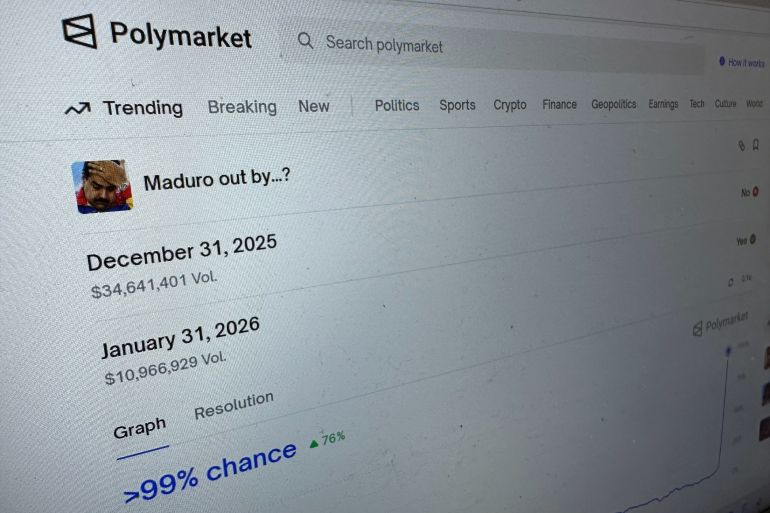
United States Senator Chris Murphy and House Representative Greg Casar are set to introduce legislation to rein in prediction markets after bettors cashed in on geopolitical conflicts, including the joint strikes the US and Israel launched against Iran and the abduction of Venezuelan President Nicolas Maduro.
On Tuesday, the two lawmakers announced their intent to introduce the Banning Event Trading on Sensitive Operations and Federal Functions (BETS OFF) Act, which would prohibit wagers on “government actions, terrorism, war, assassination, and events where an individual knows or controls the outcome”.
Recommended Stories
list of 4 itemsend of list
“Our legislation is pretty simple. It simply says that these markets cannot allow people to make bets on government decision-making and frankly on other instances where there is one single individual who controls and knows the outcome of a market,” Murphy told reporters.
The bill comes amid a slate of legislation to put guardrails on prediction market platforms like Kalshi and Polymarket, which allow users to wager money on the outcomes of real-life events.
Already, bets on the platforms have been placed on US military strikes and monetary policy.
“What happens to us spiritually when every moral question in this country becomes a market? Don’t we lose something? Don’t we rot a little bit inside when the question of famine in Gaza isn’t a question of what is right and what is wrong, but whether you can make money or lose money?” Murphy added.
“I think it’s really important that there are certain matters that are not monetised by prediction markets.”
Making a profit on war?
Critics have pointed to the trends on the online betting platforms that suggest links between upcoming government actions and increases in the number of bets made.
Advertisement
For example, in the hours leading up to the US-Israeli attack on Iran in late February, 150 new accounts appeared on Polymarket and made wagers on the then-looming strikes.
Of those accounts, 109 made more than $10,000, and one made more than half a million dollars, according to Casar and Murphy.
As Al Jazeera previously reported, one Polymarket user, known as Magamyman, made more than $500,000 with a wager that Iran’s supreme leader, Ayatollah Ali Khamenei, would be out of power. That bet was placed only hours before the February 28 strike.
That echoes what happened in the lead-up to the January 3 attack to topple Maduro.
A trader profited from the attack by predicting Maduro’s ousting only hours before US forces abducted him. The payout, in that case, was $400,000.
On Polymarket, in particular, users can wager anonymously, raising questions about whether government officials might be profiting from insider knowledge.
At Tuesday’s news conference, Murphy alleged that the recent bets on the Iran war and the Venezuela attack must have come either from the White House or someone close to the administration.
“It seems pretty clear what happened. People inside the White House — or those close to the White House with knowledge of the attack that was imminent — cashed in,” the Connecticut senator said.
Casar, who represents parts of San Antonio and Austin, Texas, suggested that the prospect of profiting from online bets could even influence government decisions.
“We shouldn’t be living in a country where someone is sitting in the situation room, making decisions on whether to invade or to bomb, decisions about war and peace, life and death — that those decisions could be driven by the fact that they have hundreds of thousands of dollars riding on the decision,” Casar added.
Al Jazeera followed up with Murphy’s office to ask if the lawmakers had proof that the White House or someone close to the White House made the bets, but the office has yet to respond.
The White House, meanwhile, pushed back on allegations that President Donald Trump or his officials were involved in the high-stakes bets.
“The only special interest guiding the Trump Administration’s decision-making is the best interest of the American people,” White House spokesperson Davis Ingle told Al Jazeera in a statement.
The president’s son is actively involved in the prediction markets, however.
In August 2025, Donald Trump Jr joined Polymarket’s board. The venture capital firm 1789 Capital, which lists Trump Jr as a partner, backed Polymarket only a month after the Department of Justice dropped its investigation into the platform.
Advertisement
Trump Jr is also a strategic adviser to Kalshi. He joined in January 2025, only months before the Commodity Futures Trading Commission withdrew an appeal to block a federal court decision allowing Kalshi to offer bets on US elections.
A wave of legislation
Concerns about prediction markets extend far beyond bets on government actions, though.
The legislation Murphy and Casar have proposed would also ban bets on outcomes that can be controlled, including the results of award shows.
“The people who benefit in these markets are always the powerful,” Murphy said. “The people who know who know who is going to perform at the Super Bowl, the people who know what words the president is going to use in a speech are very powerful people.”
Casar added that he is not opposed to gambling in general, but that he and Murphy are simply trying to ensure a level playing field.
“I think we should have the ability for folks to go to a casino and play a poker game or play a game of roulette, but we have rules that say the house cannot rig the poker game,” Casar said.
“When people get on their phone and see these prediction markets, they expect that there are rules to make sure the game isn’t rigged against them.”
Their legislation is part of a slate of bills and regulatory pushes to increase oversight across the entire prediction market industry.
Just this month, Democratic Senator Richard Blumenthal introduced legislation that would establish federal consumer protections for the prediction market industry, including through age verification for usage and a ban on advertisements targeting underage users.
Senators Jeff Merkley and Amy Klobuchar, both Democrats, also put forward legislation that would bar elected officials from profiting from prediction markets.
And lawmakers in Minnesota are pushing to ban prediction markets altogether, as a violation of state gambling laws. Arizona, meanwhile, filed criminal charges against Kalshi on Tuesday, citing similar reasons.
“I hope we take a comprehensive look at the way that prediction markets are rigging our entire economy and government actions,” Murphy said.
Neither Kalshi nor Polymarket, the two largest prediction market platforms, responded to Al Jazeera’s request for comment.