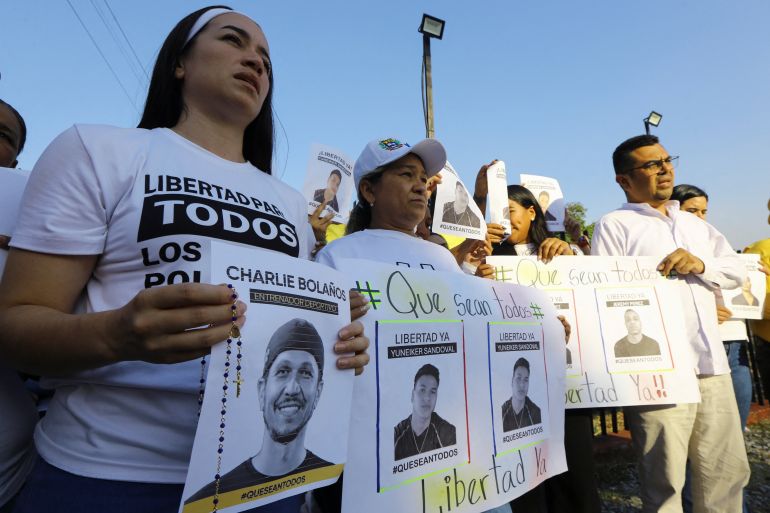
Venezuela grants amnesty that could release hundreds of political detainees
More than 600 people may be in custody for political reasons, one Venezuelan rights group estimates.

Published On 20 Feb 202620 Feb 2026
Save
Venezuela’s acting president has signed into law an amnesty bill that could see hundreds of politicians, activists and lawyers released soon, while tacitly acknowledging what the country has denied for years – that it has political detainees in jail.
The law, signed on Thursday, in effect reverses decades of denials in the government’s latest about-face since the United States military’s January 3 attack in the country’s capital, Caracas, and the abduction of President Nicolas Maduro.
Recommended Stories
list of 3 itemsend of list
Opposition members, activists, human rights defenders, journalists and others who were targeted by the governing party over the past 27 years could benefit from the new law.
But families hoping for the release of relatives say acting President Delcy Rodriguez has failed to deliver on earlier promises to release prisoners. Some of them have been gathered outside detention centres for weeks.
Venezuela-based prisoners’ rights group Foro Penal has tallied 448 releases since January 8 and estimates that more than 600 people are still in custody for political reasons.
The new law provides amnesty for involvement in political protests and “violent actions” which took place during a brief coup in 2002 and during demonstrations or elections in certain months going back to 2004.
It does not detail the exact crimes which would be eligible for amnesty, though a previous draft laid out several, including instigation of illegal activity, resistance to authorities, rebellion and treason.
People convicted of “military rebellion” for involvement in events in 2019 are excluded. The law also does not return assets of those detained, revoke public office bans given for political reasons or cancel sanctions against media outlets.
Opposition divided
“It’s not perfect, but it is undoubtedly a great step forward for the reconciliation of Venezuela,” opposition politician Nora Bracho said during a debate on the bill in the legislature on Thursday.
Advertisement
But the law was criticised by other members of the opposition, including Pedro Urruchurtu, international relations director for opposition leader and Nobel Peace Prize laureate Maria Corina Machado.
“A true amnesty doesn’t require laws, but rather will, something that is lacking in this discussion,” he said on X on Thursday. “It is not only an invalid and illegitimate law, but also a trap to buy time and revictimize those persecuted.”
Since Madura’s abduction, US President Donald Trump has praised Rodriguez, Maduro’s former deputy, while downplaying the prospect of supporting the opposition.
For her part, Rodriguez has overseen several concessions to the US, including freezing oil shipments to Cuba and supporting a law to open the state-controlled oil industry to foreign companies.
The US has said it will control the proceeds from Venezuela’s oil sales until a “representative government” is established.