‘I came back from the dead’: 21 hours underground after DRC mine collapse
In mineral-rich Rubaya, source of most of the world’s coltan, artisanal miners suffer poverty and dangerous working conditions.

Survivor of deadly mine collapse in DR Congo recounts rescue
 By Al Jazeera StaffPublished On 6 Feb 20266 Feb 2026
Save
Goma, Democratic Republic of the Congo – It was the afternoon of Thursday, January 29 in the eastern Congolese city of Goma. More than 24 hours had passed since Grace Barata’s relatives had any word about him.
For days, Barata had been in the town of Rubaya, about 60km (37 miles) northwest of Goma, at a mine where he worked. But the day before, news had reached the family that there was a huge landslide and hundreds of people were dead.
Recommended Stories
list of 3 itemsend of list
Almost sure they would never see him again, Barata’s family began making funeral arrangements.
Then, at about 6pm on Thursday, they were shocked and overjoyed as he was brought through the door of the house, weary and exhausted – but alive.
“We had already begun to mourn our brother,” Munguiko Ntacyumpenze, Barata’s cousin, told Al Jazeera from the family home in Goma.
“We were overwhelmed and found it difficult to accept this situation because we did not expect [that he was alive]. By the grace of God, he has returned from the dead,” he said with a smile.
Barata, 35, who began working on the mines in 2012, was one of the rare survivors.
Rebel authorities in charge of the town say at least 200 people were killed when the coltan mine in the mineral-rich eastern DRC city collapsed last week.
Many victims died of asphyxiation due to a lack of oxygen, while others were crushed by the weight of the earth caving in around them.
Heavy rains, landslides
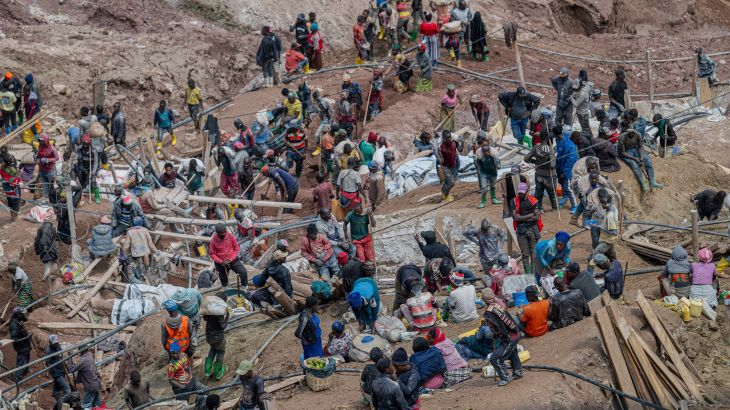
Above the mines of Rubaya are hills that rise steep and green. From the flanks of the mountainside, orange‑brown terraces have been carved out, cutting into the slopes. Mounds of mud and rock sit beside trenches filled with murky water.
Advertisement
On the slopes on any given day, lines of artisanal miners climb and descend, some with sacks of wet earth slung over their shoulders, others swinging pickaxes into the walls of the pit.
Rubaya is a small town that sits on stores of some of the world’s most strategic and valuable minerals – coltan, tin and tungsten, which are essential for use in modern technology such as smartphones and electric cars.
But most people there live simple lives.
Every day, thousands of small-scale miners come to work in the vast open mining pits, digging by hand. While the resources they find are to power expensive modern technology, for most of those doing the mining, life is a daily routine of risk and survival.
Wednesday, January 28, at the Luwowo mining site in Gasasa, on the Rubaya mining perimeter, where the mine collapse happened, was a typical work day.
That overcast morning, hundreds of people – men, mostly miners, and women who are mainly vendors selling food and local drinks – hurried to the mining site, locals told Al Jazeera.
By the afternoon, heavy rains lashed the area, which witnesses said caused a landslide at the mining site.
As a result, the mine collapsed, trapping hundreds of men underground.

‘I found myself in darkness’
Sitting at his family home in Goma after his return, Barata recounts the day of the collapse.
“It started raining around 3pm local time, and we took shelter from the rain in the mine,” the survivor told Al Jazeera, speaking calmly with a distant look in his eyes.
“I heard rocks rubbing together and thought it was pebbles being washed away by the water, and then I found myself in darkness.”
Below ground, some people were crushed in the collapse, while those who were alive felt afraid.
“My biggest concern underground was the lack of oxygen,” Barata said, adding that he managed to calm himself down, and soon “we heard the voices of the crowds who came to our rescue.”
Above ground, local authorities had launched a search and rescue operation to reach those buried under the mine, with locals stepping in to help.
The typically ordered terraces had become a raw slope of fallen earth, as mud covered what used to be clear pathways between them. Where miners once stood and worked, rescuers were gathered, wading into the thick mud, digging with shovels and bare hands, to haul survivors and dead bodies from the slurry.
Around the landslide, the community gathered to watch – many faces tight with grief – as they waited for news of survivors.
Advertisement
After 21 hours underground, rescuers finally pulled Barata from the earth on Thursday at about 1pm.
He feels lucky to have been rescued alive, along with two of his friends, but says that dozens of others who were with him in the mine shaft did not survive.
“There were many of us in the same shaft, which I would describe as a tomb,” said Barata, a bandage covering part of his head.
“We saw the light from afar and knew we would be rescued,” he remembers, but laments that “the others died before our eyes, without saying a word.”

Trading blame
Last year, the antigovernment Alliance Fleuve Congo (AFC) and M23 rebel coalition stormed through eastern DRC, seizing key towns and cities from government control, including North Kivu’s Goma and Rubaya.
The AFC-M23 officials who now control the area reported at least 200 deaths in the Rubaya mine tragedy, but local civil society says the number may rise.
The Congolese authorities in Kinshasa say M23 and Rwanda – who they accuse of backing the rebels – are behind the deadly mine tragedy.
According to government spokesperson Patrick Muyaya, the Rubaya mining area is classified as “red status”, which prohibits all mining and commercialisation of minerals, including artisanal mining. He emphasises that digging activities that continue there are in “flagrant” violation of the law and do not comply with any safety standards.
Kinshasa and regional experts have also accused M23 of smuggling minerals out of the DRC and into Rwanda, to be sold to the international market – an accusation Rwanda rejects.
“It is clear that the more than 200 percent increase in coltan exports by Rwanda is the result of this illegal and uncontrolled exploitation,” claimed Muyaya.
The AFC-M23 coalition rejects these accusations, instead claiming that Kinshasa is attempting to “exploit” an accident caused by torrential rains for “political” purposes.
In a statement on February 1, the group referred to the “irresponsible, politicised and misinformed attitude” of Kinshasa, saying the DRC government is “choosing to manipulate public opinion to mask its appalling record on miner safety”.
It urged Kinshasa to instead conduct an audit of its own governance, particularly in the mining, flood management, and sanitation sectors.
Natural wealth, material poverty
Daniel Kalalizi, an environmental analyst, said the Rubaya collapse is a human tragedy as well as a revealing environmental disaster. Such landslides are also the result of unregulated and illegal mining, he added, because that activity weakens the soil, destroys vegetation cover, and disregards basic safety standards.
“The responsibility lies with the Congolese state, which is responsible for regulating the mining sector, enforcing environmental laws, and protecting citizens,” he said.
“The lack of effective control of mining sites contributes directly to this type of tragedy,” he added, calling on miners to focus on safety over profits and saying mineral supply chains must prioritise sustainability in their sourcing.
Advertisement
Mines in Rubaya produce between 15 and 30 percent of the world’s coltan and are believed to account for over 60 percent of global coltan reserves.
However, despite the region’s immense natural wealth, observers say the local population still languishes in undignified living conditions, working in extreme and unsafe circumstances just to make a living.
Barata, who is now recovering in Goma from the trauma of what he endured, says that because of economic concerns, he has no choice but to return to the mines for work.
But in the meantime, he tries to focus on the fond memories of the miners who were with him underground.
Although several people he knew died that day, he remembers the last good hours he spent underground with a man named Bosco, a father of two, whose funeral took place on Friday, January 30, in Goma.
Barata says on the evening before the collapse, the two shared their meals, towels and even sleeping space. When the collapse happened, they talked about whether they would make it out alive.
“Before the oxygen ran out in the shaft, we told each other to repent so that we would not miss what we had come for or the kingdom of heaven,” Barata remembers.
Bosco didn’t make it, he says, but “I came back from the dead.”