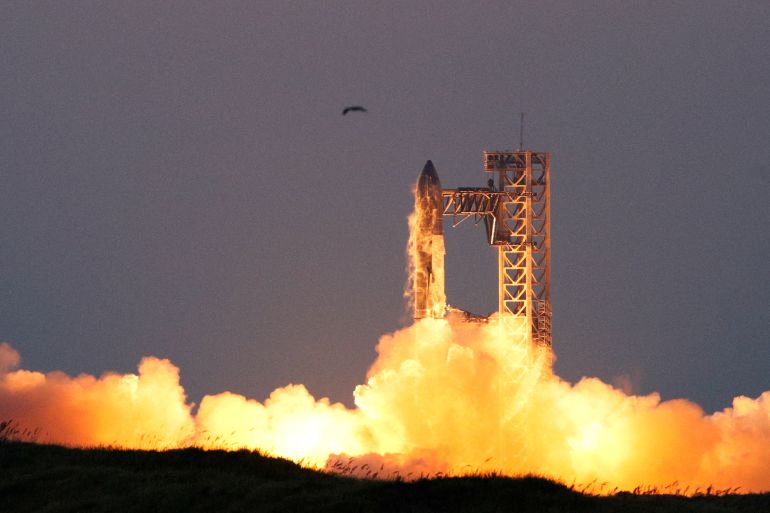
Musk merges SpaceX and xAI firms, plans for space-based AI data centres
Musk says solar powered and space-based data centres are the only way to meet AI’s burgeoning energy demands.


Published On 3 Feb 20263 Feb 2026
Save
Elon Musk’s SpaceX has acquired his AI company xAI as part of an ambitious scheme to build space-based data centres to power the future of artificial intelligence.
The billionaire, who is also the CEO of Tesla, announced the merger in a statement on Tuesday on the SpaceX website.
Recommended Stories
list of 4 itemsend of list
Musk said the merger will help to address the emerging question of how to meet the power-hungry demands of artificial intelligence.
AI demand will require “immense amounts of power and cooling” that are not sustainable on Earth without “imposing hardship on communities and the environment,” he said.
Space-based data centres that harness the power of the Sun are the only long-term solution, according to Musk.
“In the long term, space-based AI is obviously the only way to scale. To harness even a millionth of our Sun’s energy would require over a million times more energy than our civilisation currently uses!” he wrote.
“The only logical solution therefore is to transport these resource-intensive efforts to a location with vast power and space,” he continued, predicting that within the next “2 to 3 years, the lowest cost way to generate AI compute will be in space”.
The merger of SpaceX and xAI will bring several of Musk’s space, artificial intelligence, internet, and social media projects under one roof.
SpaceX operates the Falcon and Starship rocket programmes, while xAI is best known for developing the AI-powered Grok chatbot. Last year, xAI also acquired X, the social media platform known as Twitter, until it was bought by Musk in late 2022.
Advertisement
Both companies have major contracts with US government agencies such as NASA and the Department of Defense .
SpaceX’s Starshield unit specifically collaborates with government entities, including military and intelligence agencies.
Musk is not the only tech CEO looking to space as a solution to AI’s energy quandary.
Jeff Bezos’s Blue Origin and Google’s Project Suncatcher are both working on solar-powered space-based data centres.
“In the history of spaceflight, there has never been a vehicle capable of launching the megatons of mass that space-based data centres or permanent bases on the Moon and cities on Mars require,” Musk wrote.
Musk also said his long-term plan for SpaceX is to launch a million satellites.
To achieve this aim, SpaceX’s Starship rocket programme aims to one day launch one flight per hour with a 200-tonne payload, he said.
Musk said Starlink, a subsidiary of SpaceX that offers satellite-based internet service, will soon get a major boost with the launch of SpaceX’s next generation of V3 satellites.
They will each add “more than 20 times the capacity to the constellation as the current Falcon launches of the V2 Starlink satellites”, he wrote.