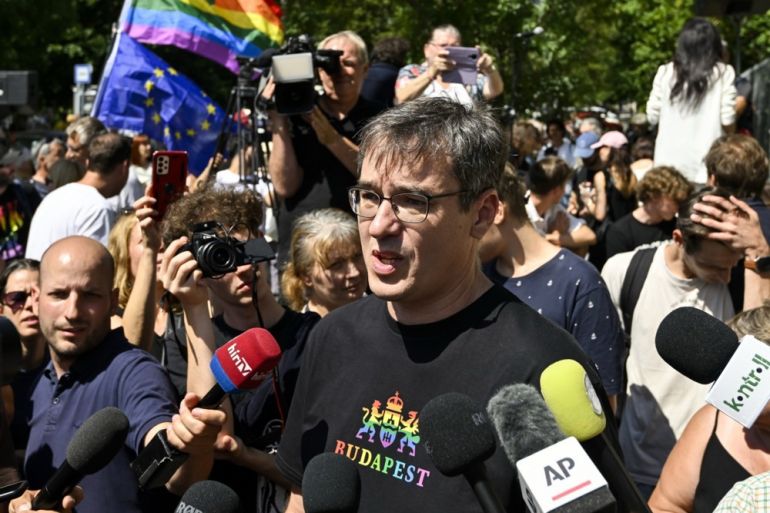
Hungary charges Budapest mayor for allowing banned pride march
Prosecutors seek fine against Mayor Gergely Karacsony ‘without a trial’.


Published On 28 Jan 202628 Jan 2026
Save
Hungarian prosecutors have charged Budapest Mayor Gergely Karacsony over his role in arranging last year’s gay pride march in the capital city, which attracted hundreds of thousands of people despite a ban.
Prosecutors have “filed charges and seek a fine against the mayor of Budapest, who organised and led a public gathering despite a police ban”, their office said in a statement announcing the case on Wednesday.
Recommended Stories
list of 3 itemsend of list
“The district prosecutor’s office proposed that the court impose a fine on the defendant in a summary judgement without a trial,” the statement added without including the amount of the fine sought against Karacsony.
Since returning to power in 2010, Prime Minister Viktor Orban has been tightening his grip over the country and has targeted groups advocating for human rights.
Orban’s conservative government has also pushed for legislation promoting traditional family values and steadily rolled back LGBTQ rights.
In 2025, his Fidesz party amended laws and the constitution to ban the annual pride march, drawing protests from critics and the European Union.
‘Proud defendant’
After the ban was imposed last year, Budapest City Hall stepped in to co-organise the annual event to try to sidestep the regulations, but police still issued their objections, and Orban warned organisers and attendees of “legal consequences”.
On Wednesday, Karacsony reacted to the charges by saying he went from a “proud suspect to a proud defendant”.
“They don’t even want a trial … because they can’t even comprehend that here in this city, we have stood up for freedom in the face of a selfish, petty, and despicable power,” he said on Facebook.
In a post on X, Ciaran Cuffe, cochairman of the EU’s European Greens party, called the charges “outrageous”.
Advertisement
In a separate post, the European Greens said the party stands with Karacsony, who is a member of Dialogue, the Greens’ party affiliate in Hungary.
Despite the ban on the march, it became “the biggest freedom march in decades”, proving that “love can’t be banned”, the party added.
Facing a year in prison
Karacsony could face up to one year in prison for organising and urging participation in a banned rally.
Participants could also face fines of up to 500 euros (nearly $600) for attending Budapest Pride although police announced in July they would not take action against the marchers.
Organisers of the June march estimated that up to 200,000 people took part in the 30th annual Budapest Pride.
The rally began at Budapest City Hall and wound through the city centre before crossing the Erzsebet Bridge over the Danube River.
The crowds waved rainbow flags and carried signs mocking Orban.
