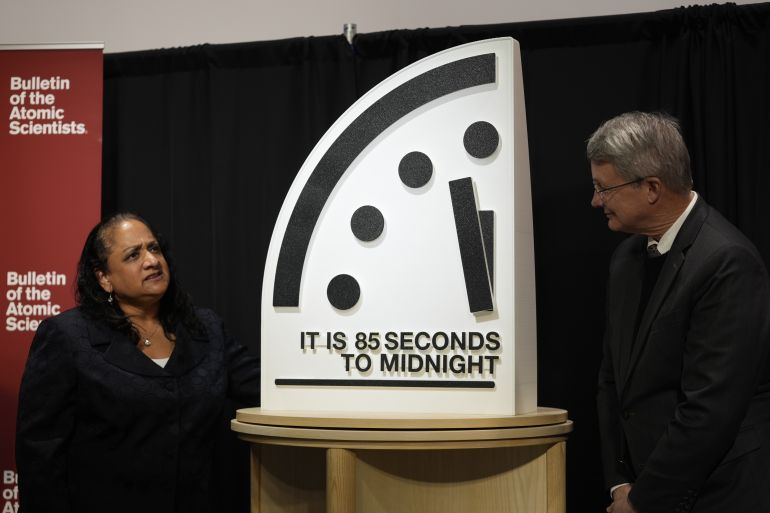
Symbolic Doomsday Clock moves closer to midnight amid ‘catastrophic risks’
Atomic scientists say the public must demand swift action from leaders to reverse course on nuclear weapons and climate threats.

Published On 28 Jan 202628 Jan 2026
Save
The world is closer than ever to destruction, scientists have said, as the Doomsday Clock was set at 85 seconds to midnight for 2026, the gloomiest assessment of humanity’s prospects since the beginning of the tradition in 1947.
The Bulletin of the Atomic Scientists, a not-for-profit organisation founded by Albert Einstein and other scientists, warned in its annual assessment on Tuesday that international cooperation is going backwards on nuclear weapons, climate change and biotechnology, while artificial intelligence poses new threats.

“The Doomsday Clock’s message cannot be clearer. Catastrophic risks are on the rise, cooperation is on the decline, and we are running out of time,” said Alexandra Bell, the president and CEO of the Bulletin of the Atomic Scientists.
Recommended Stories
list of 4 itemsend of list
“Change is both necessary and possible, but the global community must demand swift action from their leaders,” Bell said.
In a more detailed statement explaining the reasoning for moving the clock closer to midnight, the bulletin expressed concerns that countries including Russia, China, and the United States were becoming “increasingly aggressive, adversarial, and nationalistic”.
It said that “hard-won global understandings are collapsing”, while a “winner-takes-all great power competition” is emerging in its place.
The assessment cited conflicts in 2025, including Russia’s war on Ukraine, clashes between India and Pakistan that erupted in May, and the US and Israel’s attacks on Iran in June.
On the climate emergency, the bulletin said that national and international responses have ranged from “wholly insufficient to profoundly destructive”.
“None of the three most recent UN climate summits emphasised phasing out fossil fuels or monitoring carbon dioxide emissions,” it said, adding that US President Donald Trump has “essentially declared war on renewable energy and sensible climate policies, relentlessly gutting national efforts to combat climate change”.
Advertisement
At the same time, the Bulletin noted that renewable energy, especially wind and solar, saw record growth in both capacity and generation in 2024, and that “renewable and nuclear energy together surpassed 40 percent of global electricity generation for the first time”.
From Cold War to climate change
The clock is used to symbolise how close humans are to extinction. Since beginning the Doomsday countdown in 1947, the bulletin has varied its assessments between as far as 17 minutes from midnight up to this year’s assessment of 85 seconds.
The lowest ever risk was recorded in 1991, the year the Cold War officially ended and the United States and Russia began making significant cuts to their nuclear arsenals.
Just seven years earlier, in 1984, the clock had been at three minutes to midnight, one of its lowest points for the period, as it said dialogue between the Soviet Union and the US had virtually stopped.
In more recent times, the clock has ticked closer to midnight, as the Bulletin has increasingly assessed the lack of action on climate change as a significant threat alongside nuclear war and other global issues.
Speaking at a ceremony revealing the new assessment on Tuesday, Daniel Holz, professor of physics, astronomy & astrophysics at the University of Chicago and chair of the Bulletin of the Atomic Scientists, said that the rise of nationalistic autocracies was adding to a range of threats.
“Our greatest challenges require international trust and cooperation, and a world splintering into ‘us versus them’ will leave all of humanity more vulnerable,” Holz said.