Trump’s ‘Board of Peace’ puts rights abusers in charge of global order
By sidelining the UN and human rights, the US president is proposing a club of impunity, not peace.


UN director at Human Rights Watch.
Published On 27 Jan 202627 Jan 2026
Save
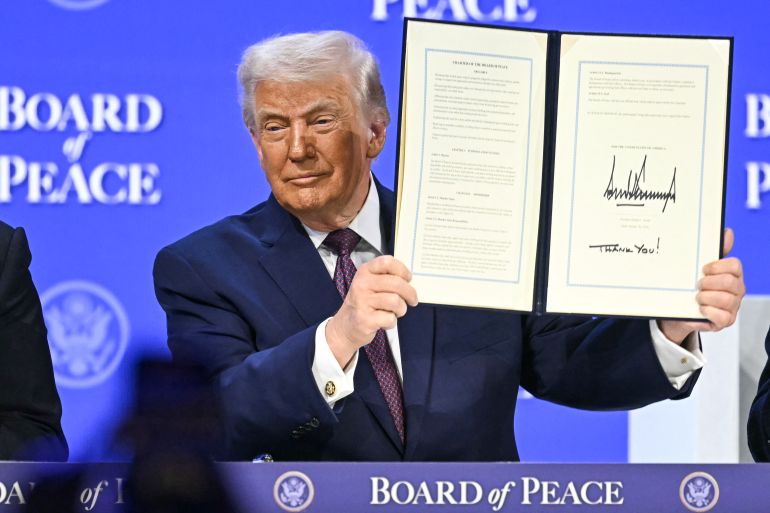
Since taking office a year ago, the Trump administration has been working hard to undermine the United Nations, especially the UN’s efforts to uphold universal human rights. Now US President Donald Trump wants to create a new organisation, a “Board of Peace” with himself as lifetime chairman. While many countries were invited, those signing up appear to be a rogues’ gallery of leaders and governments with human rights records ranging from questionable to appalling.
The United States played a central role in establishing the UN in 1945 to prevent a repeat of the crimes against humanity and genocide during World War II. Ever wary of perceived threats to its autonomy, the US has always had a love-hate relationship with the UN. But the Trump administration has emphasised the hate and dispensed with the love, denouncing what it perceives as “anti-American” and “hostile agendas.”
The administration has disregarded and defunded dozens of lifesaving UN programs. It has also withheld much of the assessed contributions, which member states are obligated to pay. The administration has pulled out of the UN World Health Organization, UN climate bodies, and international climate agreements, and stopped funding the UN population fund, which supports and protects women and girls in armed conflicts and crisis zones.
US negotiators have pushed Trump’s ideological agenda in UN negotiations, demanding the removal of selected human rights language from resolutions and statements. According to UN diplomats, targeted language includes words like “gender,” “diversity” and “climate” because the Trump administration views them as “woke” or politically correct. While the administration has had some success with its ideological campaign in the UN Security Council thanks to its veto power, it has been less successful in the General Assembly, where the US is just one of 193 voting members and has no veto.
Advertisement
But it is the Security Council that the administration appears determined to recreate in a Trumpian form. The Board of Peace’s proposed charter describes it as “an international organization that seeks to promote stability, restore dependable and lawful governance, and secure enduring peace in areas affected or threatened by conflict.”
The charter doesn’t mention human rights, which is doubtless music to the ears of the Russian and Chinese governments, which have worked for years to de-emphasize human rights at the UN.
Trump’s board appears to be a kind of pay-to-play, global club, judging from the $1 billion fee for permanent membership. With several notorious human rights abusers and leaders implicated in war crimes – and few countervailing voices – it is hard to imagine this body giving priority to ending suffering, hatred and bloodshed, as Trump declared at the launch event on the sidelines of the World Economic Forum. Among those Trump has invited to join are two who are subject to International Criminal Court (ICC) arrest warrants for war crimes and crimes against humanity – Russian President Vladimir Putin and Israeli Prime Minister Benjamin Netanyahu. Trump has invited leaders of other countries with appalling human rights records to join his board: From China and Belarus to Kazakhstan.
The charter makes clear that Trump as board chairman would have supreme authority “to adopt resolutions or other directives” as he sees fit.
So far, the only European Union members that agreed to join are Hungary and Bulgaria. Hungary’s far-right populist Prime Minister Viktor Orban has long been a Trump supporter. French President Emmanuel Macron is among those who turned down an offer to join – Trump responded with a threat to significantly increase tariffs on French wine and champagne.
Trump also offered Canada a permanent seat on the board. But he withdrew the offer after Prime Minister Mark Carney’s speech in Davos. Without naming Trump or the US, Carney said the UN and other multilateral organisations are under threat, and sharply criticised great powers’ use of economic coercion against smaller countries. Carney urged middle powers to band together and resist great power bullying.
Originally the Board of Peace was meant to oversee the administration of Gaza following over two years of onslaught and destruction by Israeli forces that left at least 70,000 Palestinians dead, with which the US was complicit. The board’s charter doesn’t mention Gaza. But Gaza was the focus of a side event at Davos led by Trump’s son-in-law Jared Kushner. Kushner will be a member of the “Gaza Executive Board,” a subsidiary body of the Board of Peace.
Advertisement
Kushner offered a surreal vision of a “New Gaza” complete with glistening office towers and pristine beaches packed with tourists. The Gaza Executive Board includes no Palestinians but has former UK Prime Minister Tony Blair, the Trump negotiator Steve Witkoff, and senior officials from Türkiye and Qatar.
Instead of handing Trump $1 billion checks, governments should work together to protect the UN and other institutions established to uphold international human rights and humanitarian law, the global rule of law, and accountability. They should use all available resources to counter unjust US actions like Trump’s sanctions on ICC judges and prosecutors, a UN special rapporteur, and prominent Palestinian human rights groups. They should press for accountability for grave international crimes by all warring parties, whether in Gaza, Sudan, Ukraine, Myanmar, or elsewhere.
Anything less would hand Trump a dangerous victory and allow him and his board to sideline the UN and other vital international organizations. The UN has its problems, including when it comes to upholding human rights. But it’s worth strengthening, not replacing with a club of rights abusers and alleged war criminals.
The views expressed in this article are the author’s own and do not necessarily reflect Al Jazeera’s editorial stance.