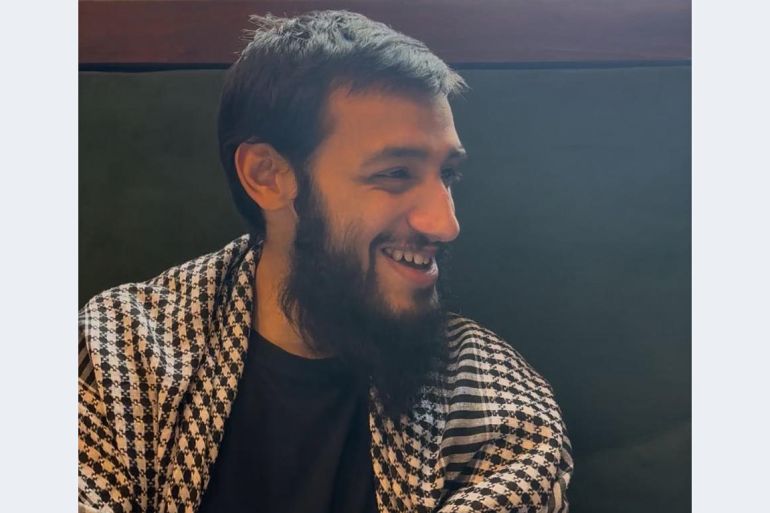
Gravely ill pro-Palestine activist ends hunger, thirst strike in UK prison
Palestine Action-linked prisoner Umer Khalid had refused liquids in protest against his conditions and the UK’s alleged complicity in genocide.

Published On 27 Jan 202627 Jan 2026
Save
Umer Khalid, a 22-year-old British pro-Palestine activist, has ended a hunger and thirst strike in prison after his health deteriorated rapidly, with fears he was at high risk of a heart attack.
Khalid, who is being held on pre-trial remand at the Wormwood Scrubs Prison in London, ended his protest on Sunday, the day he was treated in intensive care as his heart rate slowed to a dangerous level. He has since returned to prison, his family understands. Khalid had begun to refuse fluids late on Friday in an escalation of his hunger strike.
Recommended Stories
list of 4 itemsend of list
Doctors had warned that Khalid, who suffers from limb-girdle muscular dystrophy, a condition that causes muscle weakness and wasting, was likely to die suddenly by refusing fluids with electrolytes, sugars and salts.
His hunger strike lasted 16 days and its conclusion brings an end to a rolling hunger strike that began in November.
Khalid is among eight remand prisoners affiliated with Palestine Action who participated in the action, which is said to have been the largest coordinated hunger strike in UK history since 1981, when Irish Republican inmates were led by Bobby Sands. Khalid was the last to keep refusing food after the others ended their protest earlier this month, one of whom had refused food for 73 days.
Saeed Taji Farouky, a filmmaker associated with the Prisoners for Palestine group, which is supporting the collective, announced the end of Khalid’s strike on Tuesday.
“It is a great relief that Umer is off his hunger strike,” he said. “There are, of course, long-term complications. He has experienced organ failure.”
Advertisement
Physicians consulting the collective are concerned that they may have already suffered irreversible health damage, as long-term symptoms related to starvation can take years to show. There are also fears around refeeding, which can be fatal if mismanaged.
James Smith, an emergency doctor, said he was worried because Khalid was discharged from the critical care unit “rather promptly”.
“The heightened period of risk … is the moment you end a hunger strike,” said Smith. “Access to medical care in the prison system has been demonstrated to be substandard.”
‘We were fearful for Umer’s health and life’
Khalid is among five activists accused of breaking into the United Kingdom’s largest airbase, RAF Brize Norton, in Oxfordshire, in June and spray-painting two Voyager refuelling and transport planes. They deny the charges against them.
The incident, which was claimed by Palestine Action, caused millions of pounds worth of damage, according to the British government, which later proscribed the protest group as a “terrorist” organisation.
Khalid had called for immediate bail; an end to alleged censorship in prison, with the authorities accused of withholding mails, calls and books and denying visitation rights; an inquiry into alleged involvement of the UK in Israeli military operations in Gaza; and the release of surveillance footage from Royal Air Force (RAF) spy flights that flew over Gaza on April 1, 2024, when British aid workers were killed in an Israeli attack.
A Prison Service spokesperson told Al Jazeera, “We do not recognise these claims. All prisoners are subject to the same national rules on post and communications, and legal visits and access to legal paperwork are never withheld from prisoners.”
John McDonnell, a Labour MP, said the end of Khalid’s strike brought a sense of relief.
“We were fearful for Umer’s health and life,” he said. “It demonstrated to me the absolute courage that he’s displayed along with others, based upon a commitment to the principles that he’s advocated in terms of peace and justice to the Palestinian people.
“I pay tribute to them, but I fear for their ongoing health – being on hunger strike for this long can have permanent features.”
Police response a ‘deliberate show of force’
In recent days, dozens of demonstrators have gathered at the gates of Wormwood Scrubs, calling on the government to engage with Khalid’s demands.
On Saturday, police arrested 86 protesters, saying they allegedly blocked prison staff from entering and leaving the facility. Some “managed to get inside a staff entrance area of a prison building”, the police said.
Advertisement
In footage of the demonstration, police officers can be seen forcefully pushing protesters to the ground.
Naila Ahmed, head of campaigns at the advocacy group Cage, said, “What we witnessed outside Wormwood Scrubs was a deliberate show of force against people protesting the serious mistreatment of Umer Khalid.”
Described by friends and family as gentle, determined and a devout Muslim, Khalid told Al Jazeera last week that his strike “reflects the severity of my demands”.
Khalid’s trial date is set for January 2027, by which time he would have spent a year and a half in prison – far beyond the standard six-month pre-trial detention limit.