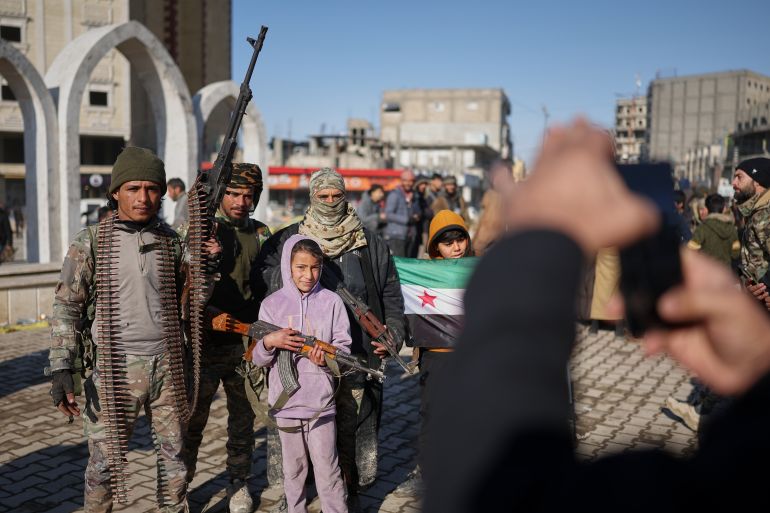
Syrian forces make gains against SDF: What it means for country’s Kurds
Analysts believe overtures from the Syrian government to the Kurdish minority have come a little late.

Published On 21 Jan 202621 Jan 2026
Save
Territorial gains in northeast Syria, where government forces took the cities of Raqqa and Deir Az Zor from the Kurdish-led Syrian Democratic Forces (SDF), have been a boon to Syrian President Ahmed al-Sharaa.
Negotiations with the SDF have been ongoing since the fall of the Bashar al-Assad regime in December 2024 over the main Kurdish representative in Syria’s integration into the Syrian armed forces. Al-Sharaa has used varying tactics against the group, recently announcing a decree for Kurdish rights while also confronting the group militarily.
Recommended Stories
list of 3 itemsend of list
The SDF’s loss is al-Sharaa and his government’s gain. But the most significant sign of Syria’s improved standing may come from the fact that US officials, who have long backed the SDF as a partner in fighting ISIL (ISIS), have given their backing to al-Sharaa and Syrian forces after these latest developments.
Ceasefire and agreements
These recent advancements by the Syrian government have stripped away much of the SDF’s leverage.
“This was about [the Syrian government forces] taking control of the most resource-rich parts of SDF territory that had the demographically highest number of Arabs, so they managed to play this very well by having a limited offensive but, at the same time, getting the tribal networks to rise up against SDF rule; and once they did that, it was basically game over for the SDF,” Rob Geist Pinfold, a lecturer at King’s College London, told Al Jazeera.
When the Assad regime fell in December 2024, the SDF was hesitant to throw its hat into the ring with the new forces in Damascus. Negotiations between Mazloum Abdi, the SDF’s leader, also known as Mazloum Kobani, and al-Sharaa culminated in an agreement on March 10, 2025 to integrate the Kurdish-led forces into the Syrian government forces.
Advertisement
However, details of the agreement were still to be ironed out. The SDF did not want to give up the hard-fought gains it had made during the last 14 years of conflict. It has previously called for autonomous control or decentralised rule in the northeast.
Tension had simmered between the two sides, manifesting in recent clashes in Aleppo and an SDF withdrawal from the city across the Euphrates River. Syrian government forces advanced towards the northeast and have now taken territory, including the cities of Raqqa and Deir Az Zor.
A ceasefire was agreed on Monday, but clashes continued on Tuesday in the Hasakah region of northeast Syria, as Kurds there and in the diaspora feared incursions by government forces.
Recent discussions seemed to have settled on a formula where the SDF leadership would maintain control over three Kurdish-led divisions in Syrian forces, while the rest of the fighters would integrate as individuals. Analysts said it now looks as though individual integration is more likely to go ahead.
“They [the Syrian government] have achieved a very big milestone by forcing the SDF to integrate as individuals,” Labib Nahhas, a Syrian analyst, told Al Jazeera. “But vetting will be a huge challenge because we are talking about 50 to 70 or 80,000 soldiers, so this is a massive infiltration from a security point of view.”
Kurdish rights
Before this significant development, the SDF had been negotiating with Damascus over a few key points. In addition to discussions about integration, it wanted some form of autonomy or political decentralisation and the recognition of Kurdish rights.
On January 16, on the back of fierce fighting between government forces and the SDF in Aleppo, al-Sharaa issued a decree formally recognising Kurdish as a “national language” and restoring citizenship to all Kurdish Syrians.
The decree, which declared Newroz, the spring and new year festival celebrated by Kurds, a national holiday and banned ethnic or linguistic discrimination, addressed one key SDF demand.
Under the Assad regime, Kurds were an oppressed minority in Syria. Their language and identity were not officially recognised and often suppressed by the state.
The move was described by Obayda Ghadban, a researcher with Syria’s Ministry of Foreign Affairs and Expatriates, as historic.
“It has recognised the cultural, linguistic rights of Kurdish Syrians, which is a grievance that has been accumulating for decades,” he told Al Jazeera. “This was seen as a gesture of goodwill by the SDF and regained the momentum of negotiations that have been going [on] for more than a year now.”
Advertisement
Al-Sharaa announced a four-day ceasefire with the SDF on Tuesday and said if a deal could be reached, government forces would leave Kurdish-majority cities like Hasakah and Qamishli to handle their security themselves.
Despite the carrot-and-stick approach, some analysts felt al-Sharaa’s recognition of Kurdish rights was likely a political tactic.
“Had a similar decree been issued six months ago in the context of relative peace between the two sides, I believe the situation would have been very different,” Thomas McGee, Max Weber fellow at the European University Institute in Florence, Italy, told Al Jazeera.
“The fact that no recognition of Kurdish rights came for the full first year after the fall of al-Assad is indeed significant. With this decree suddenly coming out within the context of large military developments shows that the Syrian government considers recognition of Kurdish rights as a tactical issue rather than such rights being considered innate and unconditional.”
Shortly after the announcement, al-Sharaa announced a military operation in Deir Hafir, a town in the north, 50km (31 miles) east of Aleppo, where SDF forces had retreated after evacuating the neighbourhoods of Sheikh Maqsoud and Ashrafieh in Aleppo. Some Syrians and analysts told Al Jazeera that the SDF’s reputation had suffered amid the fighting in Aleppo, even among some Kurds, but it did not mean Kurds would throw their weight behind the government.
“[Al-Sharaa] wanted to do this before the military operation,” Wladimir van Wilgenburg, an analyst of Kurdish politics based in Erbil, Iraq, told Al Jazeera.
“The Kurdish sentiment will not change much towards the government because it doesn’t recognise any form of local autonomy, and both the main Kurdish parties want some form of autonomy or decentralisation.”
US and Turkiye
International actors will also have their eyes on the developments in northeast Syria.
Turkiye appears to be a big winner in the latest developments. The country warned the SDF in early January that its “patience is running out” with the group.
“Ankara has welcomed the ceasefire and Full Integration Agreement, and it is certainly in Turkish interests,” McGee said. “Ultimately, on the SDF/self-administration integration, Turkiye and Damascus have long shared the same general red lines.”
There has also been a discussion about foreign fighters in SDF-controlled areas, which, under the ceasefire agreement, Nahhas said, the SDF was required to expel any “PKK-linked or affiliated individuals or operatives”.
Then there is the United States, which helped broker the ceasefire due to its close relationship with the SDF and Damascus. The US currently has about 900 soldiers in the SDF-controlled parts of Syria for countering ISIL, and analysts said it was unlikely those troops would withdraw.
But under the Trump administration, relations between Washington and Damascus have warmed considerably.
Al-Sharaa, who had been considered a “terrorist” by the US when the Assad regime fell in 2024, visited the White House in November 2025, marking a remarkable turnaround in barely a year. Shortly after that visit, Syria joined the anti-ISIL coalition.
Advertisement
After a phone call with al-Sharaa, US President Donald Trump released a statement on Monday supporting Syria’s unity and “fight against terrorism”.
Not every US official was pleased with the recent events. US Senator Lindsey Graham, a close Trump ally, posted on X on Tuesday his support for the SDF.
“You cannot unite Syria by the use of military force as Syrian government leader Ahmed Al-Sharaa is trying to do,” he wrote. “This move by Syrian government forces against SDF members is fraught with peril.”
Graham and others may be concerned about reports of 39 escaped ISIL detainees from prisons previously held by the SDF, or, on the other side, SDF claims that government forces killed female Kurdish fighters.
But the sentiment in the US seems to be shifting heavily in favour of Damascus. On Tuesday afternoon, US Special Envoy for Syria Tom Barrack posted on X that the US was throwing its support behind al-Sharaa and choosing Damascus over the SDF.
“The greatest opportunity for the Kurds in Syria right now lies in the post-Assad transition under the new government led by President Ahmed al-Sharaa,” Barrack wrote. “This shifts the rationale for the US-SDF partnership: the original purpose of the SDF as the primary anti-ISIS force on the ground has largely expired, as Damascus is now both willing and positioned to take over security responsibilities, including control of ISIS detention facilities and camps.”