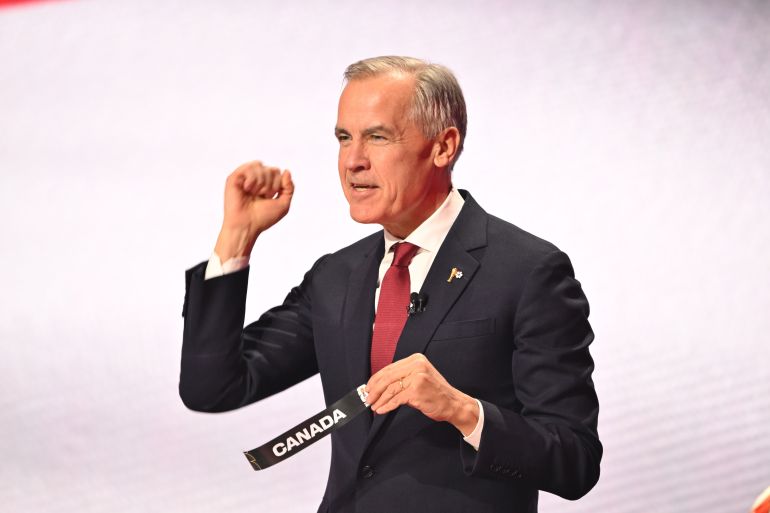
Canada’s Carney hails improving ties with China
Carney is on a four-day trip to China, the first by a Canadian PM since 2017, in a move to thaw tense relations.

Published On 15 Jan 202615 Jan 2026
Save
Prime Minister Mark Carney has hailed Canada’s improving ties with China, as well as the leadership of President Xi Jinping, declaring that their nations were charting a new course in cooperation at a time of global division and disorder.
The four-day visit to China was the first by a Canadian prime minister since 2017, following up on Carney’s positive meeting with Xi in South Korea in October. The two are set to meet on Friday.
Recommended Stories
list of 4 itemsend of list
“We’re heartened by the leadership of President Xi Jinping and the speed with which our relationship has progressed,” Carney told China’s top legislator, Zhao Leji, in a meeting in Beijing on Thursday.
“It sets the stage for these important discussions on a wide range of issues where we can be strategic partners from energy to agriculture, to people-to-people ties, multilateralism, to issues on security.”
Carney’s optimism follows months of intense re-engagement by both countries aimed at recalibrating ties that had soured under the previous prime minister, Justin Trudeau.
The efforts have also been fuelled by a push to diversify export markets after United States President Donald Trump imposed tariffs on Canada last year and suggested the longtime US ally could become his country’s 51st state.
“Our teams have worked hard, addressing trade irritants and creating platforms for new opportunities,” Carney told Premier Li Qiang in a separate meeting.
“I believe that together, we are bringing this relationship back toward where it should be.”
Auto tariffs
Periods of tension in the past decade have strained ties, most recently after Trudeau’s government imposed tariffs on Chinese electric vehicles in 2024, following similar US curbs.
Advertisement
Trudeau said at the time the EV tariffs were imposed because Chinese state subsidies had given manufacturers in China an unfair advantage in the global marketplace, harming the outlook for Canada’s car industry.
China retaliated last March with tariffs on more than $2.6bn of Canadian farm and food products, such as canola oil and meal, leading to a slump of 10.4 percent in Chinese imports of Canadian goods in 2025, as shown in customs data on Wednesday.
Canadian Industry Minister Melanie Joly, who was part of Carney’s delegation to China, said talks about auto tariffs were still ongoing when asked by reporters if Canada might reduce the EV tariffs by 50 percent.
Negotiations will continue on Friday, Joly said, when Carney will meet with Xi.
‘Maintaining open channels of communication’
Efforts to strike up new dialogue have gathered pace since Carney took the helm last year, with top officials from both sides setting up meetings and telephone calls that resulted in the leaders’ October meeting in South Korea.
In a trade and economic roadmap signed on Thursday, both committed to “maintaining open channels of communication” to resolve issues on trade in agricultural products.
In the roadmap, Ottawa welcomes Chinese investments in energy, agriculture and consumer products, while Beijing looks forward to Canada’s investment in services, new materials, aerospace and advanced manufacturing, among other fields.
In energy, both sides are to explore oil and gas development, as well as cooperation in the natural uranium trade.
The pacts provide “an example to the world of cooperation amidst a time globally of division and disorder”, Carney said in his meeting with Zhao.
Since arriving in the Chinese capital on Wednesday, Carney has met senior executives of its business groups, such as EV battery giant Contemporary Amperex Technology (CATL) and China National Petroleum Corp.
He has also met officials of smart wind turbine maker Envision Energy, Industrial and Commercial Bank of China, investment firm Primavera Capital Group and e-commerce titan Alibaba.