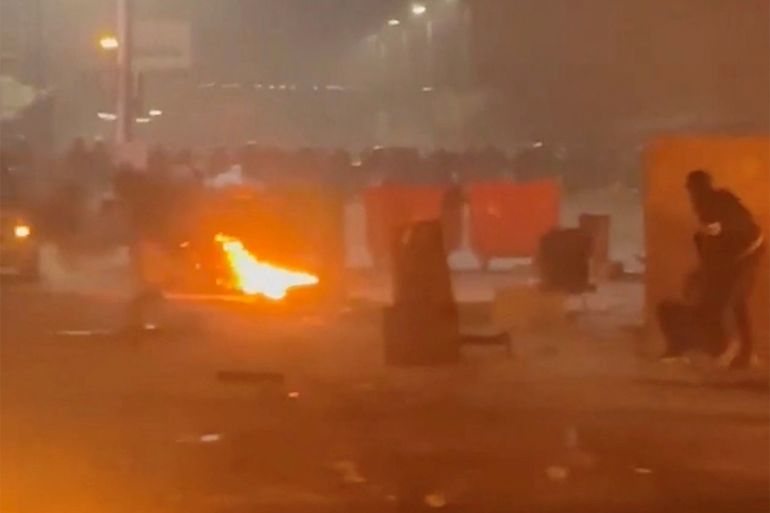
Iran’s FM says protests became ‘bloody’ to give Trump intervention excuse
The Iranian media report a calm night as a nationwide internet ban continues and the US president announces a possible meeting.


Published On 12 Jan 202612 Jan 2026
Save
Iran’s Foreign Minister Abbas Araghchi has alleged that nationwide protests “turned violent and bloody to give an excuse” for United States President Donald Trump to intervene militarily in the country.
Araghchi told foreign diplomats in Tehran on Monday that the violence spiked over the weekend, but the “situation is now under total control”.
Recommended Stories
list of 4 itemsend of list
He said Trump’s warning of military action against Tehran should protests turn bloody motivated “terrorists” to target protesters and security forces to invite foreign intervention. “We are ready for war but also for dialogue,” he added.
Araghchi also said Iran has footage of weapons being distributed to protesters, adding authorities will soon release confessions of detainees, and that authorities are “closely following” the ongoing events on the streets.
The demonstrations were “stoked and fuelled” by foreign elements, he said, noting security forces would “hunt down” those responsible.
Iran’s spiralling protests have now entered a third week amid a nationwide internet blackout and repeated military intervention threats from Trump.
Iran’s government has declared three days of national mourning for the “martyrs” killed during the protests, including members of security forces.
The semiofficial Tasnim news agency reported on Sunday that 109 security personnel have been killed in the protests.
Authorities have not confirmed the number of demonstrators who have lost their lives, but opposition activists based outside the country say the death toll is higher and includes hundreds of protesters.
Advertisement
Al Jazeera cannot independently verify either figure.
Initially prompted by anger over the rising cost of living, the demonstrations have evolved into nationwide protests and a serious challenge to the government in place since the 1979 Islamic revolution.
The Fars news agency reported that limited protest gatherings took place in several neighbourhoods of the capital on Sunday night.
There were limited “riots” in Navvab and Saadat Abad neighbourhoods of Tehran, Junqan and Hafshejan in Chaharmahal and Bakhtiari province, and Taybad of Mashhad, which were intervened and dissolved by security forces, according to Fars.
The agency reported that the other cities and regions in the country were generally calm without “riots” overnight.
On Monday morning, Iranian media showed reported footage of pro-government rallies on its Telegram channels from various cities.
‘National internet blackout’
A nationwide internet blackout has entered its fourth day in the country, according to reports, a move widely criticised by human rights organisations.
Connectivity watchdog NetBlocks reported the internet across Iran is still down, describing the situation as a “national internet blackout”.
It has now been 84 hours since the country last had consistent connectivity. NetBlocks noted, however, some Iranians have developed methods to bypass the restrictions.
There have been fewer videos showing protests on social media recently due to the internet shutdown.
The United Kingdom-based Amnesty International slammed the practice on Friday as a way of hiding “violations in escalating deadly crackdown on protesters”.
Addressing the internet blackout, Araghchi said it would soon be restored, and added that the government was coordinating with the security establishment to make progress on that. He said the connection would be restored to embassies and government ministries, too.
Iran’s leadership wants to show the situation in the country is under control and that is why the internet will be turned back on, Mehran Kamrava, an Iran analyst at Georgetown University in Qatar, told Al Jazeera.
Araghchi “doesn’t want to lose face”, he added, “but what we’re seeing is a multi-pronged approach” by Iran to end the turmoil.
Al Jazeera’s Tohid Asadi, reporting from Tehran, said that the remarks by Araghchi “are the part of the same rhetoric that we have been hearing from different Iranian political figures”.
“Basically, there are three components we have to keep in mind when it comes to this particular discourse,” he said.
Advertisement
Asadi stressed that Iranian officials have been expressing that they recognise people’s “right to take part in peaceful protests” due to the economic difficulties they are facing.
He said the country is also witnessing an “unrest flaring up into violence” that has been going on since Thursday, resulting in fatalities, injuries, and arrests, and reminded the reported unconfirmed death toll of Iranian security officers.
Our correspondent said the third component that made the situation “even more complicated” was “rising security concerns related to foreign intervention”.

‘We’re looking at some very strong options’
As protests persist, defying a crackdown, Trump said on Sunday the US is considering “strong options” in response to the situation in Iran, including possible military intervention.
“We’re looking at it very seriously. The military is looking at it, and we’re looking at some very strong options. We’ll make a determination,” he told reporters on board Air Force One, adding that Iran’s leadership had called “to negotiate” after his threats of military action, and that a “meeting is being set up”.
Earlier on Sunday, parliament Speaker Mohammad Baqer Qalibaf warned the US against “a miscalculation”.
“Let us be clear, in the case of an attack on Iran, the occupied territories [Israel] as well as all US bases and ships will be our legitimate target,” said Qalibaf, a former commander in the Islamic Revolutionary Guard Corps (IRGC).
Iran faced a 12-day war with Israel and the US last year after Israel attacked in June, when Washington also bombed the country’s nuclear sites.
The war killed hundreds of civilians, military commanders and scientists, and Tehran responded with hundreds of ballistic missiles targeting Israel, killing 28.
Meanwhile, Iran’s President Masoud Pezeshkian addressed economic plans in an interview on Sunday.
Pezeshkian said the US and Israel want to “sow chaos and disorder” in his country by ordering “riots” and called upon citizens to distance themselves from “rioters and terrorists”, according to the state media.
The protests have become one of the biggest challenges to the rule of Supreme Leader Ayatollah Ali Khamenei, 86, coming in the wake of the 12-day war. State TV has aired images of burning buildings, including a mosque, as well as funeral processions for security personnel.