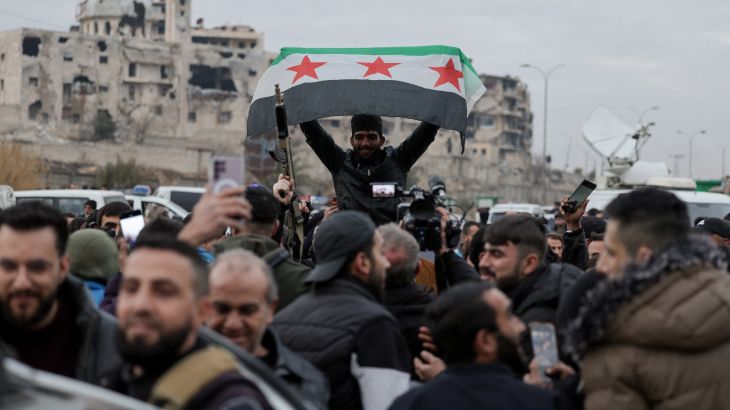
Last Kurdish-led SDF fighters leave Syria’s Aleppo after days of clashes
Aleppo governor says last SDF fighters have left the city after the Syrian army took control of the Sheikh Maqsoud neighbourhood.

Aleppo’s governor says that Kurdish-led SDF have completely left the city

Published On 11 Jan 202611 Jan 2026
Save
The last fighters from the Kurdish-led Syrian Democratic Forces (SDF) have left the city of Aleppo, according to officials, following a ceasefire deal that allowed evacuations after days of deadly clashes in Syria’s second-largest city.
Aleppo Governor Azzam al-Gharib told Al Jazeera early on Sunday that Aleppo has become “empty of SDF fighters” after government forces coordinated their withdrawal on buses out of the city overnight.
Recommended Stories
list of 4 itemsend of list
SDF commander Mazloum Abdi (also known as Mazloum Kobani) said the group had reached an understanding through international mediation on a ceasefire and the safe evacuation of civilians and fighters.
“We have reached an understanding that leads to a ceasefire and securing the evacuation of the dead, the wounded, the stranded civilians and the fighters from the Ashrafieh and Sheikh Maqsoud neighbourhoods to northern and eastern Syria,” he said in a post on X.
“We call on the mediators to adhere to their promises to stop the violations and work towards a safe return for the displaced to their homes,” he added.
The development came after the Syrian army took over the Kurdish-majority neighbourhood of Sheikh Maqsoud following days of clashes that broke out when talks to integrate the SDF into the national army collapsed.
At least 30 people were killed in the clashes, while more than 150,000 were displaced.
Al Jazeera’s Ayman Oghanna, reporting from Damascus, said calm has returned to Aleppo, and that the United States was instrumental in brokering the agreement between the SDF and the government.
Advertisement
“The US is in a unique position, because it enjoys good relations with the SDF and the government,” Oghanna said, noting that Washington has been working with the Kurdish-led force against ISIL (ISIS) for more than a decade.
With the fall of former President Bashar al-Assad’s government in late 2024, the US has also built close ties with the rebel commander who became Syria’s interim leader, Ahmed al-Sharaa. The Syrian president met US President Donald Trump at the White House last year and has formally joined the US-led coalition against ISIL.
The fighting in Aleppo began on Tuesday in the predominantly Kurdish neighbourhoods of Sheikh Maqsoud, Ashrafieh and Bani Zaid, amid tensions over a failure to implement a March 2025 agreement to reintegrate the Kurdish forces into state institutions.
The deadline for the deal passed at the end of last year, and the SDF refused to leave areas that have been under its control since the early days of the Syrian war, which erupted in 2011.
Al Jazeera’s Oghanna said that though the fighting in Aleppo has ended, “the fault line, the backdrop for this fighting, remains”.
“There are many difficult issues in Syria, but the greatest threat to national stability and unity remains this question of whether the SDF join Damascus and be under Damascus’s control,” he said.
The SDF has a large amount of fighters, estimated at between 50,000 to 90,000. They are mainly in the northeast of the country and control almost a quarter of Syria’s territory.
Oghanna said the fighting in Aleppo makes the SDF integration “look far less likely”.
“There are also other sticking points, which might make the SDF refuse to put down their weapons,” he said.
“The SDF don’t want to cede control of the country’s northeast, and they want to maintain a certain amount of autonomy in order to have the governance in northeastern Syria.”