Sahel Summit: What is the biggest challenge facing the region?
Sahel countries launch a joint battalion to fight armed groups as they boost ties with Russia amid vulnerable security situation.


By Usaid Siddiqui and News Agencies
Published On 24 Dec 202524 Dec 2025
Save
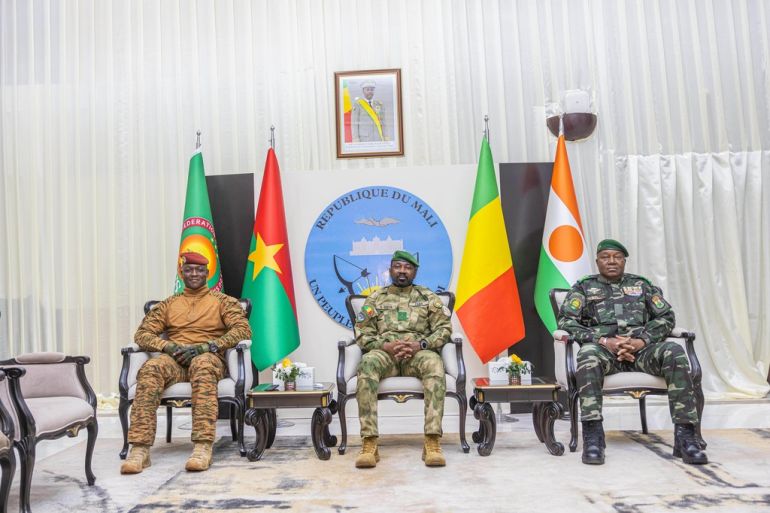
Mali, Burkina Faso and Niger have announced the launch of a joint military battalion aimed at fighting armed groups across the Sahel, one of Africa’s poorest and most volatile regions.
The initiative was announced at the end of the two-day Alliance of Sahel States (AES) summit in the Malian capital, Bamako, as the three countries struggle to improve the security situation amid rising attacks from separatist groups as well as armed groups linked to al-Qaeda and ISIL (ISIS).
Recommended Stories
list of 3 itemsend of list
This was the group’s second summit since its formation in 2023.
Here is what you need to know about the summit and whether the joint battalion will help improve the security situation in the three Sahel countries.
What was agreed on?
They agreed to launch a joint battalion, which is expected to comprise an estimated 5,000 soldiers from the three countries, with a mandate centred on counterterrorism and border security.
Burkina Faso leader Ibrahim Traore, who was named the head of the alliance, announced “large-scale” joint operations against armed groups in the coming days.
Moreover, the three leaders also jointly launched the AES Television, described in official communications as an instrument to counter disinformation and promote the region’s narrative.
A Burkinabe presidency statement said the leaders would review implementation reports, adopt decisions to consolidate achievements and address major challenges facing the bloc.
General Omar Tchiani, leader of Niger’s military government, said the AES had “put an end to all occupation forces in our countries”. “No country or interest group will decide for our countries any more,” he said.
Advertisement
Has the reliance on Russian forces improved the security situation?
The military leaders of the three nations in recent years kicked out longtime security partners France and the United States. Thousands of French soldiers were stationed in several African nations, including the three Sahel countries, while Niger hosted nearly 1,000 US soldiers and was the site of the largest drone base in Africa. US forces withdrew from Niger last year.
After snapping ties with their Western partners, the military leaders from the Sahel countries turned to Russia amid an increasingly vulnerable security situation.
Bamako is now collaborating with Russian forces, with about 1,500 personnel from the Wagner mercenary group initially, and since June, roughly 1,000 fighters from the Kremlin-controlled paramilitary group Africa Corps.
Russian soldiers are also present, though in smaller numbers, in Burkina Faso and Niger.
On the apparent contradiction of allowing Russian mercenaries to operate on their soil while claiming independence from foreign influence, analyst Ulf Laessing says it is a message from the military-run nations to the West with whom they would like to “work less”.
“They don’t mind working with Russia, and all three countries have bought drones from Turkey,” Laessing, Sahel analyst at Konrad-Adenauer Stiftung, noted.
“China also delivers weapons to some countries, so that’s a message against the West.”
Meanwhile, Rida Lyammouri, senior fellow at the Policy Center for the New South, says Russia is less likely to interfere in their “domestic politics”.
“On the other hand, Western partners often condition interventions with what they see as democratic practices aligning with the Western world,” he said.
Several Western nations, including the United States, France and the United Kingdom, as well as the European Union, imposed targeted sanctions, aid suspensions, and visa restrictions on the three Sahel nations in response to their respective military coups.
But the reliance on Russian forces has not helped improve the security situation, analyst Laessing says.
“Since the Russians arrived in Mali, the security situation has worsened because they don’t distinguish between fighters and civilians,” he said, pointing to human rights reports which have accused Russian forces of grave abuses.
Analyst Lyammouri says while Russian mercenaries might have helped the military recapture the city of Kidal and parts of northern Mali from Tuareg rebels, they have struggled to make any improvements when it comes to fighting against “violent extremist groups”.
Advertisement
“They don’t only continue to pose a real threat and carry [out] almost daily attacks but also expanded into new geographical areas in southern and western parts of Mali.”
Which armed groups are operating in Burkina Faso, Mali and Niger?
The three countries have for more than a decade battled armed groups, including some linked to al-Qaeda and ISIL, as well as separatists.
The most influential group is Jama’at Nusrat al-Islam wal-Muslimin (JNIM), an al-Qaeda-linked coalition formed in 2017. The JNIM is deeply entrenched in central and northern Mali, has expanded across much of Burkina Faso, and now operates in western Niger as well.
Another leading group is the ISIL affiliate in the Greater Sahara (ISGS), also known as the ISIL affiliate in the Sahel Province (ISSP).
ISGS is particularly active in eastern Mali, western Niger and parts of northern and eastern Burkina Faso, especially in the tri-border zone. It has carried out large-scale assaults on military bases and villages.
Among other actors is the Azawad Liberation Front (FLA), a Tuareg-led separatist movement operating in northern Mali. Formed in 2024 after a merger with other groups such as the Tuareg National Movement for the Liberation of Azawad (MNLA), it has launched attacks against both Malian and Russian forces.
The roots of the conflict date back to 2012, when the MNLA group – fighting for an independent state of Azawad – captured parts of northern Mali, but their control over the territory was short-lived.
The security chaos of 2012 coincided with a coup in Bamako, creating a power vacuum in the north. This vacuum enabled al-Qaeda-affiliated Ansar Dine to seize territory from Tuareg rebels, triggering military intervention from France in 2013.
Ansar Dine, along with several other armed groups, merged to form the JNIM.
What are the main challenges facing all three states?
According to analyst Lyammouri, all three countries face “major security challenges”. He said, “The dynamics of the overall conflict might differ from one country to another.”
Moreover, the conflict has led to economic challenges for the landlocked nations, Lyammouri added, noting, for example, that JNIM has put up blockades around the main roads since September.
JNIM has been targeting fuel tankers, particularly those coming from Senegal and the Ivory Coast, through which the majority of Mali’s imported goods transit.
“This demonstrates the vulnerabilities of Mali’s economy relying solely on traffic from coastal states without any other alternatives,” he said, adding that it remains diplomatically isolated from the West and regional bloc Economic Community of West African States (ECOWAS).
“Tensions with these countries have isolated AES states further and put them under social pressure as the prices of goods increase and access to basic goods becomes a struggle for the local population,” he added.
On whether the joint battalion is likely to succeed, Laessing said the security challenges are “so complex”. “Anyone would struggle to contain this threat,” he said.
Advertisement
“At the end of the day, you need negotiations, you need a political solution … a military force alone might help a bit, but it won’t solve the conflict.”