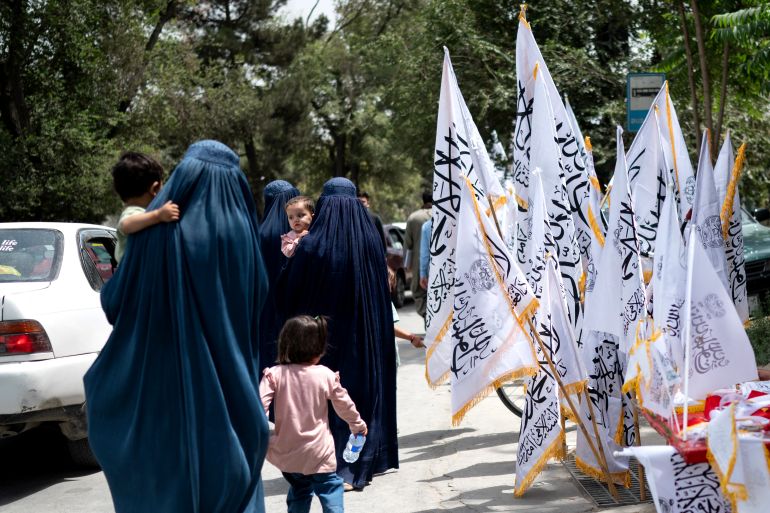
Australia sanctions Afghan Taliban officials over women’s rights abuses
Canberra said the Taliban officials are guilty of oppressing women and girls, as well as ‘undermining good governance’.


By Alastair McCready and News Agencies
Published On 6 Dec 20256 Dec 2025
Save
The Australian government has imposed financial sanctions and travel bans on four officials in Afghanistan’s Taliban government, citing the deteriorating human rights situation in the country, particularly for women and girls.
Australia’s Foreign Minister Penny Wong said in a statement on Saturday that Canberra had established a “world-first” autonomous sanctions framework for Afghanistan, which would allow it to “directly impose its own sanctions and travel bans to increase pressure on the Taliban”.
Recommended Stories
list of 3 itemsend of list
The new framework also introduces an arms embargo, Australia’s Department of Foreign Affairs and Trade said, as well as prohibitions on “providing related services and activities to Afghanistan”.
The department named the sanctioned Taliban officials as Minister for the Propagation of Virtue and the Prevention of Vice Muhammad Khalid Hanafi; Minister of Higher Education Neda Mohammad Nadeem; Minister of Justice Abdul-Hakim Sharei; and Chief Justice Abdul Hakim Haqqani.
Wong said the officials had been sanctioned due to their involvement “in the oppression of women and girls and in undermining good governance or the rule of law”.
“This includes restricting access to education, employment, freedom of movement and the ability to participate in public life,” she said.
Advertisement
Canberra said its new framework “builds on” the 140 individuals and entities it already sanctions as part of the United Nations Security Council’s Taliban framework.
Afghanistan’s Taliban government is yet to publicly respond to Canberra’s latest measures.
In July, the International Criminal Court (ICC) issued an arrest warrant for Chief Justice Haqqani, alongside the Taliban’s supreme leader, Haibatullah Akhunzada, for alleged crimes against humanity for persecuting women and girls.
Announcing the sanctions, the ICC said the Taliban has “severely deprived” girls and women of the rights to education, privacy, family life and the freedoms of movement, expression, thought, conscience and religion.
Since returning to power following the withdrawal of United States and NATO troops – of which Australia was a part – from Afghanistan in August 2021, the Taliban has enacted severe restrictions on the rights and freedoms of women and girls, including the right to work and study.
The Taliban has rejected accusations of violating women’s rights, claiming they are respected “within the framework of Islamic law”.
In December 2022, Afghanistan’s Ministry of Higher Education banned female students from the country’s universities until further notice, in a move widely condemned by the international community.
Last year, the UN said the Taliban government had “deliberately deprived” at least 1.4 million girls of their right to an education during its time in power, totally about 80 percent of school-age girls.
Afghans have also been plunged further into poverty since the Taliban takeover, fuelled in part by the ban on female participation in the workplace, with vast swaths of the country’s population now heavily reliant on humanitarian aid to survive.
In her statement, Wong said the Australian government “remains deeply concerned at the deteriorating situation” in the country, continuing that a “humanitarian permit” had been carved out in the new sanctions framework, allowing the continued provision of aid.
“Our thoughts are with those suffering under the Taliban’s oppression, as well as the Afghan community in Australia,” she said.