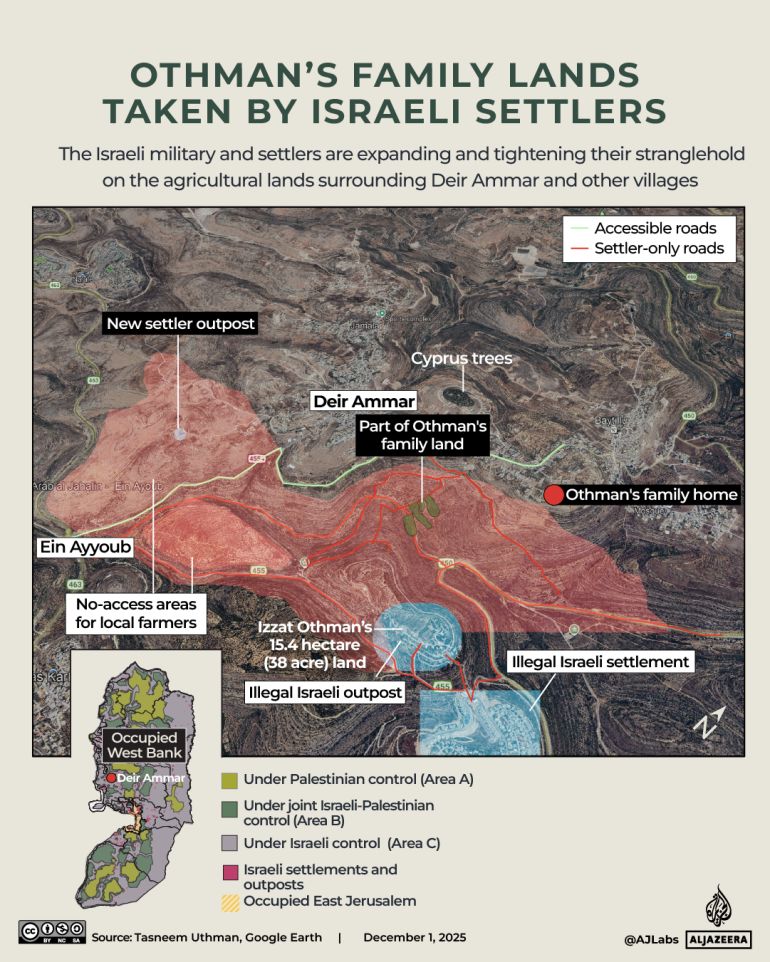
Israel occupied the West Bank in 1967, impacting Palestinian agrarian life by imposing progressively harsher military restrictions and continuing its theft of Palestinian land to construct and expand illegal Israeli settlements and outposts.
Land was taken from Deir Ammar to build the illegal settlement of Neria in 1991, across the valley from the Othmans’ homes. The village lost more land as the settlement expanded.
Several years ago, a settler outpost was built on the ridge extending west of Neria.
On his cousin Ismail’s terrace, Izzat Othman pointed to lights flashing from the outpost. “I have 38 acres there. [The settlers] took it, and I can’t even walk there,” he said. “They tore all my trees down.”
Pointing to more lights on the other side of the valley, Izzat moved his finger west: “That land is also mine,” he said, gesturing to his cousins beside him one at a time.
“And that’s [my cousin’s], and his, and his – all the way down to Ein Ayyoub,” he said.
“The settlers took it.”
Locals say Israeli settlers have managed to seize approximately 7,000 dunums (700 hectares or 1,730 acres) of land around the village homes over time – aided by the Israeli military.

Ali, Ismail and two of Ismail’s brothers inherited land in the valley that has been largely carved up by two roads for settlers only – one built seven years ago, and another six months ago.
With greater losses of their land and incentivised by higher wages, the family and others in the village were pushed to seek employment as manual labourers in Israel.
But then Israel cancelled the permits for West Bank Palestinians to enter and work there two years ago, as it launched its genocidal war on Gaza.
The Othmans were left with nothing but farming to fall back on.
Yet, restrictions on village farmland increased until this year, when the entire valley and all the fields surrounding Deir Ammar were effectively declared off-limits by the Israeli military.
By villagers’ estimates, about 80 percent of the olive trees around Deir Ammar have gone unpicked; only the trees within the village were reachable.
In October and November, the olive press in Deir Ammar normally runs 24/7, producing 1,000 to 2,000 tins of olive oil, with each tin holding 10 litres (2.6 gallons), according to workers there.
But this year, on a weekday afternoon in the peak of the season, the press was empty, the machines silent. The entire village’s harvest only produced about 30 tins.
The olive harvest season has effectively been cancelled in Deir Ammar.

According to Ismat Quzmar, economic researcher and the external relations officer of the Palestine Economic Policy Research Institute (MAS) in Ramallah, the total value of the Palestinian olive oil sector is $120m to $140m.
Olive cultivation comprises about 20 percent of Palestine’s total agricultural output, a relatively small portion of total economic output that plays an outsized role for rural families.