Iran FM says US outreach a ‘positive step’ as delegation in Qatar for talks
Iran’s Foreign Minister Abbas Araghchi tells Al Jazeera Tehran doesn’t rule out attack, is ‘prepared for all scenarios’.

31 Oct 2026
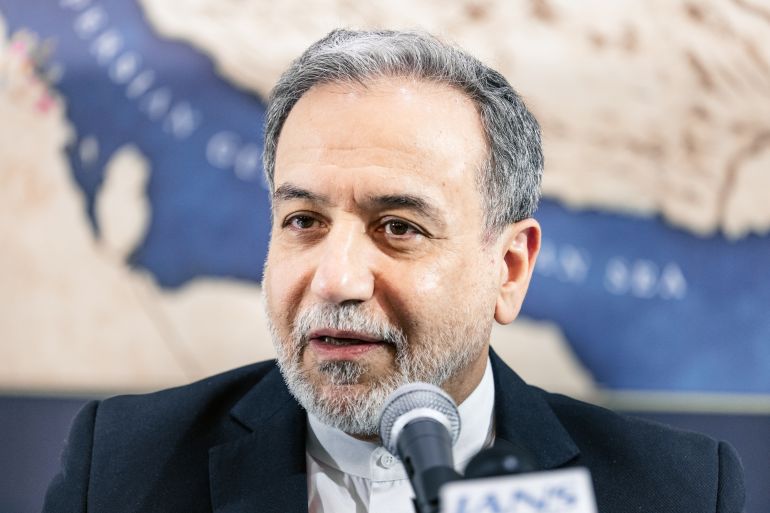
Iran’s Foreign Minister Abbas Araghchi says a United States effort to open dialogue with Tehran is “a positive step”, but that there are currently no plans for meetings with US officials regarding the eight-month-old war.
Speaking to Al Jazeera on Saturday, Araghchi said Iran had studied a letter sent by US Vice President JD Vance in high-level meetings, and set out Tehran’s conditions for reopening the Strait of Hormuz, which he said would pave the way for renewed negotiations with Washington.
end of list
He added that an Iranian delegation has travelled to Doha, a day after Qatari mediators were in Tehran in an apparent bid to negotiate a revival of the US-Iran ceasefire. Araghchi said one of his aides is in Qatar to continue consultations.
“The American side’s attempt to open the door to dialogue and understanding more broadly is a positive step,” the foreign minister told Al Jazeera.
However, he warned: “If Washington’s goal in sending this letter is to stir up discord, it would be yet another mistake to add to its previous ones.”
‘No need to meet with the Americans’
Araghchi played down talk of upcoming meetings between the two sides.
“What is being circulated in this regard is merely media speculation,” he said.
“We see no need to meet with the Americans at this stage. Our conditions are clear, and mediators are continuing their consultations regarding them,” he added.
Araghchi said whether Iran would hold direct or indirect talks with the US depended on Tehran’s conditions being met.
“Mediators have presented proposals concerning the nuclear dossier, which we are currently reviewing as part of the second phase,” he said.
“Qatari and Pakistani mediators are continuing consultations regarding our conditions,” he said.
Rouzbeh Parsi, an Iran analyst and affiliated researcher at Lund University’s Department of History and Human Rights Studies, told Al Jazeera that any progress in Friday’s talks in Tehran was most likely on “the sequencing of the first steps needed to establish the barest of trust – without which further bolder steps are not possible”.
Conditions for Hormuz
Araghchi said talks with Qatari mediators had shortened the time needed to implement Iran’s proposal to reopen the Strait of Hormuz.
“The Qatari side proposed shortening the implementation period of the Iranian proposal to five days. We have reached a proposal at this stage that reduces the implementation period to two days,” he said.
“Our conditions include lifting the sanctions imposed following the Islamabad memorandum and reducing US forces in the region,” he said, adding, “We demand the restoration of oil waivers and the release of all our frozen funds, including those held in Qatar.”
Iran is also demanding recognition of shipping routes through the strait that it had discussed with Oman, and the closure of other routes, he said.
Al Jazeera’s Resul Serdar Atas, reporting from Tehran, said there was “no remarkable flexibility in Iran’s position”, with Tehran insisting on the same demands while negotiations continue.
Under a Memorandum of Understanding (MoU) signed between the US and Iran in June, Washington guaranteed the oil waivers and said there would be no further restrictions on Iranian oil exports, Atas said. But when the MoU collapsed months later, the US cancelled all the waivers.
Tehran is also still insisting on the release of its frozen assets, including $6bn held in Qatar, and on the lifting of sanctions, not only those on its energy and nuclear file, but also those imposed since the MoU collapsed, which are putting huge pressure on Iran’s economy, he said.
The US, for its part, wants Iran to reopen the strait, and both sides want their demands met on the ground, not only on paper, Atas added.
‘Prepared for all scenarios’
In his remarks to Al Jazeera, Araghchi said his country does not rule out the possibility of an attack against Iran.
“We are prepared for all scenarios,” he said.
“We have upgraded our weaponry, addressed our vulnerabilities, and tested new arms. Our forces are at the highest level of readiness.”
This comes as Iran’s armed forces chief of staff, Major-General Ali Abdollahi, said in a statement on Saturday that Iran would respond to any attack with “immense force”, with no geographical limits, and that it would decide when any new war ends.
Abdollahi said Iran was acting on Supreme Leader Mojtaba Khamenei’s orders.
“We have a new stockpile of enemy targets and assets, and they are on our agenda,” he said. “America and Israel will face an unimaginable response, and we are the ones who will determine the end of any new war.”
Abbas Khamayar, a former Iranian diplomat, told Al Jazeera he expected the current situation to hold until next week’s US midterm elections.