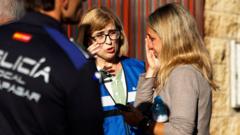
Spanish Prime Minister Pedro Sánchez has said “the whole of Spain is grieving” and that “lives have been shattered, families have been torn apart”.
“The pain is immense,” he said on a visit to the crash site.
The government was “trying to determine what was the origin of this tragedy, of this terrible accident,” he added.
“We will get to the bottom of this, and if there has been any negligence, it will come to light.
“If there have been failures in the security system, they will be addressed with the utmost firmness.”
Opposition conservative leader Alberto Núñez Feijóo, whose People’s Party leads most opinion polls ahead of 29 November elections, said it was not the day to talk about political responsibility, but insisted “Spain has the right to know what is going on with its infrastructure”.
Most Spanish politicians cancelled all public engagements on Wednesday and suspended their election campaign.
However, Santiago Abascal of the far-right Vox refused to take part in what his party described as attempts to “use mourning to silence criticism” of the country’s rail infrastructure.
Three days of official mourning began on Thursday.
Spain’s royal family posted on X that it was “shocked and concerned” and expressed condolences for the relatives of the deceased and those affected by the crash.
A spokesperson for the EU said the bloc was ready to help Spain if needed.
A huge emergency response was under way with fire crews and helicopters at the scene.
Hospitals in the area suspended planned surgeries as they deal with an influx of patients from the crash, Spanish media have reported.
A blood transfusion centre in Madrid appealed for “urgent” donations. In a post on X, Centro de Transfusión said it made the request “in the face of a possible sudden increase in care needs”.
It reported that facilities in Toledo, Ciudad Real and Alcázar de San Juan had cancelled procedures as casualties from the crash begin to arrive.
The Spanish Civil Guard set up bureaus in Madrid, Toledo, Seville and Córdoba to investigate reports of missing persons.
“The top priority is the identification of the missing persons and the taking of DNA samples to be able to locate their relatives,” the civil guard wrote in a post on X.
This is the second high-speed rail tragedy in Spain this year.
In January a high-speed train derailed in southern Spain, its rear carriages going into the path of a state-run Renfe train, claiming the lives of 46 people.