How a radio glitch triggered a false hijack alert in Germany
Authorities scrambled fighter jets to escort a plane on its way from Corfu to Nuremberg after a pilot sent a hijack alert.

14 Oct 2026
German authorities briefly closed an airport and scrambled fighter jets to escort a passenger plane on Tuesday following an emergency alert indicating a hijacking was taking place on board. However, the alert had been accidentally triggered by a radio “malfunction”.
Corendon Airlines said its Boeing 737-800, which was en route from the Greek holiday island of Corfu to Nuremberg, Germany, sent out an emergency code while it was flying over Croatia “due to a brief malfunction in the radio communication system”.
In a statement, the airline said that “no emergency situation occurred”, and the 178 passengers, flight crew and aircraft had not been in danger at any point. The plane landed safely in Nuremberg.
What happened?
German police said Corendon Airlines flight XR456 “inadvertently” sent out an emergency “squawk” alert with the code 7500 while flying over Croatia on Tuesday.
A squawk is a four-digit code a pilot sends via the jet’s transponder to air traffic control. The code 7500 tells air traffic controllers that a hijacking is in progress.
However, air traffic controllers were unable to make contact with the pilots or crew, causing the alarm to be raised further. It is unclear why this happened.
“The aircraft could no longer be reached by radio to clarify the situation”, prompting warnings to be activated in several European countries, police said.
A Rafale fighter jet was scrambled from Croatia to intercept the Boeing passenger jet, while the German military also dispatched warplanes.
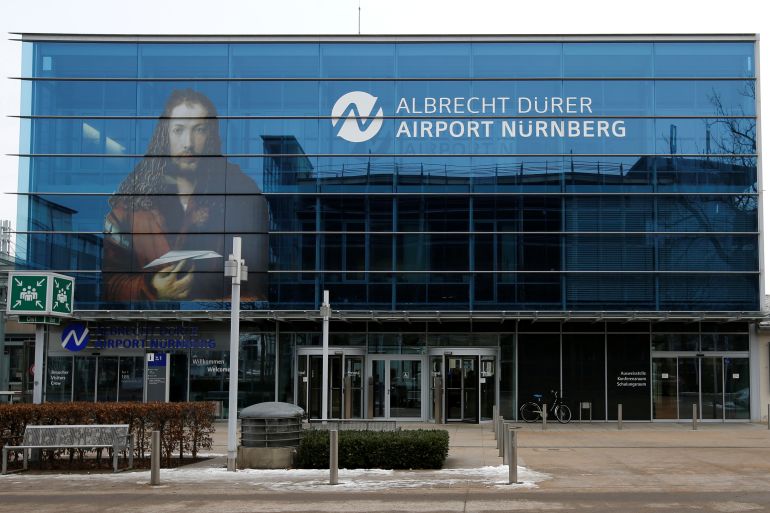
Police cordoned off the Albrecht Dürer airport in Nuremberg as a precaution until they knew the reason the pilot had sent the hijack alert.
Police spokesman Michael Petzold explained that authorities had “received a code directly from the cockpit that suggested a hijacking”.
“Since we were then unable to reach the cockpit, and the tower was also unable to contact the cockpit, we had to assume the worst – that it might indeed be a hijacking,” Petzold said.
The incident disrupted flights, with six flights delayed and two inbound flights diverted to other airports as a precaution, a Nuremberg airport spokesperson said.
Why are aviation authorities so concerned?
The hijack scare has come amid heightened concerns about aviation security after the copilot on board a Flydubai jet bound for Israel from Dubai attacked the captain with an emergency crash axe, forcing the flight to make an emergency landing in Saudi Arabia on September 30.
On Friday, the United Arab Emirates’ prosecutor general said the copilot was on a “suicide” mission to crash the plane at Ben Gurion airport in Tel Aviv and called the incident a “terrorist attack”.
Also, before the false hijack alert in the early hours of Tuesday, flights had been briefly disrupted at Nuremberg airport after pilots reported suspected drone sightings.
Authorities across Europe have already stepped up surveillance of the skies in recent weeks after a series of mostly mysterious drone incidents and concerns about Russian hybrid warfare.
Western nations, including Germany, have accused Moscow of launching a campaign of sabotage, espionage and disruption to undermine European support for Ukraine and destabilise the continent.
Several German airports have had to suspend operations for brief periods in recent months due to drone activity, with suspicion often falling on Russia.
Last month, the German government blamed Russia for an attempted attack at Leipzig/Halle airport in August using a drone laden with explosives. Berlin closed the Russian consulate among other measures.
Russian President Vladimir Putin dismissed the allegations, saying Berlin “fabricated” the evidence. However, in light of the concerns, NATO’s top general told the Warsaw Security Forum earlier this week that the alliance has a new war plan for countering a Russian attack on its members, embedding lessons learned from the Ukrainian front lines.

How common are radio glitches and false hijack alerts?
Radio glitches are common, but incidents rarely escalate to major security events because pilots use back-up radios to communicate with air traffic controllers when they lose communication signals.
In 2019, a pilot flying an Air Europa jet from Amsterdam to Madrid accidentally transmitted hijack alert 7500. For half an hour, aviation authorities thought the alarm was a genuine emergency and followed safety protocols, which disrupted flights and led to the evacuation of part of Schipol airport in the Netherlands.
In 2011, a flight from Chicago to Germany was diverted to Toronto when a pilot spilled coffee and accidentally set off a hijack alarm. The spill caused distress signals to go out, including the 7500 transponder code.