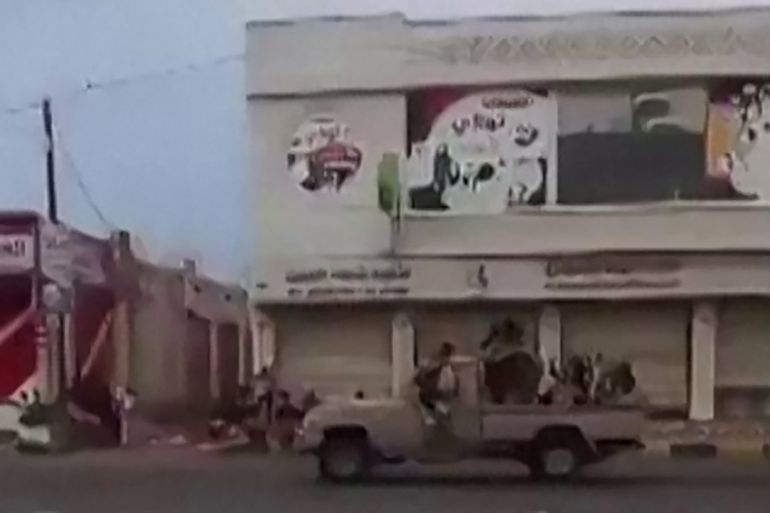
Yemen’s Houthis seize strategic Red Sea city of Mocha
Houthis deliver ‘significant blow’ to the Yemeni government, expand control over Bab al-Mandeb, analysts say.

 By Al Jazeera Staff10 Sep 2026
Yemen’s Houthis have seized the crucial Red Sea city of Mocha, expanding control over the strategic Bab al-Mandeb strait, one of the world’s most important trade routes.
The Iran-backed group took over Mocha on Thursday while internationally recognised government forces withdrew, sources told Al Jazeera’s Yemen correspondent, Yousef Mawry. Three Yemeni government sources also told the Reuters news agency that the city had been taken.
end of list
“The Yemeni government tried to put up a fight; they called reinforcements … but the overwhelming military pressure of the Ansar Allah Houthis eventually [led to them taking] over the port and the city itself,” Mawry said, adding that the strategic district of Hais was also seized.
Yemen’s government forces have yet to issue an official confirmation.
Over the past 10 days, the Houthis have been trying to push west of Taiz with the objective of taking over Mocha. The Houthis were also nearing complete control of other coastal cities that sit directly along the strait as they push to take over the whole Yemeni Red Sea coast.
Mawry said the Houthis having control of the port of Mocha means they also control the Bab al-Mandeb strait. “This gives the Houthis the eyes, the ears, and the pressure to monitor international trade. Bab al-Mandeb is responsible for 10-12 percent of global trade,” he said.
Wolfgang Pusztai, a defence analyst, said seizing Mocha was a major development as it puts the Yemeni rebels in a position to cut off the road leading to Taiz, in a “very significant blow against the government”.
It also enables them to “control pretty much all of Yemen’s coast on the Red Sea” and Bab al-Mandeb, Pusztai told Al Jazeera.
He noted that while the Strait of Hormuz is about 50km (30 miles) wide, the Bab al-Mandeb strait is much narrower at about 20km (12 miles).
“This means they could control it just with artillery; they wouldn’t need to even use missiles or drones to attack ships. This would certainly be a major blow to Saudi Arabian shipping and international shipping,” the analyst said.
‘Not overly surprising’
Yemen’s ambassador to Qatar, Rajeh Badi, accused Iran of reigniting the war after a lull of about five years and using the Houthis to tighten its grip on Red Sea shipping routes.
Badi said the relationship between Iran and the Houthis was “no longer a secret”, describing the group as one of Iran’s key regional arms alongside Hezbollah in Lebanon and the Popular Mobilisation Forces (PMF) in Iraq.
Tehran is “doubling down on the Houthis as its remaining lever” and had helped reignite the war after a lull of about five years, Badi told Al Jazeera. “Its grip over these two choke points would be more powerful than any nuclear arsenal.”
Pusztai said that while Iran has “a huge influence on the Houthis”, “the Houthis are not only proxies of Iran. They are fighting also their own war.”
As part of the Houthis’ offensive against Yemen’s Saudi-backed government, the group has staged attacks on oil facilities and civilian infrastructure deep inside Saudi Arabia.
The Houthi-affiliated news agency Saba on Thursday said Saudi forces launched an additional 40 air strikes on the governorates of Taiz, Hodeidah, al-Jawf and Marib.
Saudi foreign policy analyst Abdulaziz Alghashian described the rapid Houthi advance in southern Yemen as “concerning; it’s disappointing, but maybe not overly surprising”.
Taking control of Mocha was not necessarily enabled by “the strength of the Houthis, but probably a discombobulation of the anti-Houthi forces”, he told Al Jazeera.
He added that Saudi Arabia would likely go for a tit-for-tat response as it does not want to enter into “a long-winded campaign”.
Pakistan has warned Iran to restrain the group and said its defence pact with Saudi Arabia and Turkiye could become operational if Houthi attacks on Saudi territory persist.
The three nations last month finalised a new mutual defence pact, named the Mecca Defence Alliance, after a meeting of senior officials.