Why has FIFA not signed a World Cup broadcast deal in India?
With the World Cup just weeks away, FIFA is struggling to find broadcast rights buyers in the world’s most populous country.
Save

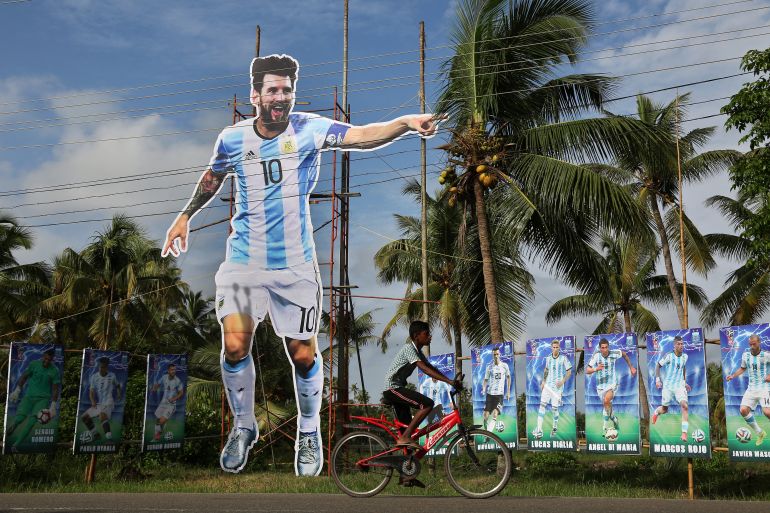
New Delhi, India — When Argentina’s Gonzalo Montiel converted a penalty to seal his country’s third FIFA World Cup title in December 2022 in Qatar, Lionel Messi fan Vishwas Banerjee celebrated the Albiceleste’s triumph with abandon in Bangalore, a football-crazy city in southeastern India.
Unable to hold back his excitement, Banerjee screamed and tossed his shirt away as he watched the match on a big screen at a street crossing close to midnight.
“It was one of the best nights, watching Messi lift the World Cup,” he told Al Jazeera.
“Everyone went crazy. We danced on the streets,” Banerjee said, reminiscing about the excitement felt more than 3,000 kilometres (1,900 miles) away in an otherwise cricket-mad country.
While Messi is expected to make his World Cup swan song at the upcoming tournament in North America, football fans in India, the world’s most populous nation, are set to miss out on watching the biggest sporting event.
With just over three weeks to the tournament’s kickoff in Mexico, organisers FIFA have not found any buyers for broadcasting its most coveted product in India.
Here’s what we know about the World Cup broadcast rights crisis in the South Asian nation:
How many people watch the FIFA World Cup in India?
When the World Cup was played in Qatar nearly four years ago, India trailed only China in overall engagement figures, with more than 745 million fans following the action across all media platforms in the country, according to figures released by FIFA.
In television viewing numbers, India was among the top 10 countries – ahead of World Cup participants Germany, France and England – with nearly 84 million viewers.
Advertisement
Digital viewership numbers were also significant in India. For the final alone, an unprecedented 32 million viewers tuned in on Reliance’s JioCinema – a subscription video-on-demand over-the-top streaming service – as the tournament clocked 40 billion minutes of watch time on the platform.
Reliance’s Jio paid $60m for tournament rights in 2022, while Sony Sports secured broadcasting rights for the 2014 and 2018 FIFA World Cups, as well as the Euro 2016 championship, for around $90m in 2013.
So when FIFA began selling media rights for the 2026 tournament and the 2027 Women’s Cup, it expected plenty of takers for an estimated price of $100m.
But with 23 days until the tournament and the asking price reportedly slashed significantly, FIFA is still struggling to find buyers in one of its biggest markets.
Why are there no buyers for the World Cup 2026 in India?
Experts say the kickoff times for the majority of the matches are the biggest concern for Indian broadcasters.
With the tournament being staged in the United States, Canada and Mexico, many games will be played at odd hours for the Indian audience, with a 10-12 hour time difference between the host cities and the South Asian nation.
Only 14 out of the total 104 World Cup games will begin before midnight for fans in India.
The final will be held in New Jersey on July 19, beginning at 12:30am in India (19:00 GMT). By comparison, 98.4 percent of matches at the 2018 World Cup started before midnight, and 82.5 percent at the following edition in Qatar.
Karan Taurani, executive vice president at investment firm Elara Capital, sees TV as a “struggling” medium in India.
“When you have these kinds of sporting events, effectively it is mostly digital that is monetising and raising big money,” Taurani told Al Jazeera. “That is a big reason why no one’s showing interest in the FIFA World Cup.”
Taurani explained that cricket leads the sports economy market in India.
“Only a small fraction of people who watch the Indian Premier League [IPL] will watch the FIFA World Cup,” he said, adding that an even smaller fraction tune in past midnight to watch a match.
For broadcasters and advertisers, Taurani explained, these factors shrink the target audience.
He also pointed out that a recent ban by the Indian government on fantasy real-money betting apps had reduced the macro form of money in the sports entertainment industry.
The World Cup begins 10 days after cricket’s IPL 2026 final, one of the most-watched sports events in India and one where major prime-time advertisers focus the majority of their annual sports spending.
Advertisement
The price of football streaming in India has been going down anyway. The English Premier League rights, which were sold for $145m for three seasons between 2013 and 2016, went for $65m for 2025-28. There are no major takers for La Liga matches in India.
FIFA appears increasingly concerned that weak broadcaster interest in India could dent both revenues and its long-term ambition to grow football in one of the world’s largest media markets.

Why has an Indian football fan taken the issue to court?
In the capital New Delhi, the high court is hearing a plea on the lack of a tournament broadcast deal and has sought responses from India’s information and broadcasting ministry and Doordarshan, India’s state-owned public television broadcaster.
“Without timely judicial intervention by this court, the petitioner and millions of Indian citizens will be irreparably deprived of their fundamental rights with no adequate alternative remedy,” the petitioner, a lawyer and football fan, has said in the plea.
He claims that missing out on the tournament violates the constitutional protections of freedom of speech.
“It is important to note that by denying access to the information in question or by not taking necessary steps to broadcast the FIFA World Cup, the respondents have directly infringed the petitioner’s fundamental right to acquire and receive information, which is an integral part of freedom of speech and expression under the constitution,” the petitioner argued in the plea.

How will Indian football fans watch the World Cup?
With China’s state broadcaster signing a late World Cup deal with FIFA last week, there’s still hope and time for football fans in India. However, if no deal is signed, all eyes will turn to Doordarshan, which last beamed the tournament in 1998.
The continuing uncertainty is chipping away at the excitement of the football World Cup. “I’m heartbroken that we will not have any reliable way to watch the World Cup this year,” said Banerjee, the Messi fan from Kolkata.
“But we will tune to pirated streams anyway,” he added. “No one can stop that.”
