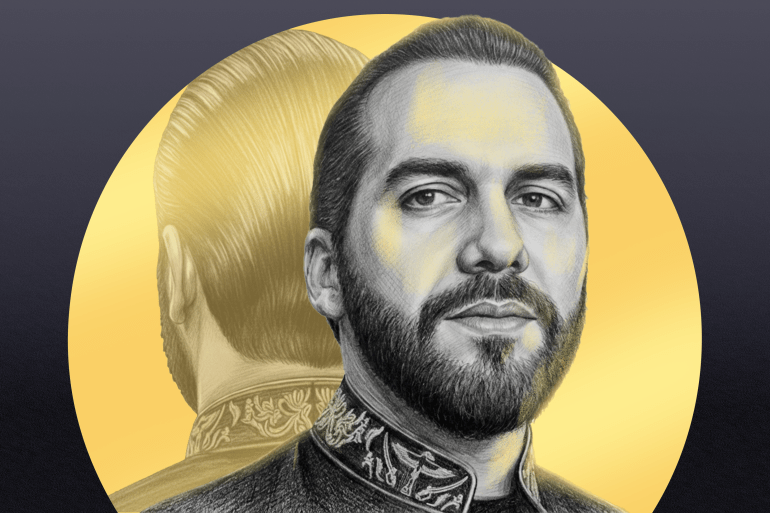
Who Is Nayib Bukele? El Salvador’s ‘coolest dictator’
At 44, Bukele has built the world’s highest imprisonment rate and scrapped presidential term limits. What comes next?
Save

Published On 2 May 20262 May 2026
On Friday, March 25, 2022, hundreds of cellphones in the small, Central American nation of El Salvador glowed with the same text message: “Adelante” (“go ahead”).
The heavily tattooed gangsters of Mara Salvatrucha (MS-13) had their order. They went on a rampage, gunning down 62 people across the nation on Saturday, the bloodiest day in El Salvador since the 1980s civil war. By Sunday, 87 lay dead.
The killing spree was calculated. One victim was deliberately dumped on the road leading to Surf City, a tourist development part of President Nayib Bukele’s efforts to position El Salvador as a tropical paradise for holidaymakers and tech entrepreneurs. The gangsters wanted to send Bukele a message: this is what happens if you push us.
Bukele’s response was swift. As parliament granted his request for a state of emergency to rein in gang violence, all constitutional rights were suspended. Suspected gang members, including children, were detained in prison indefinitely. Soldiers and law enforcement manned checkpoints, stopping buses and demanding male passengers get out and lift their shirts to check for gang tattoos.
More than 10,000 alleged gang affiliates were rounded up in just over two weeks. By 2026, some 1.9 percent of the population, or one in 50 Salvadorans, was being held in confinement – the highest imprisonment rate in the world, prompting serious concern about human rights violations. One legal study found that the mass arrests may have led to crimes against humanity. By Bukele’s own admission, thousands of innocent civilians have been caught in the dragnet. The state of emergency is now in its fourth year.
Advertisement
Many Salvadorans, however, could not be happier.
An opinion poll in January suggested Bukele’s approval rating was 92 percent. In just a few years, El Salvador has gone from being the country with the highest murder rate in the Western Hemisphere to being the safest. Many no longer fear walking in the streets at night or accidentally straying into the wrong neighbourhood.
“They say, these international organisations, that he is not giving these gangsters their human rights, that he is not feeding them pupusas [tortillas],” said a businessman standing in San Salvador’s Cuscatlan park – once a derelict hotspot for muggings, now a symbol of the capital’s regeneration.
“They say we are living in a dictatorship. But it was a dictatorship we were living in before, under the gangs. Now we go to church each week to thank God for the liberty we have now. If this is a dictatorship, sign me up!”
Bukele’s popularity extends beyond his home. Throughout Latin America, from Mexico to Chile, citizens fed up with lawlessness are demanding their own Bukele. But there are signs that, besides organised crime, journalists and civil society members too have been arrested, forced into exile or intimidated into silence by Bukele’s government, under whom presidential term limits have been abolished.
“Now he can be re-elected as many times as he wants, and people are being told that if another government comes in, all the gangs will be released and the country will go back to the way it was, and that’s why Bukele must remain,” said Samuel Ramirez of the Movement of Victims of the Regime (MOVIR), which aids the victims of arbitrary arrests.

While opponents accuse him of tyranny, Bukele, 44, presents a polished, even playful public persona, eschewing a formal suit and tie for a back-to-front baseball cap and a bomber jacket.
“He’s like a teenager who’s always on his phone, constantly scrolling through tweets and jumping from one social network to another; he’s not a sensible guy who studies, reads, prepares, or is interested in understanding the country’s problems and finding solutions,” Bertha de Leon, a high-profile lawyer working on cases of violence against women, told Al Jazeera. She was Bukele’s lawyer for about five years, but now is one of the president’s harshest critics.
“In El Salvador, there’s no politics, no real government plan, no state policy, nothing. It’s just an impulsive guy who makes decisions on a whim.”
Advertisement
While El Salvador becomes one of the world’s most extreme police states, does the self-described “world’s coolest dictator” plan to reign forever?
The ‘class terrorist’
Nayib Bukele was born in the capital, San Salvador, on July 24, 1981, during the Salvadoran Civil War. A period of turmoil in the 1970s ended in a coup d’etat bringing a far-right military government into power. When San Salvador archbishop Oscar Romero, who stood up for the poor and denounced the ruling government’s abuses from the pulpit, was shot dead in 1980 while celebrating mass, the left-wing Farabundo Marti National Liberation Front (FMLN) announced its uprising from the mountains and jungles. The ensuing civil war claimed 75,000 lives, the vast majority at the hands of the military and death squads slaughtering suspected rebel sympathisers among villagers.
Nayib Bukele grew up privileged, in a wealthy family unaffected by the war. From his mother, Olga Marina Ortez, he has three younger brothers: Karim, and twins Yusef and Ibrajim. But his father, Armando Bukele Kattan, was a polygamist, and Bukele has another six half-siblings. Armando was a prosperous businessman of Palestinian Christian origin who converted to Islam and opened the country’s first mosque.
Descendants of immigrants from the early 20th century, Palestinian Salvadorans endured a lot of prejudice. Racist laws during the military dictatorship of the 1930s barred them, along with others of Middle Eastern or Asian origin, from opening businesses, even if they were Salvadoran citizens. Bukele’s father and uncles were sympathetic to the FMLN, even hosting rebel commanders at their homes. Armando Bukele was close friends with FMLN’s cofounder Schafik Handal, who, too, was of Palestinian descent.

The war ended in 1992, and the FMLN became a legitimate political party alongside the conservative Nationalist Republican Alliance (ARENA), founded by a notorious death squad chief.
As a teenager, Bukele attended the Panamerican School in San Salvador – a small, private, bilingual English-Spanish school for upper-middle-class families.
“He was a pretty normal kid, nothing special to highlight, neither good nor bad,” remembered Oscar Picardo, the editor of the newspaper El Diario de Hoy, who was Bukele’s teacher in 1994.
“Although he had a group of friends that today work next to him within the government.”
Fellow pupils remembered him as talkative and always cracking jokes, always making his classmates laugh at his impression of cartoon character Mr Magoo. His ambition, or perhaps need for recognition, was already apparent in his final year of high school when he ran for class president. His classmates were bored by the idea, leaving him as the sole candidate.
Because of their Arab background, the Bukeles were stopped by airport security upon returning from a family trip shortly after the 1998 US embassy bombings in East Africa. Following the experience, Bukele called himself the “class terrorist” in his yearbook profile.
Advertisement
In 1999, Bukele enrolled in law school at the Jesuit-run Central American University, but dropped out several months later to work at Brand Nolck Publicidad, his family’s PR firm. In about 2001, he began managing a nightclub named Mario’s, which at the time had a sleazy reputation – its waiters were suspected of serving drugs to customers. Eventually, he bought the club himself and renamed it Code. In 2003, the young businessman met the ballet dancer and psychology student Gabriela Roberta Rodriguez Perezalonso. They married in 2014.
Building the Bukele brand
In 2011, 29-year-old Bukele put aside the family business and entered politics. Why, exactly, is unknown.
“I got up from my comfortable couch to do something for the country,” he said in a 2012 televised debate, without elaborating further.
Despite his own political tendencies, Armando warned him against entering politics, saying he could end up wasting a lot of time and money only to be cast aside. Bukele steamed ahead regardless, jumping into the mayoral race for Nuevo Cuscatlan, a town on the green, hilly outskirts of San Salvador. Bukele easily secured the nomination for the FMLN, which was also a client of the family PR business, while his family’s wealth enabled him to self-finance the campaign. The FMLN had nothing to lose by letting an outsider run on their behalf with their own money in an ARENA stronghold.
While campaigning as a leftist, promising progressive taxes, better healthcare, public services and infrastructure investment as part of the FMLN, Bukele distanced himself from them. Instead of the traditional red and white party colours, his campaign posters had his name in white against a blue background. He told advisers this was to avoid alienating conservatives.
“I’m of the post-war generation, a generation that has new ideas,” he told a TV interviewer at the time.
Bukele managed to gain the endorsement of a relative of former ARENA President Tony Saca, swinging the conservative vote in his favour and pushing him over the victory margin in 2012 by 2 percent of the vote. Even before taking office, he had LED streetlights installed in Nuevo Cuscatlan, convincing residents he was using his personal wealth for good.

As mayor, Bukele opened a library, community centre and a 24-hour clinic. As he cut the ribbon, he uttered what later became his 2019 presidential campaign slogan: “There’s enough money when no one steals.”
Except there wasn’t enough money: by 2014, the town’s debt had grown by 320 percent. This exemplified Bukele’s model of governance: just plough ahead with projects and worry about the budget or red tape later. Still, his projects played well in the media, and the mayor became extremely popular. Bukele maintained a high-profile social media presence. He always looked sleek in his videos: wearing slacks, shiny shoes, a white shirt with the sleeves rolled up to his forearms, and a thick layer of gel in his hair.
“He was always very media-savvy,” de Leon, who initially connected with Bukele over social media in 2015, told Al Jazeera.
“He promoted a campaign about completing a project every day, for example … Successful advertising campaigns were paid for with state funds, even though they don’t reflect reality at all. So I’d say it was poor management, but in terms of propaganda, it was good, and that’s precisely what garnered him the support to become president.”
Advertisement
Leaving his mark on Nuevo Cuscatlan, Bukele had the old mayoral coat of arms replaced with a new emblem: a white N in a circle against a blue background – an N for the town’s name, but also an N for Nayib. He was building his own brand, independent of any party, and openly criticised the FMLN, adding to his popularity.
“I feel disappointed in the government,” he said of the once-revolutionary party in 2012.
“It is the most right wing in all of Central America; it is not a left-wing government.”
At the time, Bukele identified as part of the “radical left”.
“I want radical changes in El Salvador, where the law of the jungle should no longer prevail,” he told an interviewer.
“In today’s world, there are radicals like me who want changes without having to wait so long.”
Nevertheless, the FMLN noticed his success and encouraged him to run for mayor of San Salvador, which was about to become one of the most dangerous cities on the planet.
Applegate
During the 2015 San Salvador mayoral race, Bukele largely ignored the FMLN (repeating the same strategy that won him his earlier posting) and instead relied on friends and family like his brother Karim, who was seen whispering in his ear during commercial breaks in the 2015 mayoral debate. In a public address, Bukele acknowledged Karim’s advice, describing him as “someone I trust.”
Family friends told El Faro – Central America’s first online newspaper, founded in El Salvador – that while Nayib is quick-witted, Karim is more thoughtful and analytical and helps shape government policy.
FMLN leader Fabio Castillo, who supported Bukele’s bid for mayor, described the brothers’ influence in an interview with El Diario de Hoy: “His father [who passed away in 2015] was a brilliant and upright man, influenced the president a great deal, but he’s dead now … The only one who can influence him is his brother Karim, who is smarter than the president. But he has a flaw — he gets the president all wound up and excited about too many things.”
This assessment of Bukele as someone who jumps from idea to idea was shared by de Leon.
“In general, he can be quite a scattered person,” she reflected.
“He doesn’t focus on a specific topic and rambles a lot … and easily gets distracted watching content on his phone.”

Bukele’s opponent in the mayoral race, Norman Quijano, was an old-school ARENA anti-communist. When a TV journalist pressed Quijano to describe his fellow contender, the veteran politician dismissed him as being “too young”.
Within hours, Karim called a meeting of the campaign team. Just as Nayib did in high school, the Bukele brothers turned the negativity around. “You’re too young” became the unofficial campaign slogan: hundreds of T-shirts bearing the logo were handed out through the city, while the hashtag #You’reTooYoung flooded social media. Bukele won more than half the vote.
As in his previous post, Bukele loved unveiling grand projects such as 100% Illuminado: installing lamps on every street in San Salvador. But his probably most talked-about project was the Mercado Cuscatlan in the capital’s neglected downtown, an extravagant four-storey complex containing a library, restaurants, rooftop bar, free Wi-Fi and two children’s play areas that was inaugurated in 2016. As before, Bukele tended to ignore bureaucracy such as zoning laws and budget approvals, holding one-on-one meetings with businessmen without including the rest of the council. The property was rented at $96,000 per month, twice the market rate, and by 2023, the mayor’s office owed $5m in unpaid rent.
Meanwhile, El Salvador found itself in the throes of another type of war.
El Salvador’s three main gangs, or maras — MS-13, 18th Street and its splinter faction, the 18th Street Revolutionaries – were actually born on the streets of Los Angeles. In the 1980s, tens of thousands of Salvadoran refugees poured into the city. Banding together partly to protect themselves from local thugs, some eventually turned to crime themselves. After the war was over, they were deported home, flooding violent offenders into a shattered country too ill-equipped to absorb them.
El Salvador isn’t a major narcotrafficking corridor, so the sort of cartels found in nearby Mexico or Honduras don’t exist. Instead, the maras’ main business was extortion: shaking down businesses for protection money. Bus drivers were a favourite target, frequently murdered for driving through a gang’s territory without paying a tax. The gangs controlled entire neighbourhoods through fear, and disrespecting a mara member meant death.
“There was almost absolute control of the territory by the gangs,” the director of a human rights NGO, who requested anonymity for fear of reprisals, told Al Jazeera.
“Daily life [for people in those territories] was complicated. [Gangs] would control who could enter or leave the community. People would hear or see murders taking place in front of their homes, and in particular, girls, teenagers, women were subject to sexual violence.”

In 2012, the FMLN government tried mediating a gang truce with the help of Catholic bishops, awarding jailed kingpins with comfier cells under more relaxed conditions. The murder rate began dropping almost immediately. But less than two years later, the new government scrapped the deal and gang warfare was back with a vengeance: by 2015, El Salvador reached an astronomical murder rate of 104 per 100,000 people: 20 times worse than the US, for instance. More than 6,650 Salvadorans were murdered that year.
The authorities’ response was mano dura, or “iron fist”. Young people standing in groups of three or more could be jailed by police for “illegal congregation”. Caught between the police and the gangs, younger generations began fleeing the country, prompting a child refugee crisis in the United States.
“The police had a strong stigma towards the communities where there were gangs, and rather than protecting them, there was always a suspicion of people living in those communities,” the NGO director explained.
At the time, Bukele didn’t approve of the iron fist, considering it a war against the poor.
“If you have a headache, what would you take? A Tylenol. But what you have isn’t a Tylenol deficiency,” he told an interviewer.
“You are stressed, or you are dehydrated, or something more severe. So you take two, and then that doesn’t work, and you take four, and then 10 … Here, Tylenol is the police. People want more police, and I understand. It’s dangerous here – they have a headache, they want the Tylenol. But that won’t solve the problem.”
But he may have had conflicts of interest. In 2025, two leaders of the 18th Street Revolutionaries claimed to El Faro they’d been paid a quarter of a million dollars to intimidate residents into voting for Bukele for mayor.
After the story was published, the treasury ministry launched an investigation into the newspaper for tax evasion, and its journalists were forced to flee the country after learning there were warrants being prepared for their arrest. El Faro now operates from exile in Costa Rica.
Bukele’s disdain for the legacy media goes back to his mayorship. When two of the nation’s biggest newspapers, La Prensa Grafica and El Diario de Hoy, criticised him in 2017, five young people created spoof versions of the newspapers’ websites with parody headlines, with Bukele’s open encouragement. The attorney general charged the young satirists with cybercrimes and copyright violations. Bukele, fearing he too may be prosecuted, enlisted Bertha de Leon as his lawyer, marking the beginning of their working relationship.

Another, more serious episode took place later that year. An argument erupted in a city hall meeting over building permits, ending with Bukele throwing an apple at a councilwoman.
“Take this apple home, you witch!” he snapped.
Bukele hired de Leon to represent him in court, but his accuser failed to appear, and the case was dropped.
“He’s characterised by being an extremely impulsive person, and he has a really fragile ego because he can’t tolerate any kind of contradictions,” de Leon said.
The FMLN expelled Bukele over Applegate. Not long afterwards, he announced he was forming his own party: New Ideas.
De Leon noted Bukele’s ideological shift.
“His discourse was progressive left wing. For example, he spoke about the rights of the LGBT community. He met with them, he took pictures. He talked about women’s rights, too. Well, in the end, it was all just a campaign issue. In practice … he clearly has no ideology. One minute he’s wearing a red shirt, the next he’s wearing an orange one, and he doesn’t care,” she said.
“And now, his style of governing is far right. I mean, he’s even talked about gender ideology, he’s banned inclusive language, he clearly has extremely sexist policies. All the progress that had been made – for example, on health, sexual and reproductive health for girls and women – all of that has been lost.”
Among other things, Bukele has upheld El Salvador’s strict abortion ban.
“Bukele’s policy is about convenience: it’s not an ideology in terms of principles or comprehensive public policy, it’s more of a question of what is convenient for him at that moment,” added the NGO director.
The world’s ‘coolest dictator’
With the FMLN out of the picture, the Bukele brothers took on an even more central role in Nayib’s campaign. Karim served as campaign manager, while Yusuf supervised key polling stations in the capital.
Bukele was elected president with more than half of the vote in February 2019. He was only 37 years old. To celebrate, Latin America’s youngest head of state-elect gathered with supporters at a plaza in downtown San Salvador, blasting Coldplay’s Viva la Vida through loudspeakers.

A few months later, on June 1, came his inauguration at the historical Gerardo Barrios Plaza. Spectators loudly booed every other lawmaker present, while Bukele was cheered. With his heavily pregnant wife at his side, he gave a speech.
“We are expecting our first baby daughter. Her name will be Layla. And for her and for everyone’s children, we must make a better country.”
Bukele appointed a cabinet staffed chiefly by friends, family and business associates. His brother Ibrajim confirmed to El Faro he’d personally interviewed 270 prospective officials. But his closest circle consists of his brothers.
“Although it’s true that they don’t have formal positions in the state, to hide the nepotism a little, but all the brothers make important and transcendental decisions for the citizens of El Salvador,” said de Leon.
“Institutions have been distributed: one brother controls one institution, one controls another … I would say Karim Bukele is the one who is really pulling the strings, and Bukele is more of a puppet.”
Meanwhile, his ascent on social media continued. During his first week in office, he gained one million Twitter followers. Shortly after assuming office, Bukele snapped a selfie while addressing the United Nations.
“If you’ll just bear with me a second,” he grinned, looking towards his phone.
“Believe me, many more people will see that selfie when I share it than will listen to this speech – I hope I took a good one.”
In February 2020, events took a darker turn when lawmakers refused to approve Bukele’s $109m national security budget, citing a lack of transparency over how the funds would be spent. Bukele supporters gathered outside the National Assembly, spurred by their president’s call for an insurrection if the government disobeyed the will of the people. A convoy of vehicles drove up, and Bukele, dressed in a business suit with no tie, stepped out from one of the cars.
“Wait here,” he told his followers, before striding inside, followed by armed soldiers clad in combat fatigues. Bukele took a seat while the soldiers assumed positions throughout the hall with automatic weapons at the ready.
“I think it’s clear who’s in control of the situation,” he said, addressing the shocked lawmakers through a microphone, before turning his palms to his face and appearing to pray. He then stood up and left, together with the troops.
“I asked God,” he told his supporters outside, “and God said to me, ‘Patience.’”
Bukele has always been ambiguous about his spiritual beliefs, saying he “respects all religions”. A month-and-a-half later, he admitted in an interview with Puerto Rican rapper Residente that he indeed deployed soldiers to intimidate legislators.
For de Leon, this was the breaking point.
“I believe the cordial and trusting relationship we had while I was his lawyer began to erode after he was elected president,” said de Leon.
“I always tried to give him my opinion because at first, I thought he was a well-intentioned but immature, impulsive man. I was speaking in good faith and I wanted to offer advice as much as possible. But his responses were always like, ‘Well, don’t be a spoilsport.’ So the February 2020 takeover of the assembly was the final straw.
“We’d been disagreeing for a while, and he’d clearly tell me no, or he’d just leave me on read. But the criticism I made on Twitter when he took over the assembly with the military really hurt him because that was clearly the last time we communicated. He said he’d never forgive me for that.”

While most of the world imposed strict measures during the coronavirus pandemic, El Salvador was exceptional: anyone breaching quarantine was detained in “containment centres” (de facto prisons) indefinitely. When the Supreme Court twice declared such measures unconstitutional, Bukele simply ignored them, joking, “If I really were a dictator, I would have [the judges] all shot.”
The next year, the entire Supreme Court was replaced with appointees selected by Bukele’s party, New Ideas, which now enjoyed a supermajority in parliament. The new judges let Bukele stand for re-election, even though the president was constitutionally forbidden from serving two consecutive terms. After an American diplomat warned of “a decline in democracy,” Bukele changed his Twitter bio to read “the coolest dictator in the world”.
Bukele largely eschewed legacy media, instead preferring to sit down with YouTubers and podcasters with millions of subscribers, while blocking the likes of El Faro from attending his news conferences. Their earlier coverage of him had been less than flattering.
“I’ve found that, for the most part, journalism often functions as propaganda,” he told Time.
“With the rise of social media, it’s a way to reach the population directly without going through the press filter.”
Foreign influencers, including right-wing Americans, have flocked to El Salvador, promoting Bukele to their millions of followers. But the president’s popularity may not be entirely organic. For example, when the hashtag #BukeleDictador (“Bukele dictator”) began trending on social media during the coronavirus pandemic, it was quickly surpassed by #QueBonitaDictadura (“what a beautiful dictatorship”), posted by accounts that appeared so chronically online that Crisis Group researchers concluded they were almost certainly bots.
Bitcoin City
Perhaps most illustrative of Bukele’s unusual, cyber-savvy vision was his experiment with Bitcoin: attempting to make El Salvador the first nation on Earth to accept cryptocurrency as legal tender.
He asked a young American tech entrepreneur named Jack Mallers, who built an app called Lightning that allows Salvadorans abroad to transfer remittances via Bitcoin, to help draft the country’s Bitcoin Law. After announcing its plans via videolink at the Bitcoin Conference in Miami in September 2021, El Salvador held a weeklong Bitcoin promotional event at the beachside resort of Mizata.
At the close of the event in November, Bukele strode out before a cheering audience as a stage erupted with a fountain of sparks. Behind him, the words EL PRESIDENTE (the president) appeared in neon-blue letters. Dressed all in white with his trademark back-to-front baseball cap, he addressed the audience, unveiling plans for a Bitcoin City: “When Alexander the Great was conquering the world, he established Alexandrias … these Alexandrias would be like beacons of hope for the rest of the world … We should build the first Alexandria here, in El Salvador. So actually, what I was going to present to you … Bitcoin City.”

Bitcoin City was to be a new urban centre powered by the geothermal energy of a nearby volcano, paid for by Bitcoin bonds.
But the plan never took off. Many Salvadorans were angry about the Bitcoin Law, which they felt was imposed undemocratically and would lead to more economic instability, since Bitcoin’s value can fluctuate wildly. Protests and even riots broke out in San Salvador, with Bitcoin ATMs being set on fire – a rare display of disapproval for Bukele’s regime.
In the end, most businesses never completed a Bitcoin transaction. Those that did were mainly large corporations such as McDonald’s, and Bukele’s bold experiment was rolled back in early 2025. Bitcoin City is yet to be built.
But Salvadorans had more immediate concerns on their minds.
State of emergency
Like his predecessors, Bukele’s administration initially negotiated with organised crime (although the government publicly denied it), offering to ease prison conditions and law enforcement in exchange for reining in the killing. For a time, it worked: between 2019 and 2020, the homicide rate nearly halved, falling more than five times lower than the deadly peak of 2015.
But then came the weekend bloodbath of March 2022.
El Faro’s reporting suggested the nationwide massacre was provoked by the arrest of a group of mob bosses while they were travelling in a government vehicle, which they considered a betrayal of their agreement.
The state of emergency transformed El Salvador. As thousands of suspected gangsters – officially branded as “terrorists” – were rounded up, Bukele posted gleeful commentary on social media.
“He must have been eating fries with ketchup,” he wrote beside a picture of a roughed-up suspect.
“There will always be a mother of a gangster, a family member, or a friend who isn’t going to like that we are cleansing that cancer,” he said.
Under the ongoing state of emergency, anyone can theoretically be jailed without due process. Merely having tattoos or acting nervously was enough to be profiled as a gang member.
“There were completely arbitrary arrests, where people were at home, coming to or from work, and there was no crime involved,” stated the NGO director.
“There have been thousands of arrests that do not have a legal basis, and … basically the pattern is: ‘First I catch you, and then I see what I can accuse you of.’”

In January 2023, Bukele opened a maximum-security facility, the Center for the Confinement of Terrorism (CECOT), to house the ballooning prison population. There, hundreds of prisoners are crammed together in mesh cages, with no privacy, no outside exercise, no family visits, no ventilation, and no idea when, if ever, they’re getting out.
“I can clearly say that there is a policy of systemic torture in prisons,” the NGO director said.
“Where there should be 30 people [in a cell], there are more than a hundred. People quickly get skin diseases due to the unhygienic conditions. There’s a lack of food and water. And there have also been testimonies of beatings, the use of tear gas, even some of those beatings and lack of medical attention have led to death. And there are also reports of sexual assaults within prisons.”
With more than one in every thousand Salvadorans now behind bars, El Salvador has the highest rate of imprisonment in the world. Basic freedoms such as the right to privacy have been curbed. But the crackdown worked. Gang members have disappeared from the streets. Merchants no longer pay an extortion “tax”. Children now play in playgrounds and football pitches, once abandoned as no-man’s land between gang territories. From 2021 to 2024, the murder rate dropped nearly tenfold to 1.9 per capita, more than twice as safe as the US.
Despite the gang menace finally being contained, there has been no easing of security: in April, a new law was approved allowing life imprisonment for defendants as young as 12.
“I don’t like the system we have now, it’s very extreme, but I understand and accept it because it’s necessary,” explained a hostel owner in Santa Ana, the country’s second-largest city.
“Even though the system is very strict, I don’t agree that we remove it now, because gang members will want to come back. If only 10 gang members walk freely in the streets, the problem begins again.”
Bukele’s uncompromising stance on law and order has won him allies and admiration from abroad, including from US President Donald Trump. Last year, Bukele offered Trump the use of CECOT to hold 238 Venezuelan deportees from the United States. An American federal judge issued a restraining order deeming the deportations unlawful, but the Trump administration had already gone ahead anyway. “Oopsie … Too late,” Bukele tweeted trollishly.

But civil society, too, has felt the force of Bukele’s crackdown. New laws have muzzled the media: now, journalists can be imprisoned for 10 years for reporting using underworld sources or anything else that can “panic” the public. Journalists and activists have had their phones hacked with the Pegasus spyware. And in May last year, one of Bukele’s most outspoken critics, Ruth Lopez, a lawyer from El Salvador’s leading human rights organisation Cristosal, was arrested for embezzlement. Among other cases, Lopez represented the Venezuelans imprisoned in CECOT without due process.
“A fundamental idea of Bukele is that human rights are like a moral prize only for honest people, that those who aren’t honest don’t have rights,” said Picardo.
“So the organisations that work for the human rights of prisoners are stigmatised negatively.”
“Bukele has shown he doesn’t care what price he has to pay to gain power and achieve his goals,” warned de Leon.
“It doesn’t matter if he has to violate the Constitution, if he has to imprison those who hold differing opinions, if he has to eliminate the independent press. In other words, he has no scruples, no ideology, no principles. That’s why he’s very, very dangerous.”
After falling out with the president, Bukele’s former lawyer left El Salvador in 2021 after an investigation was opened against her on a variety of criminal charges, including alleged child abuse. She now lives in Mexico.
“I was subjected to online attacks; they accused me of being a gang lawyer, and my clients dropped to almost zero,” she said.
“I was always followed on a motorcycle, I even had drones flying in the courtyard of my house. But the main reason why I left was the criminal cases launched against me, so I feared for my freedom and made the decision to leave the country and ask for asylum.
“I think he is fascinated by power, and all the business he is doing with public money,” concluded de Leon.
“I think his real motivation was never to do something different and raise El Salvador out of misery, but to be the centre of attention and profit as much as possible from the state.”