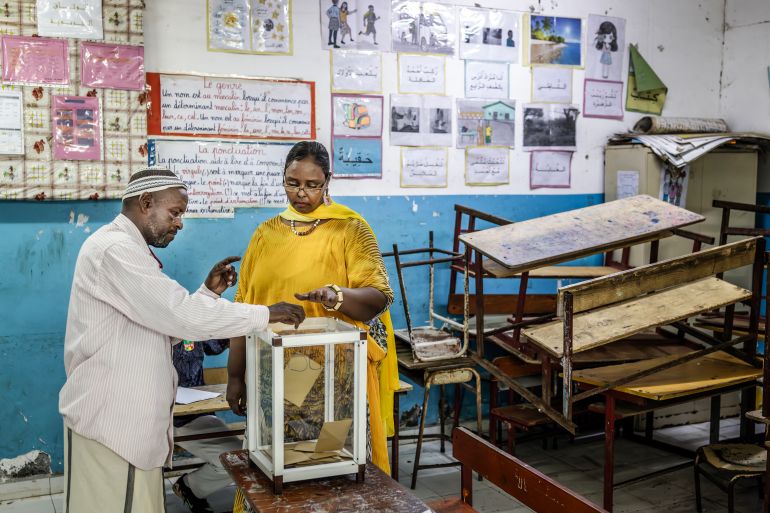
Djibouti votes as long-time leader seeks sixth presidential term
Lawmakers scrapped presidential age limit last year, allowing incumbent Ismail Omar Guelleh to compete for another term.
Save


Published On 10 Apr 202610 Apr 2026
Voters in Djibouti are heading to the polls to choose their next president, with incumbent leader Ismail Omar Guelleh expected to easily secure a sixth term after politicians last year scrapped presidential age limits.
Just over 256,000 voters are eligible to cast ballots in Friday’s election between Guelleh, 78, and his only opponent, Mohamed Farah Samatar, the leader of the Unified Democratic Centre (CDU), a party with no seats in parliament.
Recommended Stories
list of 4 itemsend of list
At city hall, where Guelleh is due to vote, only a handful of voters had turned up when the doors opened, with turnout remaining generally low in the early hours, AFP reported. In the capital, Djibouti City, some polling stations opened late, the news agency said.
Human rights groups have accused authorities of abuses and repressing freedom of political activity. The government has denied the allegations. Two of the main opposition parties have boycotted elections since 2016.
Polling stations will close at 6pm local time (15:00GMT). Provisional results are expected shortly after or by Saturday morning, according to electoral authorities, as reported by the state-run news agency.
Several international organisations are observing voting, including the African Union (AU), the Organisation of Islamic Cooperation (OIC) and the League of Arab States.
Guelleh has governed the small nation in the Horn of Africa since 1999, when he succeeded Hassan Gouled Aptidon, the founding president of the country with about a million people.
Guelleh won re-election in 2021 with 98 per cent of the vote.

‘We have preserved peace’
Though Guelleh was originally ineligible to stand in this election due to age limits, politicians removed the restriction last year, paving the way to extend his 27-year rule.
Advertisement
“The scrapping of term limits in Djibouti is less about electoral competition and more about preserving regime continuity in a highly strategic state,” Mohamed Husein Gaas of the Raad Peace Research Institute told the Associated Press news agency.
“While it raises concerns about democratic backsliding, external actors are likely to prioritise stability given Djibouti’s critical role in Red Sea security and global trade routes, especially amid ongoing tensions in the Middle East,” he said.
Stability was key in Guelleh’s election campaigning.
“Let us remember we have managed to maintain the stability of our country in an unstable region. We have preserved peace when others have descended into chaos,” he said last month.
Djibouti hosts important military bases for the United States, France, China and other powers, earning it a reputation as the country with the most foreign military bases. It is also an important port hub for landlocked neighbours such as Ethiopia.
Since 2023, several commercial ships damaged in attacks by Houthi fighters in Yemen have docked there.