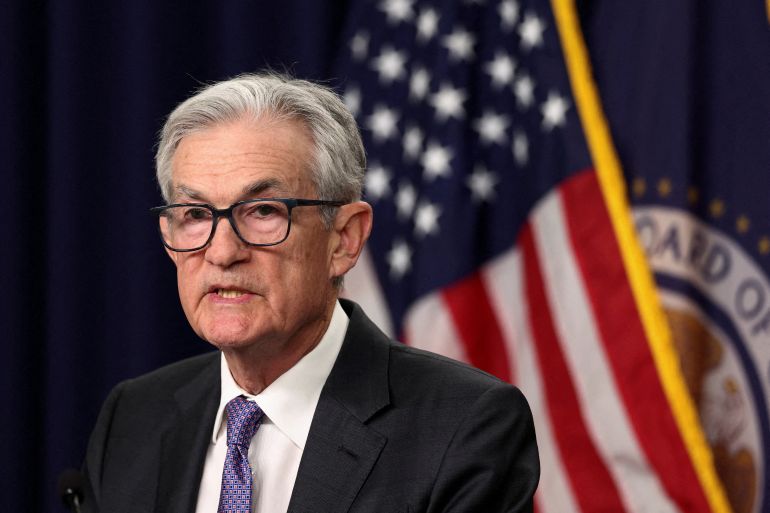
US judge upholds decision to toss subpoenas into Fed Chair Jerome Powell
Judge James Boasberg says Trump administration’s arguments ‘do not come close to convincing the Court’ of the subpoenas’ legitimacy.
Save

 By Al Jazeera StaffPublished On 3 Apr 20263 Apr 2026
A United States federal judge has once again batted down a pair of subpoenas from the administration of President Donald Trump seeking information about Jerome Powell, the chairman of the Federal Reserve, the country’s central bank.
In a brief, six-page opinion published on Friday, Judge James Boasberg rejected the Department of Justice’s motion to reconsider his earlier ruling rejecting the subpoenas.
Recommended Stories
list of 3 itemsend of list
“The Government’s arguments do not come close to convincing the Court that a different outcome is warranted,” Boasberg wrote.
On March 13, Boasberg, a judge for the federal court in the District of Columbia, nullified the subpoenas on the basis that they were issued for an “improper purpose”: to pressure Powell into compliance with the president’s demands.
Trump and Powell — an appointee from the president’s first term — have been at loggerheads since the Republican leader returned to the White House in January 2025.
Although the Federal Reserve is an independent government agency, not subject to political demands, Trump has repeatedly called on the bank to slash interest rates, and he has denounced Powell as “incompetent”, “crooked” and a “fool” for not following suit.
For months, pressure had been building from the Trump White House to investigate Powell and push him prematurely from his job as Federal Reserve chair. Powell’s term is slated to expire in May.
Much of the Trump administration’s focus has fallen on renovations to the Federal Reserve’s historic 1930s buildings in Washington, DC, which have gone over budget.
Advertisement
The administration has pointed to the cost overruns as evidence of malfeasance.
Last July, for instance, Trump appointee William Pulte called on Congress to investigate Powell for “political bias” and “deceptive” testimony related to the renovation project.
The following month, Trump posted on his platform Truth Social that he was considering “a major lawsuit against Powell” in response to “horrible, and grossly incompetent” work on the renovations.
The pressure reached a climax on January 11, when Powell made a rare statement announcing he was under a Justice Department investigation over the renovation project. He dismissed the probe as a “pretext” to undermine the Federal Reserve’s leadership over monetary policy.
“The threat of criminal charges is a consequence of the Federal Reserve setting interest rates based on our best assessment of what will serve the public, rather than following the preferences of the president,” Powell said.
The Federal Reserve has since sought to have the subpoenas into Powell’s behaviour tossed.
Boasberg sided with the central bank in his initial ruling, and in Friday’s opinion, he called the Trump administration’s efforts to change his mind insufficient.
The Justice Department had argued that it does not need to produce evidence of a crime to seek a grand jury subpoena.
Boasberg agreed with that point, but he said subpoenas were also subject to a legal standard that bars them from being issued for “improper” purposes.
“The subpoena power ‘is not unlimited’ and may not be abused,” Boasberg wrote, citing court precedent.
He therefore ruled that the lack of evidence overall against Powell was relevant to the legality of the subpoenas.
“The controlling legal question is what these ‘subpoena[s’] dominant purpose’ is: pressuring Powell to lower rates or resign, or pursuing a legitimate investigation opened because the facts suggested wrongdoing,” Boasberg said.
“Resolving that question requires probing whether the Government’s asserted basis for the subpoenas — suspicions of fraud and lying to Congress — is colorable or tenuous. That inquiry, in turn, means asking how much evidence there is to back up the Government’s assertions.”
Boasberg underscored that he has seen no suggestion that Powell committed criminal wrongdoing and pointed to the long list of statements Trump has made attacking the Federal Reserve chair, suggesting an ulterior motive.
“The Government’s fundamental problem is that it has presented no evidence whatsoever of fraud,” he concluded.
Advertisement
Friday’s ruling is likely to set the stage for the Trump administration to appeal. US Attorney Jeanine Pirro has previously denied any political motivation for the investigation.
She has also asserted that Boasberg is “without legal authority” to nullify the subpoenas.