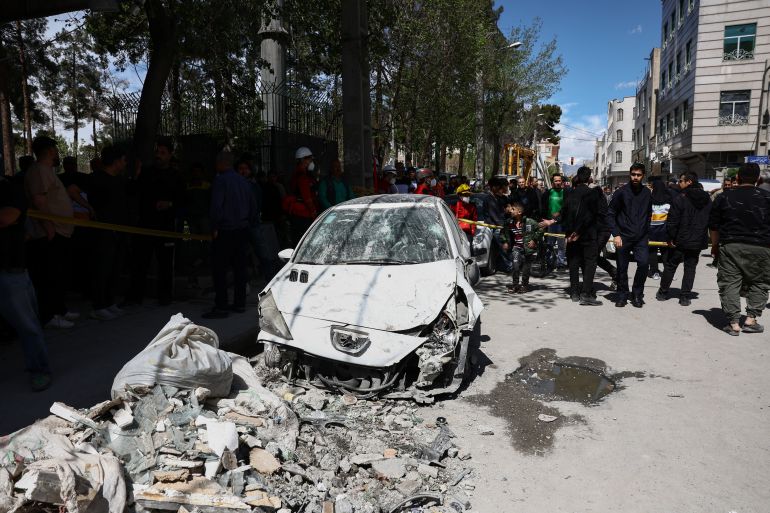
Israel launches strikes on nuclear sites as Iran warns of retaliation
Uranium facility, steel plants and heavy water complex among targets hit as IRGC warns of escalation.
Save


Published On 27 Mar 202627 Mar 2026
Israel has struck a uranium processing facility in the central Iranian city of Yazd, the Israeli military confirmed, in an escalatory move that comes as regional diplomats have been attempting to broker an agreement to halt the joint US-Israeli war on Iran.
The Israeli Air Force said it hit a plant used to extract raw materials essential to the uranium enrichment process, describing it as a “unique facility” in Iran’s nuclear infrastructure. Iran’s Atomic Energy Organization confirmed the strike, but said there were no casualties or radiation leaks.
Recommended Stories
list of 3 itemsend of list
Friday marked day 28 of the conflict, and the assault on Yazd was part of a broad wave of strikes on sites across the country.
The Khondab Heavy Water Complex in central Iran was also hit.
Two major steel plants, the Khuzestan Steel facility in the country’s southwest and the Mobarakeh Steel complex in Isfahan, were also struck, with Iran’s Mehr news agencies both reporting damage to an electrical substation, an alloy steel production line and a warehouse.
Foreign Minister Abbas Araghchi said Iran will “exact heavy price” for Israeli attacks on several important infrastructure sites. “Israel has hit 2 of Iran’s largest steel factories, a power plant and civilian nuclear sites among other infrastructure,” said Araghchi in a post on X.
Strikes also hit areas in and around Tehran, the city of Kashan and Ahwaz, while 18 people were killed in Qom.
More than 1,900 people have been killed in US-Israeli attacks on Iran since the war began on February 28.
Advertisement
Iranian officials said US-Israeli strikes have damaged at least 120 museums and historical sites across the country since hostilities began.
Negar Mortazavi, a senior non-resident fellow at the Center for International Policy, told Al Jazeera that even Iranians who had been critical of their own government increasingly view the war as an assault on the Iranian people rather than its leadership, saying the targeting of water, electricity, gas, cultural heritage, schools and hospitals was “unacceptable.”
Israeli Defence Minister Israel Katz said Israel would “intensify” its campaign and expand the range of sites it targets, accusing Tehran of deliberately directing missiles at Israeli civilians.
IRGC Aerospace Commander Seyed Majid Moosavi warned that the conflict was entering new territory, saying “the equation will no longer be an eye for an eye.” He urged employees of US and Israeli-linked industrial companies across the region to immediately vacate their workplaces.
Al Jazeera’s Ali Hashem, reporting from Tehran, noted that the strikes on two major Iranian nuclear facilities could prompt the IRGC to target Dimona again, Israel’s nuclear site, as it did last week.
Prior to Friday’s strikes, US President Donald Trump said Thursday he had pushed back planned attacks on Iran’s energy infrastructure by 10 days, to April 6, saying negotiations to end the war were “going very well”.
Iranian officials flatly rejected that characterisation, describing Washington’s proposal to end the war as “one-sided and unfair” and outlining their own list of conditions, which include war reparations and the recognition of Iranian control of the Strait of Hormuz.
On Friday, an Iranian official said the ongoing strikes, while simultaneously discussing talks, were “intolerable”.
Meanwhile, Pakistan said it is actively relaying messages between the two sides, with Turkiye and Egypt also supporting mediation.
US Secretary of State Marco Rubio, speaking after G7 talks in France, said he expected the operation to be wrapped up in “weeks, not months”.
Strait of Hormuz tolls
Rubio also warned that Iran’s plans to impose tolls on vessels passing through the Strait of Hormuz were “illegal, unacceptable and dangerous to the world,” saying he had found broad support among G7 allies for confronting the move.
Iran’s Revolutionary Guard on Friday said it had turned back three ships attempting to use the strait, declaring it closed to vessels heading to or from ports linked to its enemies.
The United Nations announced the creation of a task force to establish a new mechanism to keep fertiliser and related raw materials moving through the waterway.
Advertisement
France said a tanker escort system would be needed once the worst of the fighting subsides.
In a joint statement, G7 foreign ministers called for the permanent restoration of “safe and toll-free freedom of navigation” through the strait in line with international law.
Later on Friday, the Iranian ambassador to the United Nations said Tehran has agreed to facilitate and expedite humanitarian aid shipments through the Strait of Hormuz.
The World Food Programme warned on Friday that the conflict could push the number of food-insecure people globally to 363 million, up from a pre-war baseline of 318 million, with rising energy prices driving food costs higher and low-income countries bearing the heaviest burden.