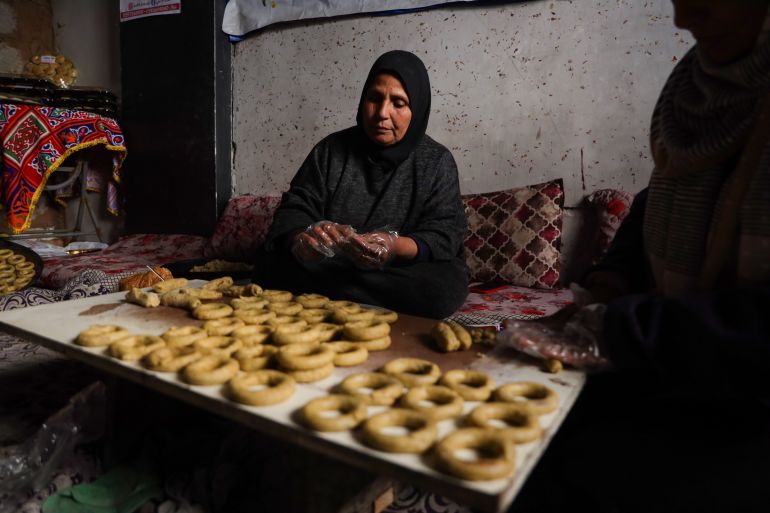
Baking in rubble: Gaza woman keeps Eid traditions alive despite shortages
Border closures and rising prices make Eid baking difficult in Gaza, but families persist to keep traditions alive.
Save

 By Maram HumaidPublished On 19 Mar 202619 Mar 2026
Gaza City – Delicious aromas drift inside a partially damaged house in northern Gaza, as Samira Touman moves between trays of kaak and maamoul cookies, putting the final touches on them before baking.
Samira, a 60-year-old mother of seven, busily works alongside her daughters and daughter-in-law in the final days of Ramadan, preparing for the arrival of Eid – the first Eid experienced by residents of the Gaza Strip after the October ceasefire.
Recommended Stories
list of 3 itemsend of list
The mother kneads the dough carefully and then begins shaping it with attention, while her daughter rolls balls of date paste mixed with sesame to fill the dough.
The steps repeat until the baking stage arrives, followed by counting the finished pieces.
In front of a blazing oven fuelled by a wood fire, Samira and her daughters take turns baking. This, they say, is the hardest part of the task due to the lack of cooking gas, yet they remain absorbed in completing their work.
“This is the season of Eid, a season of blessings. It’s true that we’re not going as big as the celebrations before the war, when I used to keep working and baking until dawn on the day of Eid,” Samira tells Al Jazeera while wiping sweat from her forehead in front of the fire.
The cookies the family are preparing this year are not just for their own household, but also include extra orders from customers and neighbours around them, giving the family a little extra money ahead of Eid al-Fitr, the Muslim festival that follows the holy month of Ramadan.
“Thank God, the demand is very good despite the high cost of food ingredients. But people want to live and reclaim a little of the taste of Eid,” Samira says.
Advertisement
Recent events have complicated Samira’s preparations. Just as she was planning to purchase her ingredients at the end of February, the United States and Israel began attacking Iran. Israel quickly used that as a justification for closing border crossings into Gaza, which it has repeatedly done for extended periods since the beginning of its war on the Palestinian territory in October 2023.
The closure doubled the prices of the ingredients Samira was planning to buy: flour, semolina, date paste, ghee, and sugar. The crossings have since partially reopened, but prices have remained high.
“There are always things that spoil the joy… there is always happiness in Gaza, but it is never complete,” she says.

“I was happy at the beginning of Ramadan… but my joy faded after I saw how expensive ingredients had become,” Samira says. Muslims typically prepare delicacies during Ramadan, to enjoy after breaking their fast.
Samira adds more wood to the fire while her son breaks pieces of furniture he collected from houses destroyed by Israel’s bombing campaign to use as firewood.
“We have forgotten what it means to work in the kitchen with order, dignity, and clean work,” she said while tending the flames with a metal rod. “Now cooking and working have become associated with soot and fire.”
Samira remembers the period before the war when she used to run her home-based business through a social media page and receive orders from customers.
“Every day I had a menu and excellent demand. I was able to support my household. I had two kitchens equipped with tools, electric mixers, blenders, ovens, cooking and baking utensils, as well as raw ingredients,” she says.
“All of that disappeared during the war and became only a memory,” she adds sadly. “Now we are starting again from zero. We do everything by hand and without any of the resources we once had. Even the raw ingredients have become more expensive.”

Price increases and border closures
Since the beginning of Israel’s genocidal war on Gaza, residents of the Palestinian enclave have had to live in extremely difficult conditions, many of them in temporary shelters, and unable to obtain basic goods.
Even when goods are available, their high prices mean they’ve often been inaccessible.
The events of the last few weeks, however, have added another layer of hardship.
Advertisement
After the outbreak of war between Israel and the United States on one side and Iran on the other in February, most of Gaza’s border crossings were closed to the entry of goods and food supplies. This led to a sharp shortage in available products and a rapid rise in prices in local markets.
The shortage highlights the uncertainty of living in Gaza. Conditions had improved since the October ceasefire, with food, aid, and fuel allowed into Gaza in limited quantities.
But, as long as Israel remains in control of the crossings into Gaza, the flow of goods can turn off as quickly as it can turn on.
And the price increases mean that families now face a difficult dilemma, whether to pay the high prices in order to preserve their Eid traditions, or put the money towards managing their daily household budgets, particularly as purchasing power declines and poverty and unemployment rates rise.

A hesitant return
Like many families in Gaza, Samira and her relatives have endured their share of suffering during the war, facing repeated displacement, movement, and the loss of life’s basic necessities.
“We returned only one month ago from our last displacement in Khan Younis,” Samira says.
“We were displaced for the second time in September to the al-Mawasi area of Khan Younis after the ground invasion [of northern Gaza]. But when the war ended, I did not feel like returning, so I stayed there in our tent.”
Under pressure from her family and children to return, Samira eventually relented and came back to northern Gaza with the rest of her family.
“Returning is beautiful when you return to your home and your place and it is livable, not when you live in rubble surrounded by rubble, with no means of life, such as water or infrastructure,” Samira says, pointing to her partially destroyed home, surrounded by houses that have been completely destroyed.
She explains that one reason she had delayed returning home was her fear that Israel would not fulfill any of the commitments and agreements it made when signing the “ceasefire” in October, which include allowing the large-scale entry of humanitarian aid into Gaza, and a stop to Israeli attacks. Instead, Israel has continued to attack periodically, killing hundreds of Palestinians, and has continued to impose regular restrictions on imports into Gaza.
“It’s true that the intensity of the bombardment has dropped significantly, but there are still violations, and the crossings and the flow of goods remain unstable. We feel as if we have been left in a void without progress,” Samira says.
Her daughter interrupts her, asking her to stay optimistic and stop talking about politics in order to celebrate Eid.
Samira laughs and says that every time she decides not to speak about the war, circumstances force her to talk about it again.
“This year, we hope the Eid will bring better days, that our affairs and lives will improve and become stable, that prices will go down, and that raw materials and construction supplies will enter Gaza,” she says with a sad smile. “We are tired of this difficult situation that has lasted far too long.”