Trump administration to drop charges against US veteran who burned flag
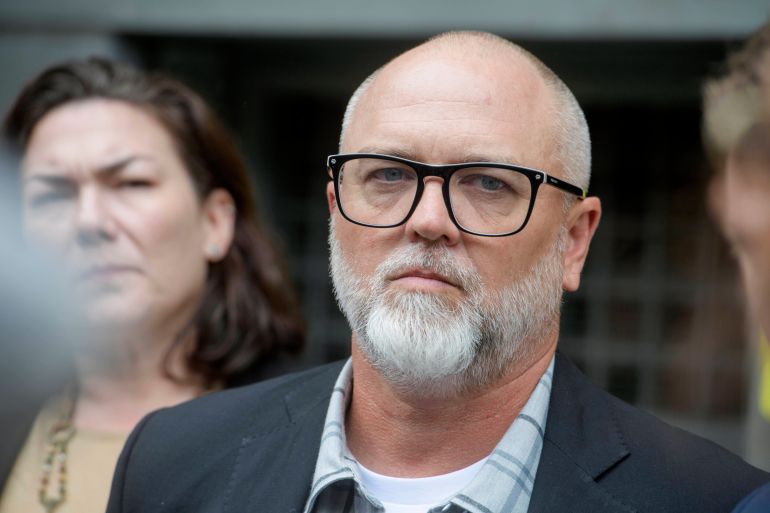
Veteran Jay Carey burned a US flag in protest of an executive order from Trump calling for prison terms for such acts.

 By Al Jazeera StaffPublished On 14 Mar 202614 Mar 2026
Save
The administration of President Donald Trump has moved to end its prosecution of a United States Army veteran who burned a national flag to protest one of the president’s executive orders.
Court filings this week show that the Department of Justice has moved to drop the charges against defendant Jan “Jay” Carey, following his motion to dismiss last October.
Recommended Stories
list of 3 itemsend of list
Carey had been charged with two misdemeanours: one for lighting a fire outside of designated areas, and the second for lighting a fire in a manner that creates a public safety hazard or threatens property.
The incident unfolded on August 25, in the hours after Trump signed an executive order calling for the prosecution of flag-burners.
The Supreme Court has long upheld flag burning as an act of protected free speech. In the 1989 case Texas v Johnson, for instance, the high court held that “flag desecration is inconsistent with the First Amendment”, which protects free speech.
It reaffirmed that decision a year later in 1990, when Congress passed a new Flag Protection Act to outlaw such destructive behaviour. The high court struck down that law as unconstitutional.
But Trump has maintained that flag burning is akin to the incitement of violence, which is not protected under the First Amendment of the US Constitution.
Since his first term, he has pushed for steep prison sentences for any protester who knowingly destroys a US flag.
“If you burn a flag, you get one year in jail,” Trump said as he signed his executive order last August. “No early exits, no nothing.”
Though his executive order acknowledged the Supreme Court’s precedents protecting flag burning as an act of free speech, it nevertheless called on the US attorney general to “prioritise enforcement to the fullest extent of our Nation’s criminal and civil laws”.
Advertisement
In short, critics say it calls on the attorney general to prosecute flag-burners by searching for laws that fall outside the First Amendment’s scope.
In an interview last year with the Al Jazeera programme UNMUTE, Carey explained he had been outraged that the president would seek to circumvent the free-speech rights he had fought for as a veteran.
“I served for over 20 years. I defended that flag, served under that flag, fought for that flag,” Carey told Al Jazeera.
“The flag is a symbol. It’s not our democracy. I didn’t burn it to desecrate the flag or protest America. I did it as a direct reaction to what our treasonous, fascist president did by signing that executive order.”
Carey recalled that, after seeing the executive order, he turned to a friend. “I was like, I think I need to go burn a flag in front of the White House.”
Video captured the incident that followed. At about 6:20pm US Eastern time (22:20 GMT) on August 25, Carey appeared in Lafayette Park, directly across from the White House.
He took out a bullhorn and identified himself as a US veteran, protesting Trump’s executive order. He then placed a US flag on a brick pathway in the park and set it alight, using rubbing alcohol as an accelerant.
Four federal law enforcement agents then approached Carey. One used a fire extinguisher to put out the flames. The others handcuffed Carey and led him away.
Body camera footage released by law enforcement showed the four officers discussing Trump’s executive order as they detained Carey.
“So the president just today signed an executive order [that] says we’re arresting him,” one says. “We got that going for us.”
The Partnership for Civil Justice Fund, a legal nonprofit, ultimately took up Carey’s defence, arguing that charging the veteran was evidence of “vindictive prosecution”. It also called the Trump administration’s actions “a direct attack on dissent”.
Carey himself pleaded not guilty to the charges in September.
In his interview with Al Jazeera, Carey emphasised that Trump’s executive order is unenforceable — but that it does threaten to dampen free speech.
“This executive order was nothing but a bunch of fluff,” Carey said. “The First Amendment means that I am able to exercise my rights, my voice, my opinions. I can protest peacefully and have my grievances redressed.”
“As long as I’m not causing violence, I’m well within my rights within the First Amendment.”