Iran to halt strikes on neighbours unless attacks from there: Pezeshkian
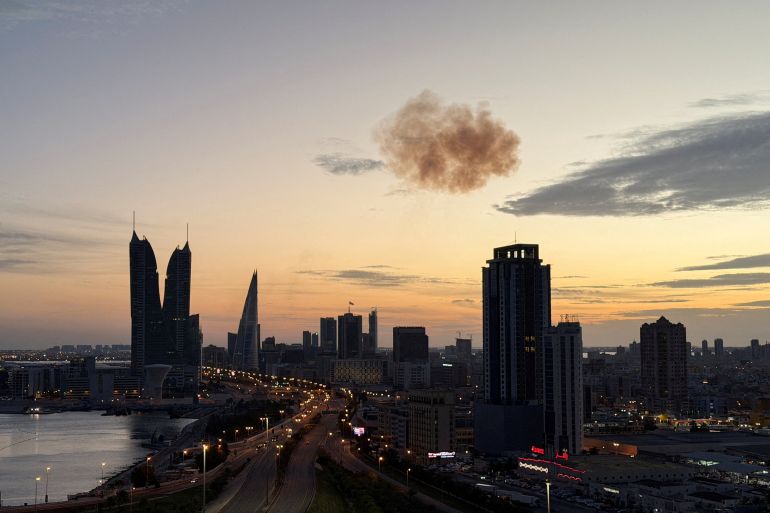
Arab states in the Gulf and beyond that house US assets have been targeted in Iranian retaliatory strikes in the war.

 By Al Jazeera StaffPublished On 7 Mar 20267 Mar 2026
Save
Iran’s President Masoud Pezeshkian has said neighbouring countries will no longer be targeted, unless an attack originates from there, as the war launched by the United States and Israel, which triggered sustained retaliation from Tehran across the Gulf and beyond, enters its second week.
The Iranian interim leadership council approved the motion on Friday, Pezeshkian said on Saturday.
Recommended Stories
list of 4 itemsend of list
In remarks carried by Iranian media, the president also apologised to neighbouring countries for the strikes that took place in recent days.
Al Jazeera’s Tohid Asadi, reporting from Tehran said, The Iranian president’s statement “is a deescalation, however small, in a very escalated situation as it is day eight of the initiation of the US and Israeli strikes across Iran. We have received reports of a continuation of these air attacks in more than 170 cities.”
Pezeshkian’s comments were in a prerecorded five-minute statement. “He began with a reference to the residential areas, schools and hospitals being attacked, in a breach of international law and regulations. He went on to call for unity and solidarity among people to defend the sovereignty of the country. He also sent a strong message to the Americans, saying what they want is an unconditional surrender, and they will ‘carry that dream to their graves’,” Asadi said.
Saudi Arabia, Qatar, the United Arab Emirates, Kuwait, Bahrain and Oman, all the Gulf Cooperation Council (GCC) nations, have been targeted due to the presence of US assets within and around their borders. Iraq, Jordan, Azerbaijan and Turkiye have also been caught in the crosshairs.
Advertisement
In the Gulf, there have been deaths, damage and major disruption to flights, closure of airspace, and a heavy knock-on impact on oil and gas production reverberating across the world.
However, Qatar said it thwarted a missile attack minutes after Iranian media released the prerecorded message from Pezeshkian.
‘IRGC is now in charge fully’
Pezeshkian’s message is overshadowed by the Iranian Revolutionary Guard Corps (IRGC)’s dominance, says Al Jazeera’s Resul Serdar.
“Political figures in Iran are responsible for running state affairs and ‘non-strategic’ affairs. But when it comes to strategic affairs, such as the country’s foreign and security policies, politicians don’t have a say, including the president, who, according to the constitution, is the number two in charge – this is a very well-known fact in Iran,” Serdar said.
The centre of power lies with the office of the supreme leader and with the IRGC, even during peacetime, he added.
Now that the country faces what it sees as a war of survival, Pezeshkian is not in a position to stop any attack, and his message to regional countries carries no weight, Serdar said.
“The IRGC is now in charge fully, and they will decide whether to attack or not,” Serdar said, adding that IRGC chief, Ahmad Vahidi, is considered one of the “most radical commanders” of the group since its foundation.
“I don’t think Pezeshkian or other politicians will have any influence when it comes to security politics,” he added.
Qatar’s Energy Minister Saad al-Kaabi, meanwhile, has said exports from the Gulf region could come to a halt “within weeks” if the war on Iran continues to escalate, throwing global energy markets into turmoil.
Al-Kaabi told The Financial Times (FT) newspaper in an interview published on Friday that if the war continues for weeks, “GDP growth around the world will be impacted.
“Everybody’s energy price is going to go higher. There will be shortages of some products, and there will be a chain reaction of factories that cannot supply,” al-Kaabi was quoted as saying.
The only US deaths in the war so far came when Iran attacked a US command centre in Kuwait, killing six.
More than 1,200 Iranians have been killed in US-Israeli attacks in the first week of the war.