Why have Europe, Australia sent military assets to the Middle East?
France, Spain and Australia are among the countries to deploy military assets to the Middle East after Cyprus attacks.


Published On 6 Mar 20266 Mar 2026
Save
This week, several countries in Europe announced that they are sending military assistance to the Middle East and the Mediterranean amid the ongoing US-Israel-Iran war, which has seen a strike on a British military base on Cyprus.
On Thursday, Australia also announced it will send “assets” to the region, but did not specify what.
The war, which started with Operation Epic Fury, the US-Israeli campaign against Iran, on February 28, continued to escalate for a seventh day on Friday as attacks continued in Iran, Israel and other countries in the region.
Which European countries are sending military assistance to the Middle East?
United Kingdom
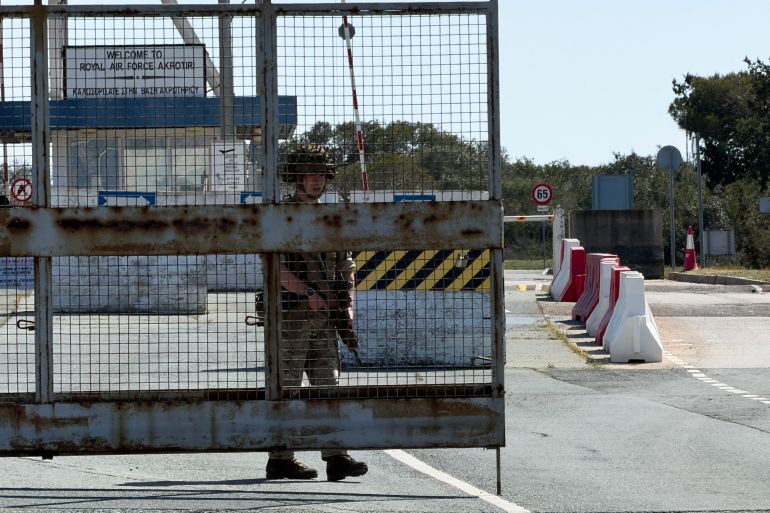
On Monday, the UK’s Royal Air Force base of Akrotiri in Cyprus suffered a drone attack overnight, the island’s president and the British Ministry of Defence said, after Prime Minister Keir Starmer said the UK would allow the US to use its bases to launch “defensive” strikes on Iran.
The UK’s Ministry of Defence said on Tuesday that it was sending the HMS Dragon to the eastern Mediterranean along with two Wildcat helicopters “to bolster drone defence for our Cypriot partners”.
One of the Royal Navy’s six Type-45 air defence destroyers, the HMS Dragon is fitted with a Sea Viper missile system, which is able to launch eight missiles in under 10 seconds and guide up to 16 missiles simultaneously, the ministry said in a statement.
On Thursday, Prime Minister Keir Starmer told a Downing Street news conference that the UK would send four more Typhoon fighter jets to Qatar to help with defence.
France
On Tuesday, French President Emmanuel Macron said France was sending an aircraft carrier to the Mediterranean in response to the widening conflict.
Advertisement
“I have ordered the aircraft carrier Charles de Gaulle, its air assets, and its escort of frigates to set course for the Mediterranean,” he said in a televised speech a day after he warned of the risk of the conflict spilling across Europe’s borders.
Macron said he was also sending military assets to Cyprus, a day after Iranian-made drones hit the Mediterranean island’s British airbase at Akrotiri.
“I have also decided to send additional air defence assets and a French frigate, the Languedoc, which will arrive off the coast of Cyprus this evening,” he said.
Greece
Greece has sent two frigates and four F-16 fighter jets to Cyprus.
It has also allowed the US to use its base in Souda Bay in Crete.
Italy
Rome said it will send “naval assets” to Cyprus in the coming days along with France, the Netherlands and Spain.
Italy has also pledged “air-defence, anti-drone and anti-missile systems” to partners in the Gulf.
Italian media reported that the assistance could include the SAMP/T air defence system.
Defence Minister Guido Crosetto said Italy’s airbases could be used by the US for “logistical support” for “aircraft not intended for combat” under existing agreements.
Portugal
The Portuguese government has given the go-ahead for the US to use its Lajes base in the Azores as part of operations targeting Iran, but with certain conditions.
Prime Minister Luis Montenegro said on Wednesday that permission had been granted “on the understanding that these operations are defensive or retaliatory in nature, that they are necessary and proportionate, and that they target exclusively military objectives”.
Spain
Spanish Prime Minister Pedro Sanchez has made clear his opposition to the war in a verbal bust-up with Trump.
On Tuesday, Spain said the US should be mindful of international law and bilateral trade agreements with the European Union, after Trump threatened to cut off all trade with the country for refusing to let the US military use its bases for missions linked to strikes on Iran.
Spain has nevertheless said it will send its most advanced frigate, the Cristobal Colon, to help protect Cyprus.
On Thursday, the defence ministry said the warship would “offer protection and aerial defence” and “support any evacuation of civilians”.
Why are European countries doing this?
Wary of getting directly involved in the US-Israeli war on Iran, European countries have nevertheless been drawn into the conflict by attacks on Cyprus and Western allies in Gulf countries, which host US troops in military bases.
Advertisement
In a social media post announcing the UK military deployment on Tuesday, Starmer said the country was “fully committed to the security of Cyprus and British military personnel based there”.
“We will always act in the interest of the UK and our allies,” he wrote on X.
On Thursday, Starmer told a Downing Street news conference that he stands by his decision to not join the US-Israel campaign in Iran, however.
His initial refusal resulted in a strong rebuke from US President Donald Trump. “This is not Winston Churchill that we’re dealing with,” Trump said on Tuesday.
Macron has condemned the campaign in Iran by US and Israel, saying: “The United States of America and Israel decided to launch military operations, conducted outside international law, which we cannot approve of.”
But “the Islamic Republic of Iran bears primary responsibility for this situation”, he added, because of its “dangerous” nuclear programme, support for regional proxies, and orders to shoot “its own people” during protests in January.
Macron added that French forces downed drones “in self-defence” during the opening hours of the conflict.
“We reacted immediately and shot down drones in self-defence in the early hours of the conflict to defend the airspace of our allies, who know they can count on us,” he said, referring to defence agreements with Qatar, Kuwait and the United Arab Emirates.
Which other countries are sending military assets to the Middle East?
On Thursday, Australian Prime Minister Anthony Albanese told Australia’s parliament that he will deploy “military assets” to the Middle East, as the government continues to coordinate flights home for stranded citizens.
“I thank those Australians going into a dangerous situation in order to help their fellow Australians,” Albanese said without providing further details about the assets.
On Friday, Australian media reported that these include a Royal Australian Air Force C-17A Globemaster and a KC-30A Multi-Role Tanker Transport, but reported that the government has not disclosed where these are currently.