The end of Iran’s strategic patience
Years of US and Israeli pressure pushed Tehran from calibrated restraint to open regional confrontation.


Humanitarian leader and political analyst from South Africa.
Published On 6 Mar 20266 Mar 2026
Save
Since October 7, 2023, the United States and Israel believed that sustained diplomatic and military pressure on Iran would deter and degrade its capacity to fight. In the process, they degraded something else entirely: Iran’s willingness to remain constrained. The missiles and drones now striking across the Gulf show that Iran is no longer holding back.
For years, Iran operated under a doctrine of “strategic patience”. This was a deliberate, calculated form of restraint that guided how Tehran and its network of allies delt with Washington and Tel Aviv.
Rather than confrontation, Iran built and leveraged a web of deterrence: Hezbollah in Lebanon, the Houthis in Yemen, Hamas in Gaza, and the Popular Mobilisation Forces in Iraq were its allies surrounding Israel, and helped to apply brakes on any major Israeli aggression.
The first serious fracture in Iran’s policy came in April 2024, when an Israeli strike destroyed the Iranian consulate in Damascus, killing senior Revolutionary Guard commanders. Tehran’s response was to launch Operation True Promise, a direct barrage of drones and ballistic missiles fired at Israeli territory.
Throughout 2024 and even into 2025, Iran attempted to maintain a form of managed restraint and carefully calibrated deterrence to avoid triggering all-out war. But the environment was shifting in ways that made this strategy untenable. Israel’s systematic targeting of Hamas and Hezbollah leadership disrupted key nodes of Iran’s deterrence architecture. The fall of the al-Assad government in Syria threatened critical supply lines through Iran’s primary land corridor to Hezbollah.
Advertisement
Following the 12-day-war in 2025, Iran formally declared a new doctrine in January 2026 of “active and unprecedented deterrence”.
When the US and Israel launched coordinated strikes on February 28, 2026, during ongoing negotiations, they confirmed to the Iranian leadership that restraint offered no protection and would likely offer none in the future.
In addition to striking Iran, Israel has struck Lebanon, Iraq, Yemen and Syria. The reaction from Iran has so far been a demonstration of its new doctrine: Kuwait, Qatar, UAE, Saudi Arabia, Iraq, Jordan, Israel and Cyprus have all been hit by Iran in a matter of days.
These countries have all played different roles in the region. Qatar, for example, has maintained its own strategy of mediation and has not only hosted a US base but also offices of Hamas; the most sophisticated display of balancing regional tensions. The fact that it has been drawn into the latest escalation is a direct indictment of the failure of governments with power and influence – particularly the US – to meaningfully resolve the crisis in Gaza over the past years.
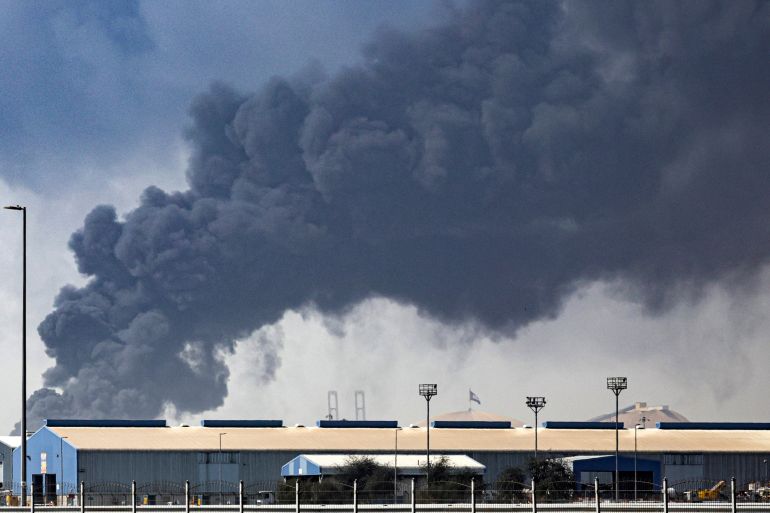
Perhaps the most significant development in the current escalation is Iran’s heavy targeting of the United Arab Emirates. The UAE has pursued a foreign policy defined by a strategy of fragmentation. This has meant working with Israel and other partners to break down unified political and military opposition across the region into smaller, disconnected elements that can be more easily contained and managed.
That strategy was always premised on the assumption that the UAE’s own stability was insulated from its actions. As rockets rain down on Dubai and Abu Dhabi, the illusion of that separation is no longer possible.
Iran’s allies in the region have not fully mobilised, and despite their severe attrition, they and have retained an organisational depth that would likely allow them to sustain low-level armed resistance, similar to what wore down US forces in Iraq.
As the primary actors lock into a cycle of overt military confrontation, dormant domestic crises are rapidly being ignited across the Middle East. There are reports that the US administration is encouraging Kurdish forces to form a ground offensive against Iran. In Bahrain, renewed protests against the monarchy have erupted, with Saudi forces being deployed to the island kingdom to crack down on the opposition. Protesters in Baghdad have tried to storm the Green Zone, the seat of parliament.
Palestine remains the clearest expression of the regional order that Israel and the US have sought to impose, with active support from the UAE: Isolated enclaves, subject to permanent low-grade military pressure in the West Bank and full-scale destruction in Gaza. The capacity for meaningful self-governance has been systematically dismantled while territorial expansion by Israel continues. This is the template.
Advertisement
The chapter of calibrated, managed conflict has been forcibly closed by the cumulative weight of Israeli choices. Each US and Israeli strike on Iran and Iranian-aligned leadership, each negotiation conducted before military operations, and each refusal to treat Palestinian political agency as a genuine variable in any regional settlement were choices made by governments that believed that security could be achieved through a combination of fragmentation and force.
When US Secretary of State Rubio addressed the Munich Security Conference, the nostalgia for an era of uncontested Western primacy was unmistakable. But that era is precisely what produced the conditions now exploding across the region. Israel’s settler-colonial expansion continues. The fragmentation model is being extended into Lebanon, Syria, and even the Horn of Africa, with regime change unleashed on Iran to facilitate this project. And the accumulated resistance to it, whether from state or non-state actors, is no longer constrained by the patience that once made it manageable.
Stability for the region will be shaped by whether a global coalition can be built after a reckoning with a basic contradiction: A rules-based order cannot coexist indefinitely with territorial expansion, collective punishment, and selective accountability.
The views expressed in this article are the author’s own and do not necessarily reflect Al Jazeera’s editorial stance.