Is BRICS bloc divided over US-Israel attacks on Iran?
Since India took over as chair, the normally outspoken BRICS grouping of countries appears to be more cautious.

 By Shola LawalPublished On 6 Mar 20266 Mar 2026
Save
Nearly a week into the United States-Israel war on Iran and the BRICS bloc, a multi-country alliance that includes Tehran, has not reacted in any form to the conflict.
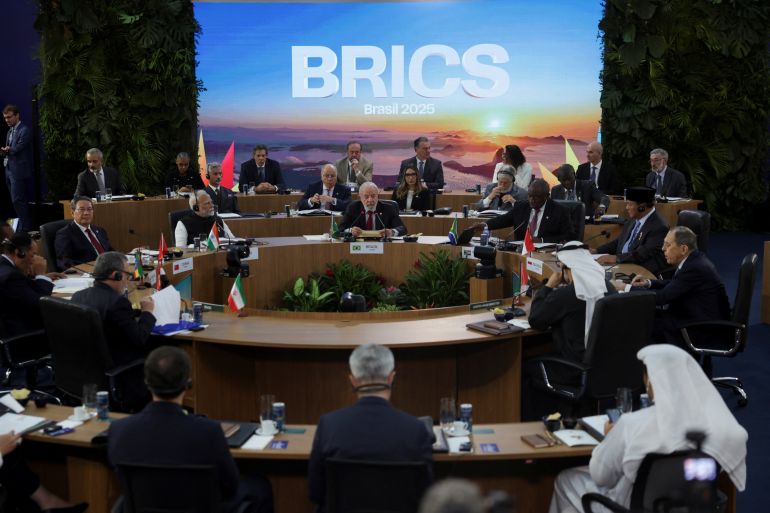
To analysts and political observers, that seems out of character. When the 12-day war between Israel and Iran broke out in June last year, the bloc, which Brazil then chaired, was quick to state that US-Israeli joint attacks on Iran were a “violation of international law”.
Recommended Stories
list of 4 itemsend of list
However, since the chairmanship of BRICS shifted to India in December 2025, New Delhi’s own interests appear to be overriding the alliance’s objectives, critics say, as India signals closer ties with Israel and the US.
The 11-member BRICS grouping was formed as an economic alliance in 2009 and is widely regarded as a “Global South” alternative to the exclusive Group of Seven (G7) alliance of industrialised economies.
US President Donald Trump once accused its members of being “anti-American”, although BRICS has said it does not see itself as competing with or countering any other groups.
In recent years, the organisation’s mandate has broadened to include security issues, with members conducting joint military drills – most recently hosted by South Africa in January this year, when India opted out.
BRICS is named after the first letters of its founding members: Brazil, Russia, India, China, and South Africa. Since 2024, BRICS has expanded to include Indonesia, Ethiopia, Egypt, Iran, Saudi Arabia and the United Arab Emirates.
Here’s what we know about how India’s interests may have come into conflict with those of other BRICS nations:

How have BRICS countries responded to the US-Israel war on Iran?
The organisation itself, under Indian leadership in 2026, has not commented directly about the US-Israeli Operation Epic Fury in Iran, which has seen multiple missile and drone attacks across the country, killing more than 1,230 people in its first six days.
Advertisement
However, individually, three of its five founding members have issued statements commiserating with Iranians mourning loved ones and denouncing violations of international law.
South Africa’s President Cyril Ramaphosa, whose administration is embroiled in a dispute of its own with the US over the Trump-alleged, but debunked, “genocide” of white South Africans, voiced concerns about the conflict on Wednesday and warned that the fighting could go beyond the Middle East.
“We want a ceasefire, we want this madness to come to an end,” Ramaphosa told reporters, three days after his African National Congress party first issued a statement “condemning” the US and Israel’s “anticipatory self-defence based on assumption or conjecture”.
South Africa, Ramaphosa added on Wednesday, is also ready to play a mediator role to help resolve the issue and end the loss of lives. The country came in for heavy US criticism earlier in January when Iran was allowed to participate in the BRICS naval drills hosted by South Africa, amid reports of massacres of Iranian protesters.
Russia’s President Vladimir Putin similarly criticised the joint US-Israel attacks and the killing of Iranian Supreme Leader Ayatollah Ali Khamenei in strikes on Saturday, in a letter to President Masoud Pezeshkian. Moscow and Tehran have close ties, with Russia providing weapons and weaponry to Iran. However, Moscow has not indicated any willingness to intervene militarily to support Iran.
Speaking at a news conference on Tuesday, Russia’s Foreign Minister Sergey Lavrov said there was no evidence that Tehran is developing nuclear weapons – a key issue for the US and Israel – and that the war could lead to the very outcome the two allies claimed they wanted to prevent: Nuclear proliferation across the region.
As the bombs dropped on Iran last Saturday, Russia’s Ministry of Foreign Affairs accused the US and Israel of “premeditated and unprovoked acts of armed aggression against a sovereign and independent UN member state”.
Moscow itself stands accused of aggression against a sovereign nation, amid its fifth year of war on Ukraine.
Meanwhile, China’s Foreign Minister Wang Yi told Gideon Saar, his Israeli counterpart, over the phone on Tuesday that Iran had been attacked as negotiations between Washington and Tehran “made significant progress, including addressing Israel’s security concerns”, China’s Ministry of Foreign Affairs said in a statement.
Wang added that China “opposes any military strikes launched by Israel and the US against Iran”, according to the Foreign Ministry.
What has India said?
Of the founding members, only India has not outrightly condemned the US-Israel attacks on Iran. Under its chairmanship of BRICS, the organisation has also been unusually silent on the war.
Advertisement
On Tuesday, three days after the first attacks hit Tehran, killing Khamenei and several of Iran’s senior military officials, New Delhi made cautious calls for an “early end to the conflict” in a statement by the country’s Ministry of External Affairs.
“India strongly reiterates its call for dialogue and diplomacy. We share our voice clearly in favour of an early end to the conflict,” the ministry said, adding that the war risked regional stability and the safety of thousands of Indian nationals living and working in the Gulf region.
Prime Minister Narendra Modi also spoke to Gulf countries and criticised retaliatory attacks on their territories, without mentioning Iran.
Critics, especially from the Indian opposition Congress party, have called out Modi’s lack of outright denunciation of the Israeli-US attacks and the killing of Khamenei, especially in light of Modi’s visit to Israel, during which he addressed the Knesset in Jerusalem, just days before the war began.
The timing of the visit gave the appearance of “tacit approval” of the attacks on Iran, the party said on Monday.

Is India moving closer to Israel?
Modi undertook a state visit to Israel on February 25 and 26, 2026. He met with Israel’s Prime Minister Benjamin Netanyahu, who is wanted by the International Criminal Court (ICC) on suspicion of war crimes related to Israel’s onslaught on Gaza.
Addressing the Knesset, Modi affirmed that “India stands with Israel, firmly, with full conviction, in this moment and beyond,” even as Israel has come under fire globally for the genocidal campaign in Gaza and deadly attacks by Israeli forces and settlers in the occupied West Bank.
Modi and Netanyahu went on to sign several trade agreements on defence and artificial intelligence, areas in which they have long collaborated. Israel also sends about 40 percent of its arms exports to India.
In a post on X, Modi wrote that the two countries had elevated “our time-tested partnership to a Special Strategic Partnership” during his visit.
About the same time, the threat of Israel-US attacks on Iran was looming. Modi may even have known about the attacks, one former Indian diplomat told Indo-Pacific-focused The Diplomat magazine.
The Modi government has not responded to this allegation.
Reuven Azar, Israeli ambassador to India, told local publication The Indian Express on Wednesday that the opportunity to launch the joint attacks on Iran came “only after Prime Minister Modi left”.
Has the US pressured India?
India has long championed a stance of strategic autonomy, allowing it to trade with Western countries while also deepening ties with countries viewed in the West as pariah states, such as Russia. That is part of the reason it was a founding BRICS member.
A tense standoff arose with the administration of US President Donald Trump over India’s continued purchase of sanctioned Russian oil last year. Trump imposed sweeping import levies of up to 50 percent on India in August 2025, partly as punishment for this. India, whose largest trading partner is the US, described the additional tariffs as “unfair, unjustified, and unreasonable”.
Advertisement
The tariffs threatened to destabilise about 70 percent of India’s exports to the US, the country’s research council warned afterwards, urging quick trade reforms. India majorly exports electronics, pharmaceuticals, and jewellery to the US.
By February, the picture had changed. Following talks, Trump announced an agreement with India that slashed tariffs to 18 percent as he claimed that Delhi had agreed to stop buying Russian oil and to instead buy more US oil and other products.
“Big thanks to President Trump on behalf of the 1.4 billion people of India for this wonderful announcement,” PM Modi wrote on the X social platform in response.
Will India’s relations with Israel and the US affect the BRICS alliance?
When President Trump first took office, he threatened BRICS countries with an additional 10 percent tariff as part of his trade war.
Then, in July, he took aim at the group again before its annual summit, saying: “When I heard about this group from BRICS, six countries, basically, I hit them very, very hard. And if they ever really form in a meaningful way, it will end very quickly.”
While India has continued to participate in routine BRICS meetings in recent months, it has notably stayed away from security issues.
In January, when BRICS countries met in South Africa to hold military drills, New Delhi was absent, although it was already the group chair at the time. India gave no reasons why. Brazil, which faced US tariff problems of its own, also chose not to participate, but was present as an observer.
Opting out for India was “about balancing ties with the US”, Harsh Pant, a geopolitical analyst at the New Delhi-based think tank Observer Research Foundation, told Al Jazeera at the time.
Fellow BRICS member China has similarly faced a gruelling trade war with the US, but has spoken up in support of Iran.
Some critics fault Beijing for not directly intervening in the war to support its ally. However, Dong Wang, a professor of international studies at Peking University, said those expectations misunderstand China’s position.
“China advocates mediation, not military involvement,” he said.
Comparing Beijing’s response to Delhi’s, the professor said India was choosing a “cautious, balanced posture emphasising de-escalation”.
But the differing responses from BRICS nations, he added, reflect a need for its members to come to a consensus even as they hold diverse ties and strategic priorities.
Such a consensus will be needed if the group continues to stand, and its existence is something Beijing takes seriously, Wang said.
“From China’s perspective, BRICS unity matters, and differences are normal within a diverse multilateral framework,” he said.
“Beijing continues to encourage BRICS to uphold its founding purpose: Supporting multilateralism, peaceful settlement, and the collective voice of the Global South.”