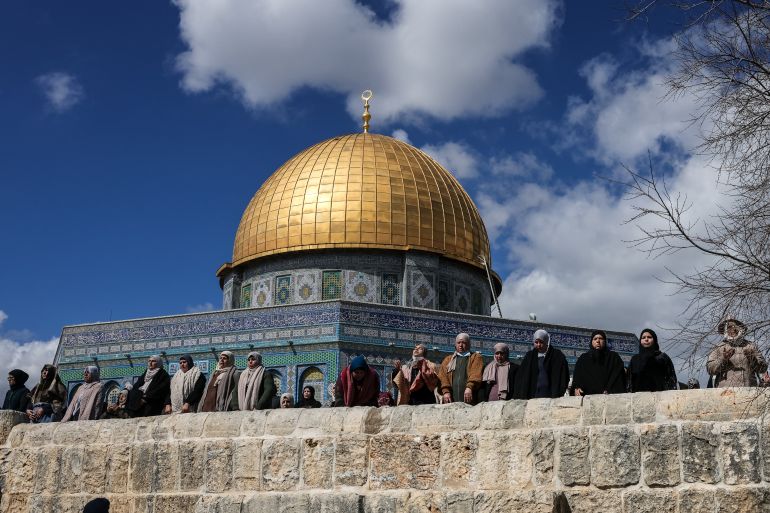
Israel cancels Friday prayers at Al-Aqsa Mosque amid Iran conflict
Authorities say the Al-Aqsa Mosque will be closed to worshippers and visitors of all faiths on Friday amid the spread of the Iran conflict.

Published On 5 Mar 20265 Mar 2026
Save
Israel’s Civil Administration has cancelled Friday prayers at the Al-Aqsa Mosque in occupied East Jerusalem, the latest in a series of Israeli restrictions imposed at Islam’s third-holiest site since the start of the Muslim holy month of Ramadan.
Civil Administration Chief Brigadier General Hisham Ibrahim said on Thursday via the Israeli army’s Al Munasiq platform that the decision was taken in light of Iran launching retaliatory strikes at “Israel and the entire region”.
Recommended Stories
list of 4 itemsend of list
Israel and its close ally, the United States, launched a military offensive on Iran on Saturday, as the mediator of talks between the countries, Oman, said a deal was “within reach” after Tehran had agreed to never stockpile the enriched uranium required to make a nuclear bomb.
“All holy sites in the Old City of Jerusalem, including the Western Wall, the Temple Mount and the Church of the Holy Sepulchre, will remain closed tomorrow, and worshippers and visitors of all religions will not be allowed to enter,” said the head of Israel’s governing body in the occupied West Bank.
Retaliatory Iranian missile strikes have so far killed 10 people in Israel, while at least 1,230 people have been killed in Israeli and US attacks.
Since the start of the US-Israel war on Iran, Israeli authorities have barred access to the Old City for anyone other than residents or shop owners.
Sheikh Ikrima Sabri, a senior imam at Al-Aqsa, has slammed Israel’s continued closure of Islam’s third-holiest site.
“The occupation authorities are exploiting any occasion to close Al-Aqsa, and this is completely unjustified,” he told Al Jazeera on Sunday.
Advertisement
Nevertheless, the imposition of Israeli restrictions predates the beginning of the war.
Last month, Israeli authorities announced that no more than 10,000 Palestinians from the occupied West Bank would be permitted to enter the mosque compound for the first Ramadan prayer – only a fraction of the numbers that have traditionally gathered there in previous years. Al-Aqsa can hold up to half a million people.
The Old City is located in occupied East Jerusalem, which Israel occupied in 1967 and later annexed, a move against international law.
Moreover, the site has become a regular target of visits by right-wing Israeli politicians and Israeli settlers, who have stormed the compound on an almost weekly basis and performed religious rituals under the protection of Israeli forces.
Palestinians fear Israeli encroachment upon the holy site has increased, with senior ministers offering prayers at the site.
The Al-Aqsa compound is administered by Jordan, but access to the site itself is controlled by Israeli security forces.
Under the decades-old status quo maintained by Israeli authorities, Jews and other non-Muslims are allowed to visit the compound in occupied East Jerusalem during specified hours, but they are not permitted to pray there or display religious symbols.
Israel’s National Security Minister Itamar Ben-Gvir has repeatedly called for Jewish prayer rights at the Al-Aqsa Mosque compound and has spoken out against the current status quo arrangement. In 2024, he said he would build a synagogue on the mosque compound.