US renews threat of military action as Iran, Russia announce naval drills
US warns Tehran to reach a deal or face strikes as Iran and Russia announce joint naval exercises in Sea of Oman.


Published On 18 Feb 202618 Feb 2026
Save
The United States has issued new threats against Tehran after a second round of nuclear talks, as Iran and Russia announced joint naval drills in the Sea of Oman to deter any “unilateral action” in the region.
White House Press Secretary Karoline Leavitt said on Wednesday that “Iran would be very wise to make a deal” with US President Donald Trump, after indirect talks in the Swiss city of Geneva ended without a significant breakthrough.
Recommended Stories
list of 3 itemsend of list
Leavitt told reporters that while some progress was made in Geneva, “we’re still very apart on some issues”.
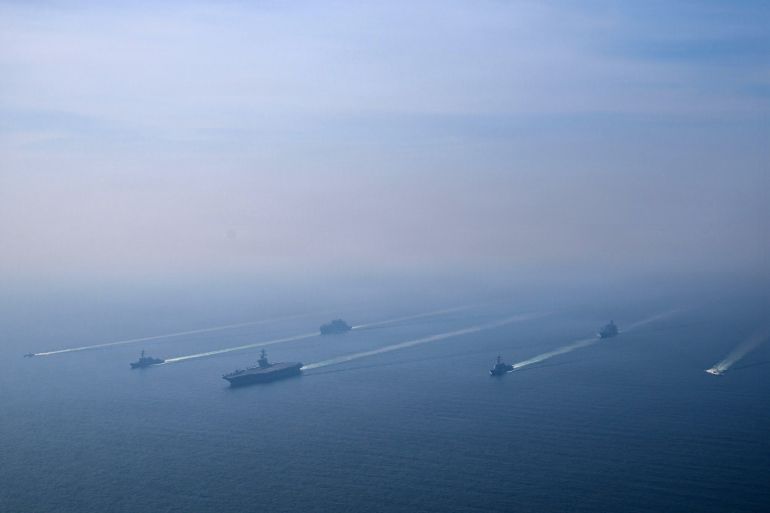
Trump – who has deployed two US aircraft carriers and thousands of troops to the Gulf – escalated his rhetoric on social media.
“Should Iran decide not to make a Deal,” the US may need to use an Indian Ocean air base in the Chagos Islands, “in order to eradicate a potential attack by a highly unstable and dangerous Regime,” he wrote on his Truth Social platform.
A previous attempt at negotiations collapsed last year when Israel launched attacks on Iran, triggering a 12-day war that Washington joined in by bombing three Iranian nuclear sites at Fordow, Natanz and Isfahan.
Trump issued new threats of military action in January following a deadly Iranian crackdown on antigovernment protesters. In response, Tehran said it would close the Strait of Hormuz, a vital oil export route from Gulf Arab states, and warned it would strike US military bases in the region.
The threat sparked concerns of a regional war and a diplomatic push by regional countries, including Oman, Qatar and Saudi Arabia, to prevent conflict.
Guiding principles
Iran and the US held a first round of indirect talks in Oman on February 6 and then met again in Geneva on Tuesday.
Advertisement
Iran’s Foreign Minister Abbas Araghchi said the two parties had agreed on “guiding principles” for a potential deal, but US Vice President JD Vance said Tehran was yet to acknowledge all of Washington’s red lines.
The US has demanded that Iran forgo uranium enrichment on its soil and has sought to expand the scope of talks to non-nuclear issues, such as Tehran’s missile stockpile.
But Iran, which insists that its nuclear programme is for peaceful purposes, has said it is only willing to discuss curbs on its programme in exchange for sanctions relief. It has said it will not accept zero uranium enrichment and that its missile capabilities are off the table.
While talks have resumed, the US has also been building up its military forces near Iran.
Washington has ordered a second aircraft carrier to the region, with the first, the USS Abraham Lincoln and its nearly 80 aircraft, positioned about 700 kilometres (435 miles) from the Iranian coast as of Sunday, satellite images showed.
Iran has also sought to display its military might, with its Islamic Revolutionary Guard Corps (IRGC) holding a series of war games on Monday and Tuesday in the Strait of Hormuz to prepare for “potential security and military threats”.
Iran-Russia drills
It also announced new joint naval drills with Russia in the Sea of Oman.
Rear Admiral Hassan Maqsoudlou said the exercises on Thursday aim “to convey a message of peace and friendship to regional countries”.
They are “also aimed at preventing any unilateral action in the region and creating convergence and coordination to counter activities that threaten maritime security and safety, especially when it comes to commercial vessels and oil tankers, as well as combatting maritime terrorism,” he added.
Iranian authorities also issued a notice to airmen that it plans rocket launches in areas across its south on Thursday from 03:30 GMT to 13:30 GMT.
Russian Foreign Minister Sergei Lavrov meanwhile said any new US strike on Iran would have serious consequences and called for restraint to find a solution to enable Tehran to pursue a peaceful nuclear programme.
“The consequences are not good. There have already been strikes on Iran on nuclear sites under the control of the International Atomic Energy Agency. From what we can judge there were real risks of a nuclear incident,” Lavrov said in the interview with Saudi Arabia’s Al-Arabiya television, which was posted on his ministry’s website
“I am carefully watching reactions in the region from Arab countries, Gulf monarchies. No one wants an increase in tension. Everyone understands this is playing with fire.”
Advertisement
Boosting tensions, he said, could undo the positive steps of recent years, including improved relations between Iran and nearby countries, notably Saudi Arabia.
Rubio to visit Israel
The Reuters news agency, citing a senior US official, said Iran agreed to make a written proposal on how to address Washington’s concerns during the Geneva talks.
Top US national security advisers met in the White House Situation Room on Wednesday to discuss Iran and were told all US military forces deployed to the region should be in place within weeks, the official said.
“The president has ordered the continued buildup in the region, including the arrival of the second carrier group. Full forces should be in place by mid-March,” the senior US official said.
Secretary of State Marco Rubio will meet Israeli Prime Minister Benjamin Netanyahu in Israel to discuss Iran on February 28, the official said.
The Israeli Kan public broadcaster meanwhile reported that Israel is preparing for the possibility of receiving a green light from the US to launch an attack on Iran’s ballistic missile system.
Barbara Slavin, a distinguished Fellow at the Stimson Center, said she is convinced there will be further attacks on Iran by the US and Israel, and possibly soon.
“What the objectives are we have yet to see. Can it be contained? Will others be drawn in? These are all really important questions, and we don’t have answers to them,” she said.
“Frankly, I do not see a basis for an agreement yet,” she added. “It doesn’t look as though these talks were very extensive. They lasted only a couple of hours… And we do have this massive build up. So I’m very concerned.”
“We will all be very nervously checking the news for the next few days,” she added.